Kulmatiski Andrew
Department of Wildland Resources and the Ecology Center Utah State University Logan UT USA.
Ecol Evol. 2018 Jan 18;8(4):2041-2049. doi: 10.1002/ece3.3649. eCollection 2018 Feb.
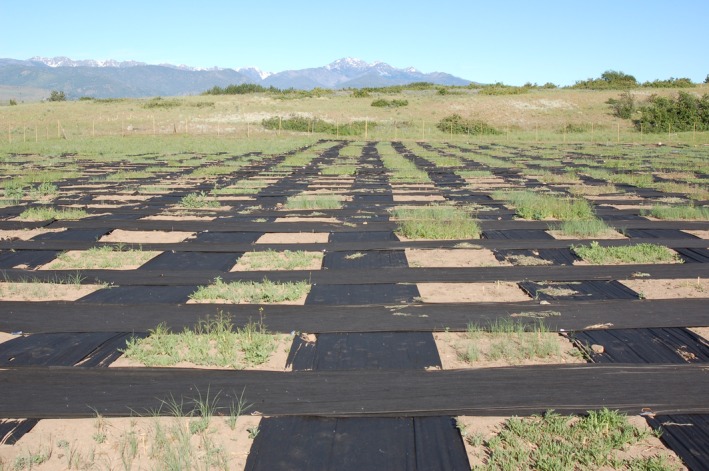
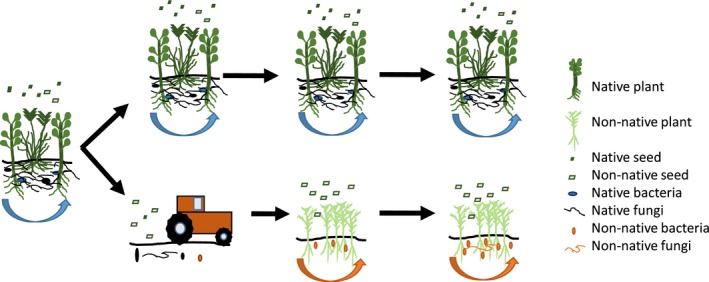
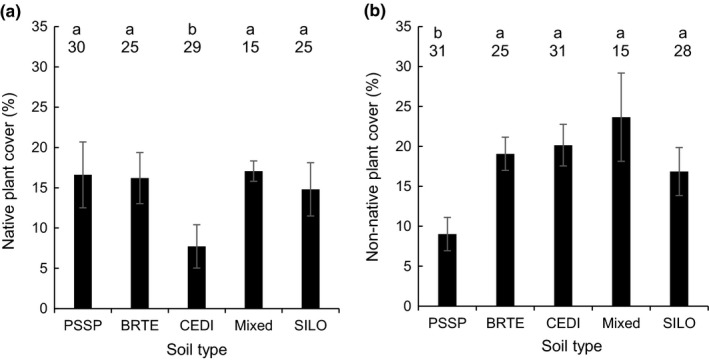
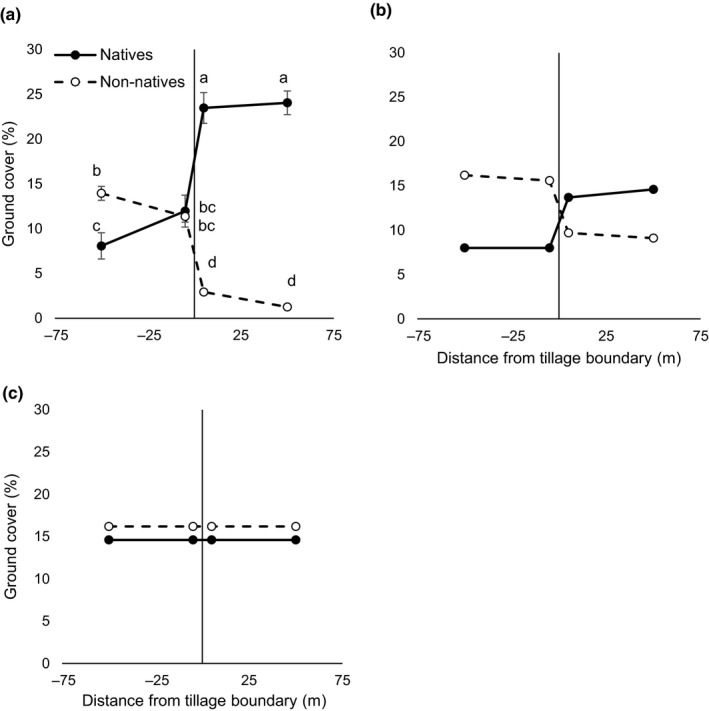
Plant-soil feedbacks (PSFs) have gained attention for their potential role in explaining plant growth and invasion. While promising, most PSF research has measured plant monoculture growth on different soils in short-term, greenhouse experiments. Here, five soil types were conditioned by growing one native species, three non-native species, or a mixed plant community in different plots in a common-garden experiment. After 4 years, plants were removed and one native and one non-native plant community were planted into replicate plots of each soil type. After three additional years, the percentage cover of each of the three target species in each community was measured. These data were used to parameterize a plant community growth model. Model predictions were compared to native and non-native abundance on the landscape. Native community cover was lowest on soil conditioned by the dominant non-native, , and non-native community cover was lowest on soil cultivated by the dominant native, . Consistent with plant growth on the landscape, the plant growth model predicted that the positive PSFs observed in the common-garden experiment would result in two distinct communities on the landscape: a native plant community on native soils and a non-native plant community on non-native soils. In contrast, when PSF effects were removed, the model predicted that non-native plants would dominate all soils, which was not consistent with plant growth on the landscape. Results provide an example where PSF effects were large enough to change the rank-order abundance of native and non-native plant communities and to explain plant distributions on the landscape. The positive PSFs that contributed to this effect reflected the ability of the two dominant plant species to suppress each other's growth. Results suggest that plant dominance, at least in this system, reflects the ability of a species to suppress the growth of dominant competitors through soil-mediated effects.
植物 - 土壤反馈(PSFs)因其在解释植物生长和入侵方面的潜在作用而受到关注。尽管前景广阔,但大多数PSF研究都是在短期温室实验中测量不同土壤上的植物单作生长情况。在此,通过在一个共同花园实验的不同地块种植一种本地物种、三种非本地物种或一个混合植物群落,对五种土壤类型进行了预处理。4年后,移除植物,然后将一个本地植物群落和一个非本地植物群落种植到每种土壤类型的重复地块中。再过三年后,测量每个群落中三种目标物种各自的覆盖百分比。这些数据被用于参数化一个植物群落生长模型。将模型预测结果与景观中本地和非本地物种的丰度进行了比较。在由优势非本地物种预处理的土壤上,本地群落覆盖度最低;而在由优势本地物种耕种的土壤上,非本地群落覆盖度最低。与景观中的植物生长情况一致,植物生长模型预测,在共同花园实验中观察到的正向PSFs将导致景观上出现两个不同的群落:本地土壤上的本地植物群落和非本地土壤上的非本地植物群落。相比之下,当去除PSF效应时,模型预测非本地植物将在所有土壤中占主导地位,这与景观中的植物生长情况不一致。研究结果提供了一个例子,说明PSF效应大到足以改变本地和非本地植物群落的优势度排序,并解释景观上的植物分布。促成这种效应的正向PSFs反映了两种优势植物物种抑制彼此生长的能力。研究结果表明,至少在这个系统中,植物优势度反映了一个物种通过土壤介导的效应抑制优势竞争者生长的能力。