The Florey Institute of Neuroscience and Mental Health Parkville Victoria Australia.
Florey Department of Neuroscience and Mental Health The University of Melbourne Victoria Australia.
Pharmacol Res Perspect. 2018 Feb 15;6(2):e00384. doi: 10.1002/prp2.384. eCollection 2018 Apr.
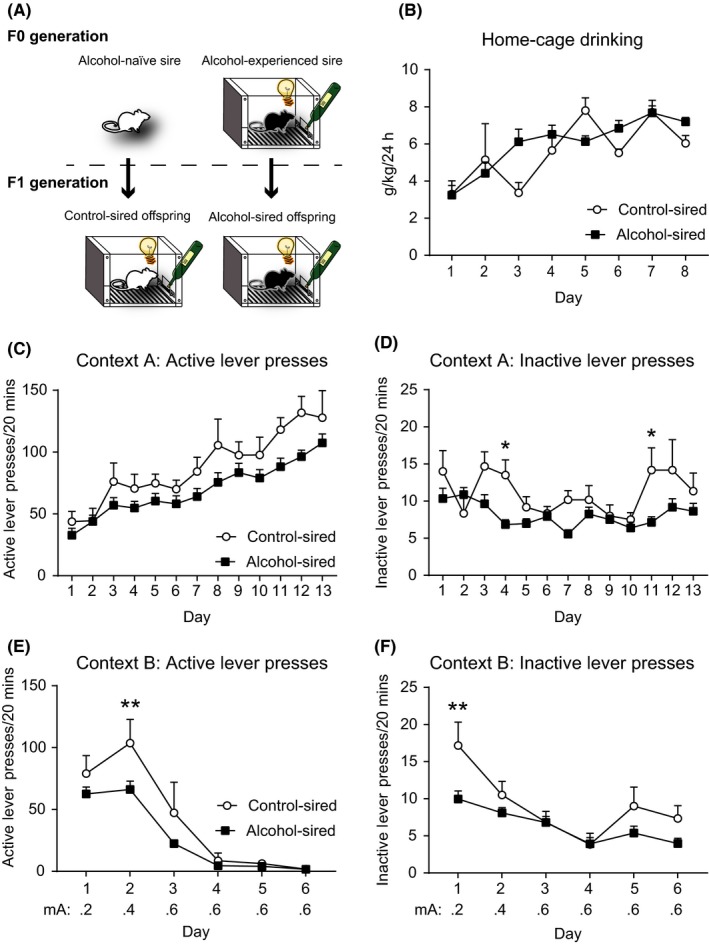
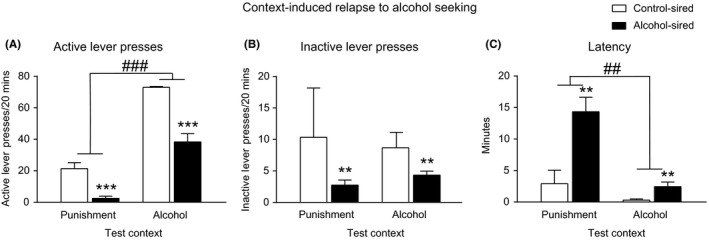
Emerging evidence has demonstrated that paternal alcohol use can modify the behavior of offspring, particularly male offspring. However, preclinical studies to date have not used voluntary self-administration of alcohol to examine alcohol-related behaviors in offspring. Here, we tested the hypothesis that paternal alcohol self-administration followed by punishment-imposed abstinence alters alcohol consumption and seeking in male offspring. Male inbred alcohol preferring iP rats were trained to self-administer alcohol in one context followed by punishment-imposed suppression of alcohol-seeking in a different context using contingent footshock. Following this, all rats were bred with alcohol naïve female iP rats. F1 offspring were then trained to self-administer alcohol in an identical operant paradigm as sires. Alcohol intake and self-administration behaviors of alcohol-sired offspring were compared to control-sired offspring whose fathers had not been exposed to the alcohol operant conditioning experience. We found that paternal alcohol self-administration reduced context-induced relapse to alcohol-seeking in male offspring. These findings indicate that voluntary paternal alcohol experience, operant conditioning, and punishment can result in intergenerational changes in offspring behavior, and that this effect may protect against the vulnerability to relapse after alcohol use. We also noted reduced alcohol responding in the punishment-associated context in alcohol-sired offspring, suggesting altered perception of punishment sensitivity or the anxiogenic response to footshock. Collectively, these findings provide evidence that paternal alcohol abuse can impact alcohol-related behaviors in male offspring.
新出现的证据表明,父亲饮酒会改变后代的行为,尤其是雄性后代的行为。然而,迄今为止的临床前研究尚未使用自愿饮酒自我给药来研究后代与酒精相关的行为。在这里,我们检验了这样一个假设,即父亲饮酒自我给药后进行惩罚性戒酒会改变雄性后代的饮酒和觅酒行为。雄性近交酒精偏爱 iP 大鼠在一种环境中接受酒精自我给药训练,然后在另一种环境中接受伴随足电击的酒精觅酒抑制惩罚。在这之后,所有大鼠都与酒精无知的 iP 雌性大鼠交配。然后,F1 后代在与亲代相同的操作性条件反射范式中接受酒精自我给药训练。将酒精亲代后代的酒精摄入量和自我给药行为与未接触酒精操作性条件反射经验的对照亲代后代进行比较。我们发现,父亲饮酒自我给药减少了雄性后代因环境刺激而复发觅酒的行为。这些发现表明,自愿的父亲饮酒体验、操作性条件反射和惩罚会导致后代行为的代际变化,并且这种效应可能会防止酒精使用后的复发易感性。我们还注意到,酒精亲代后代在与惩罚相关的环境中酒精反应减少,这表明对惩罚敏感性的感知或对足电击的焦虑反应发生了改变。总的来说,这些发现提供了证据表明,父亲酗酒会影响雄性后代与酒精相关的行为。