Hasunuma Tomohisa, Matsuda Mami, Kondo Akihiko
Organization of Advanced Science and Technology, Kobe University, 1-1 Rokkodai, Nada, Kobe 657-8501, Japan.
Biomass Engineering Program, RIKEN, 1-7-22 Suehiro, Tsurumi, Yokohama, Kanagawa 230-0045, Japan.
Metab Eng Commun. 2016 May 3;3:130-141. doi: 10.1016/j.meteno.2016.04.003. eCollection 2016 Dec.
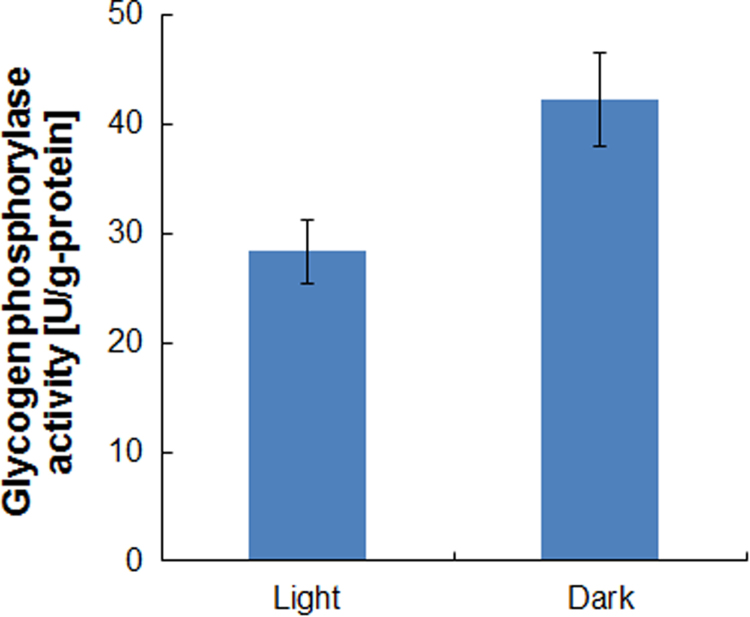
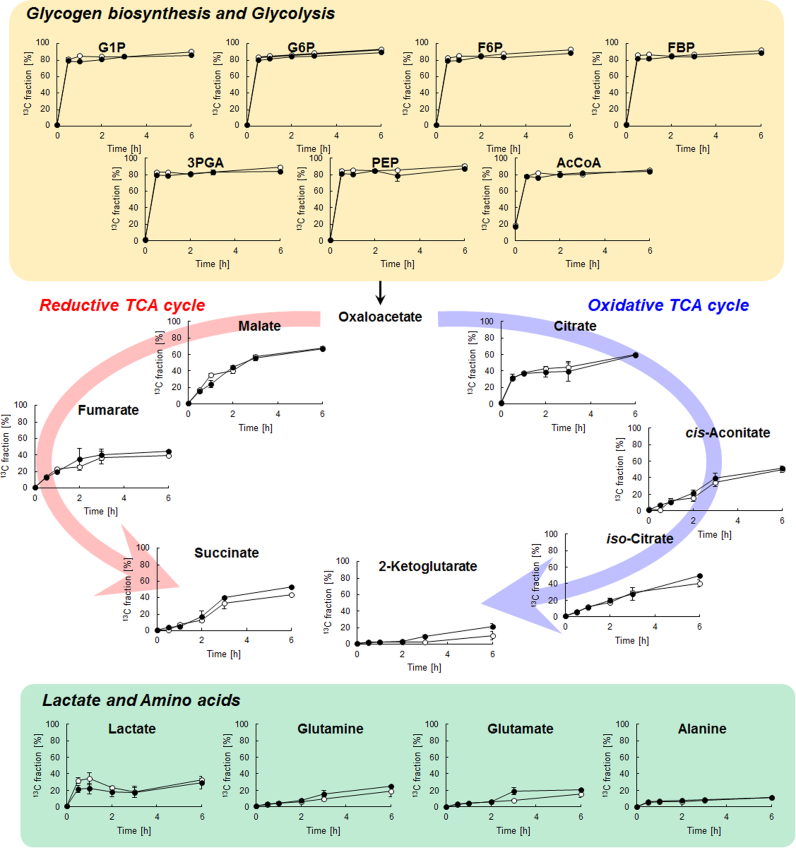
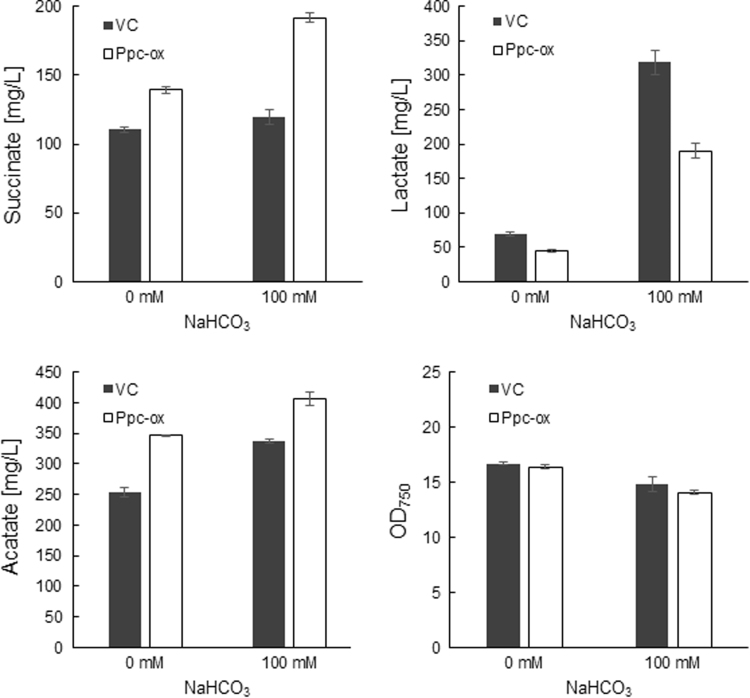
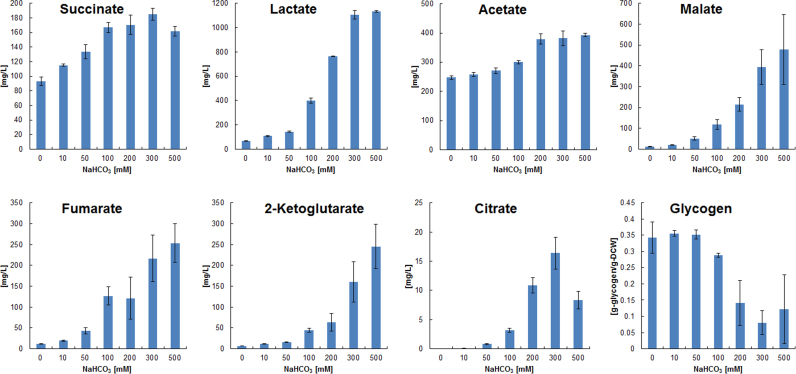
Succinate produced by microorganisms can replace currently used petroleum-based succinate but typically requires mono- or poly-saccharides as a feedstock. The cyanobacterium sp. PCC6803 can produce organic acids such as succinate from CO not supplemented with sugars under dark anoxic conditions using an unknown metabolic pathway. The TCA cycle in cyanobacteria branches into oxidative and reductive routes. Time-course analyses of the metabolome, transcriptome and metabolic turnover described here revealed dynamic changes in the metabolism of sp. PCC6803 cultivated under dark anoxic conditions, allowing identification of the carbon flow and rate-limiting steps in glycogen catabolism. Glycogen biosynthesized from CO assimilated during periods of light exposure is catabolized to succinate via glycolysis, the anaplerotic pathway, and the reductive TCA cycle under dark anoxic conditions. Expression of the phosphopyruvate (PEP) carboxylase gene () was identified as a rate-limiting step in succinate biosynthesis and this rate limitation was alleviated by overexpression, resulting in improved succinate excretion. The sugar-free succinate production was further enhanced by the addition of bicarbonate. labeling with NaHCO clearly showed carbon incorporation into succinate via the anaplerotic pathway. Bicarbonate is in equilibrium with CO. Succinate production by sp. PCC6803 therefore holds significant promise for CO capture and utilization.
微生物产生的琥珀酸可以替代目前使用的石油基琥珀酸,但通常需要单糖或多糖作为原料。蓝细菌sp. PCC6803可以在黑暗缺氧条件下,利用未知的代谢途径,从不含糖的CO中产生琥珀酸等有机酸。蓝细菌中的三羧酸循环分为氧化途径和还原途径。本文所述的代谢组、转录组和代谢周转的时间进程分析揭示了在黑暗缺氧条件下培养的sp. PCC6803代谢的动态变化,从而能够确定糖原分解代谢中的碳流和限速步骤。在光照期间从同化的CO生物合成的糖原在黑暗缺氧条件下通过糖酵解、回补途径和还原三羧酸循环分解代谢为琥珀酸。磷酸丙酮酸(PEP)羧化酶基因()的表达被确定为琥珀酸生物合成中的限速步骤,通过过表达该基因可缓解这种速率限制,从而提高琥珀酸的排泄量。添加碳酸氢盐进一步提高了无糖琥珀酸的产量。用NaHCO进行标记清楚地表明碳通过回补途径掺入琥珀酸中。碳酸氢盐与CO处于平衡状态。因此,sp. PCC6803生产琥珀酸在CO捕获和利用方面具有巨大潜力。