Microbial Chemistry, Department of Chemistry-Ångström, Uppsala University, Box 523, 751 20, Uppsala, Sweden.
Analytical Chemistry, Department of Chemistry-BMC, Uppsala University, Box 599, 751 20, Uppsala, Sweden.
Microb Cell Fact. 2021 Feb 8;20(1):39. doi: 10.1186/s12934-021-01529-y.
Cyanobacteria are promising hosts for the production of various industrially important compounds such as succinate. This study focuses on introduction of the glyoxylate shunt, which is naturally present in only a few cyanobacteria, into Synechocystis PCC 6803. In order to test its impact on cell metabolism, engineered strains were evaluated for succinate accumulation under conditions of light, darkness and anoxic darkness. Each condition was complemented by treatments with 2-thenoyltrifluoroacetone, an inhibitor of succinate dehydrogenase enzyme, and acetate, both in nitrogen replete and deplete medium.
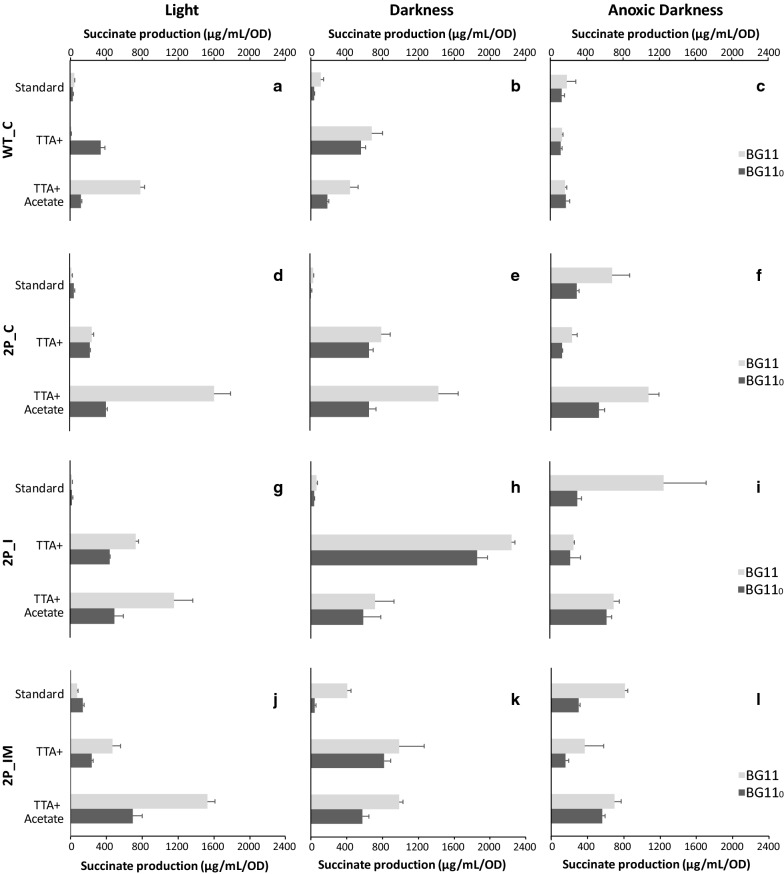
We were able to introduce genes encoding the glyoxylate shunt, aceA and aceB, encoding isocitrate lyase and malate synthase respectively, into a strain of Synechocystis PCC 6803 engineered to overexpress phosphoenolpyruvate carboxylase. Our results show that complete expression of the glyoxylate shunt results in higher extracellular succinate accumulation compared to the wild type control strain after incubation of cells in darkness and anoxic darkness in the presence of nitrate. Addition of the inhibitor 2-thenoyltrifluoroacetone increased succinate titers in all the conditions tested when nitrate was available. Addition of acetate in the presence of the inhibitor further increased the succinate accumulation, resulting in high levels when phosphoenolpyruvate carboxylase was overexpressed, compared to control strain. However, the highest succinate titer was obtained after dark incubation of an engineered strain with a partial glyoxylate shunt overexpressing isocitrate lyase in addition to phosphoenolpyruvate carboxylase, with only 2-thenoyltrifluoroacetone supplementation to the medium.
Heterologous expression of the glyoxylate shunt with its central link to the tricarboxylic acid cycle (TCA) for acetate assimilation provides insight on the coordination of the carbon metabolism in the cell. Phosphoenolpyruvate carboxylase plays an important role in directing carbon flux towards the TCA cycle.
蓝藻是生产各种工业重要化合物的有前途的宿主,如琥珀酸。本研究集中于将乙醛酸支路引入天然仅存在于少数蓝藻中的集胞藻 PCC 6803。为了测试其对细胞代谢的影响,在光照、黑暗和缺氧黑暗条件下,对工程菌株进行了琥珀酸积累的评估。每种条件都用琥珀酸脱氢酶抑制剂 2-硫代三氟丙酮和乙酸盐进行了补充,分别在氮充足和耗尽的培养基中进行。
我们能够将编码乙醛酸支路的基因 aceA 和 aceB 引入到过表达磷酸烯醇丙酮酸羧激酶的集胞藻 PCC 6803 工程菌株中。我们的结果表明,与野生型对照菌株相比,在黑暗和缺氧黑暗条件下,在硝酸盐存在的情况下培养细胞时,完全表达乙醛酸支路会导致细胞外琥珀酸积累更高。在有硝酸盐的情况下,添加抑制剂 2-硫代三氟丙酮会增加所有测试条件下的琥珀酸产量。在抑制剂存在的情况下添加乙酸盐会进一步增加琥珀酸的积累,当磷酸烯醇丙酮酸羧激酶过表达时,与对照菌株相比,会产生较高的琥珀酸积累水平。然而,当过表达磷酸烯醇丙酮酸羧激酶的工程菌株在黑暗中培养时,添加部分乙醛酸支路和异柠檬酸裂解酶,同时仅补充 2-硫代三氟丙酮到培养基中,可获得最高的琥珀酸产量。
异源表达乙醛酸支路及其与三羧酸循环(TCA)的中心连接,用于乙酸盐同化,为细胞中碳代谢的协调提供了深入了解。磷酸烯醇丙酮酸羧激酶在将碳通量引导至 TCA 循环方面发挥着重要作用。