MacLean Margaret Mandy R
Research Institute of Cardiovascular and Medical Sciences, College of Medical, Veterinary and Life Sciences, University of Glasgow, Glasgow, UK.
Pulm Circ. 2018 Apr-Jun;8(2):2045894018759125. doi: 10.1177/2045894018759125.
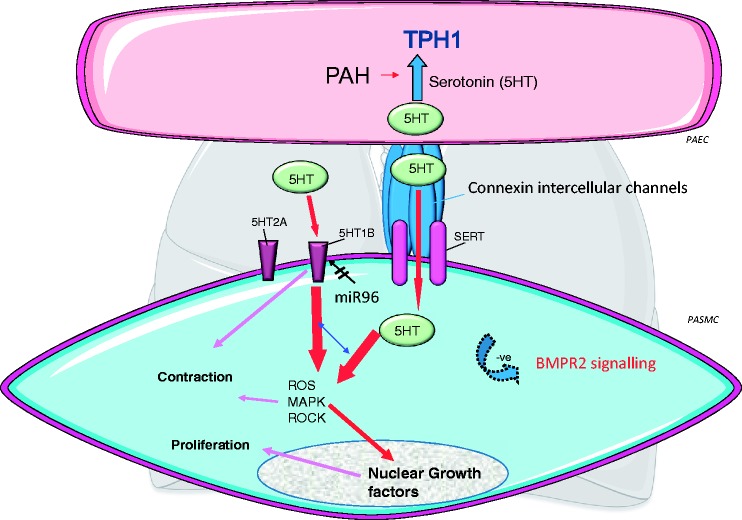
Increased synthesis of serotonin and/or activity of serotonin in pulmonary arteries has been implicated in the pathobiology of pulmonary arterial hypertension (PAH). The incidence of PAH associated with diet pills such as aminorex, fenfluramine, and chlorphentermine initially led to the "serotonin hypothesis of pulmonary hypertension." Over the last couple of decades there has been an accumulation of convincing evidence that targeting serotonin synthesis or signaling is a novel and promising approach to the development of novel therapies for PAH. Pulmonary endothelial serotonin synthesis via tryptophan hydroxlase 1 (TPH1) is increased in patients with PAH and serotonin can act in a paracrine fashion on underlying pulmonary arterial smooth muscle cells (PASMCs), In humans, serotonin can enter PASMCs via the serotonin transporter (SERT) or activate the 5-HT1B receptor; 5-HT1B activation and SERT activity cooperate to induce PASMC contraction and proliferation via activation of downstream proliferative and contractile signaling pathways. Here we will review the current status of the serotonin hypothesis and discuss potential and novel therapeutic targets.
肺动脉中血清素合成增加和/或血清素活性增强与肺动脉高压(PAH)的病理生物学有关。与减肥药如氨基苯唑、芬氟拉明和氯苯丁胺相关的PAH发病率最初引发了“肺动脉高压的血清素假说”。在过去几十年里,有越来越多令人信服的证据表明,针对血清素合成或信号传导是开发PAH新型疗法的一种新颖且有前景的方法。PAH患者肺内皮细胞通过色氨酸羟化酶1(TPH1)合成血清素增加,血清素可通过旁分泌方式作用于下层肺动脉平滑肌细胞(PASMCs)。在人类中,血清素可通过血清素转运体(SERT)进入PASMCs或激活5-HT1B受体;5-HT1B激活和SERT活性通过激活下游增殖和收缩信号通路协同诱导PASMC收缩和增殖。在此,我们将综述血清素假说的现状,并讨论潜在的新型治疗靶点。