Department of Clinical Epidemiology and Medical Technology Assessment, Maastricht University Medical Center+, P. Debyelaan 25, 6202 AZ, Maastricht, the Netherlands.
Care and Public Health Research Institute (CAPHRI), Maastricht University, Universiteitssingel 40, 6229 ER, Maastricht, the Netherlands.
Int J Colorectal Dis. 2018 Apr;33(4):493-501. doi: 10.1007/s00384-018-2978-x. Epub 2018 Feb 22.
The evidence regarding the (cost-)effectiveness of sacral neuromodulation (SNM) in patients with therapy-resistant idiopathic slow-transit constipation is of suboptimal quality. The Dutch Ministry of Health, Welfare and Sports has granted conditional reimbursement for SNM treatment. The objective is to assess the effectiveness, cost-effectiveness, and budget impact of SNM compared to personalized conservative treatment (PCT) in patients with idiopathic slow-transit constipation refractory to conservative treatment.
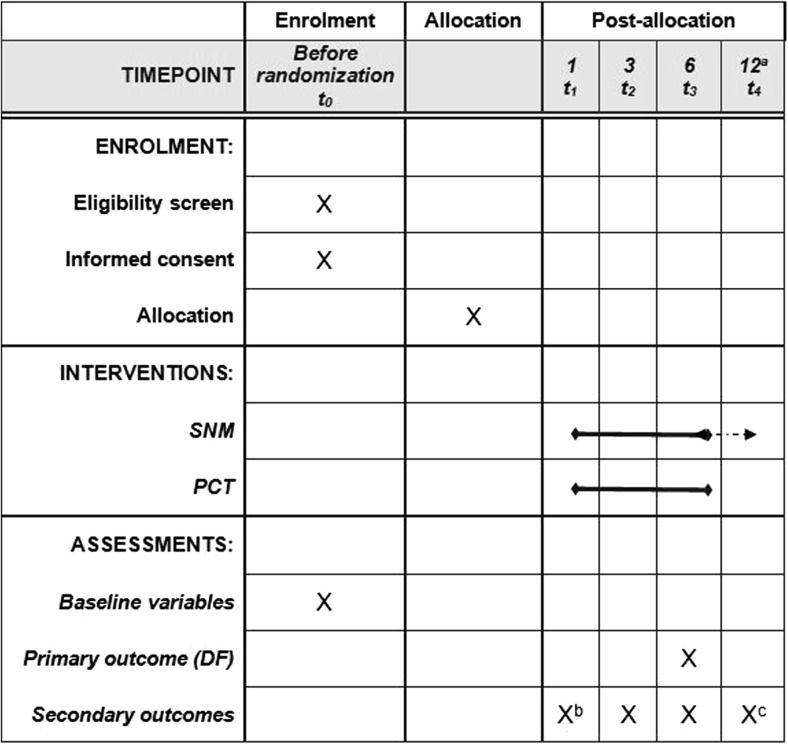
This study is an open-label, multicenter randomized controlled trial. Patients aged 14 to 80 with slow-transit constipation, a defecation frequency (DF) < 3 per week and meeting at least one other Rome-IV criterion, are eligible. Patients with obstructed outlet, irritable bowel syndrome, bowel pathology, or rectal prolapse are excluded. Patients are randomized to SNM or PCT. The primary outcome is success at 6 months (DF ≥ 3 a week), requiring a sample size of 64 (α = 0.05, β = 0.80, 30% difference in success). Secondary outcomes are straining, sense of incomplete evacuation, constipation severity, fatigue, constipation specific and generic quality of life, and costs at 6 months. Long-term costs and effectiveness will be estimated by a decision analytic model. The time frame is 57 months, starting October 2016. SNM treatment costs are funded by the Dutch conditional reimbursement program, research costs by Medtronic.
The results of this trial will be used to make a final decision regarding reimbursement of SNM from the Dutch Health Care Package in this patient group.
This trial is registered at clinicaltrials.gov , identifier NCT02961582, on 12 October 2016.
对于治疗抵抗性特发性慢传输型便秘患者,骶神经调节(SNM)的(成本)效性证据质量欠佳。荷兰卫生部、福利和体育部已批准 SNM 治疗的有条件报销。本研究旨在评估 SNM 与个性化保守治疗(PCT)相比在保守治疗无效的特发性慢传输型便秘患者中的有效性、成本效益和预算影响。
这是一项开放标签、多中心随机对照试验。年龄在 14 至 80 岁之间、慢传输型便秘、排便频率(DF)<每周 3 次且符合至少另一项罗马 IV 标准的患者有资格参加。排除有出口梗阻、肠易激综合征、肠道病变或直肠前突的患者。患者被随机分配到 SNM 或 PCT 组。主要结局为 6 个月时的成功率(DF≥每周 3 次),需要样本量为 64 例(α=0.05,β=0.80,成功率差异为 30%)。次要结局为排便费力、排便不尽感、便秘严重程度、疲劳、便秘特异性和一般性生活质量以及 6 个月时的成本。长期成本和效果将通过决策分析模型进行估计。时间框架为 57 个月,从 2016 年 10 月开始。SNM 治疗费用由荷兰有条件报销计划支付,研究费用由美敦力公司支付。
本试验的结果将用于在这组患者中对 SNM 从荷兰医疗保健计划中进行最终报销的决策。
本试验于 2016 年 10 月 12 日在 clinicaltrials.gov 注册,标识符为 NCT02961582。