Hematology Laboratory, Biology and Pathology Center, CHRU of Lille, France.
INSERM, UMR-S 1172, Cancer Research Institute of Lille, Paris, France.
Haematologica. 2018 May;103(5):822-829. doi: 10.3324/haematol.2017.183525. Epub 2018 Feb 22.
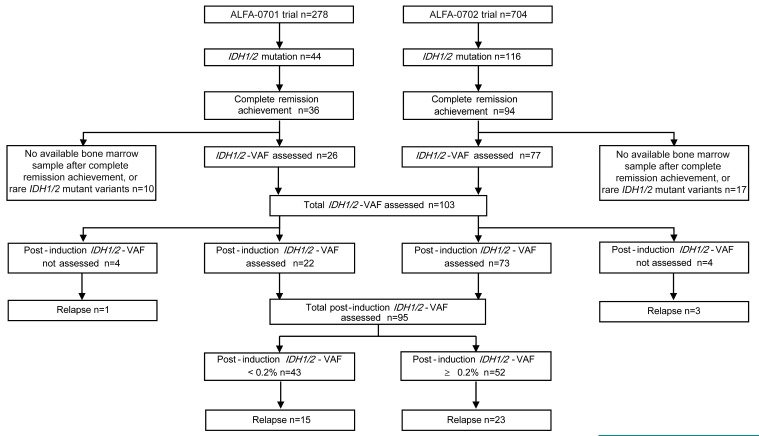
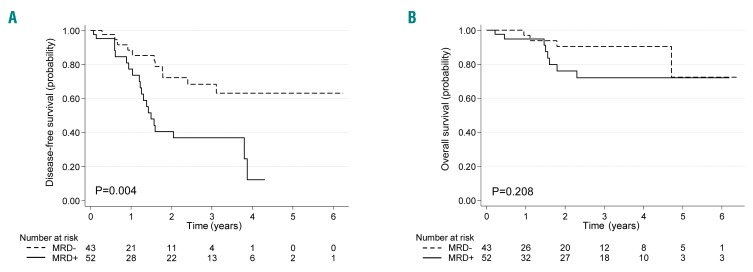
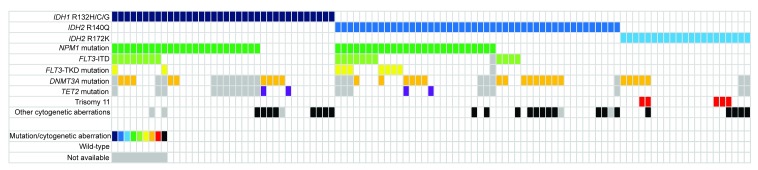
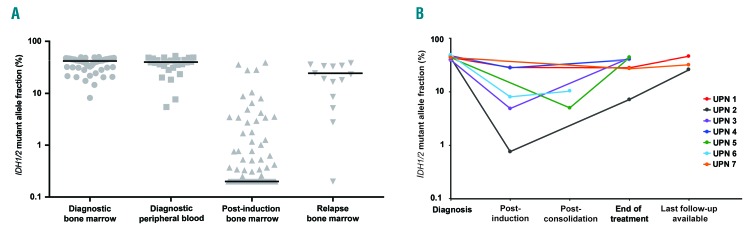
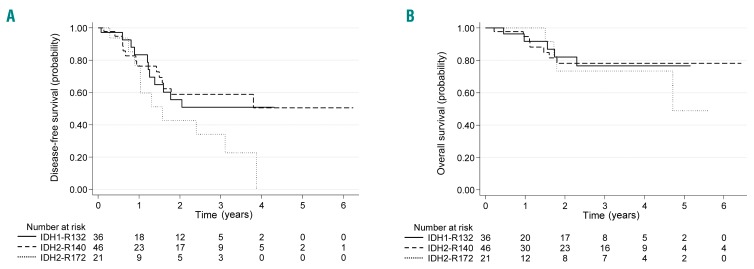
Assessment of minimal residual disease has emerged as a powerful prognostic factor in acute myeloid leukemia. In this study, we investigated the potential of mutations as targets for minimal residual disease assessment in acute myeloid leukemia, since these mutations collectively occur in 15-20% of cases of acute myeloid leukemia and now represent druggable targets. We employed droplet digital polymerase chain reaction assays to quantify , , and mutations on genomic DNA in 322 samples from 103 adult patients with primary mutant acute myeloid leukemia and enrolled on Acute Leukemia French Association (ALFA) - 0701 or -0702 clinical trials. The median mutant allele fraction in bone marrow samples was 42.3% (range, 8.2 - 49.9%) at diagnosis of acute myeloid leukemia, and below the detection limit of 0.2% (range, <0.2 - 39.3%) in complete remission after induction therapy. In univariate analysis, the presence of a normal karyotype, a mutation, and an mutant allele fraction <0.2% in bone marrow after induction therapy were statistically significant predictors of longer disease-free survival. In multivariate analysis, these three variables remained significantly predictive of disease-free survival. In 7/103 (7%) patients, mutations persisted at high levels in complete remission, consistent with the presence of an mutation in pre-leukemic hematopoietic stem cells. Five out of these seven patients subsequently relapsed or progressed toward myelodysplastic syndrome, suggesting that patients carrying the mutation in a pre-leukemic clone may be at high risk of hematologic evolution.
微小残留病评估已成为急性髓系白血病强有力的预后因素。在本研究中,我们研究了 突变作为急性髓系白血病微小残留病评估靶点的潜力,因为这些突变共同发生在 15-20%的急性髓系白血病病例中,现在是可治疗的靶点。我们采用液滴数字聚合酶链反应检测法,对 103 例初诊伴 突变的成人急性髓系白血病患者(入组急性白血病法国协会 [ALFA] -0701 或 -0702 临床试验)的 322 个样本的基因组 DNA 中的 、 和 突变进行定量检测。在诊断急性髓系白血病时,骨髓样本中 突变等位基因分数的中位数为 42.3%(范围,8.2-49.9%),在诱导治疗后完全缓解时低于检测下限 0.2%(范围,<0.2-39.3%)。在单因素分析中,正常核型、 突变和诱导治疗后骨髓中 突变等位基因分数<0.2%的存在是无病生存时间较长的统计学显著预测因素。在多因素分析中,这三个变量仍然是无病生存的显著预测因素。在 103 例患者中的 7 例(7%)中,完全缓解时 突变持续高水平,与白血病前造血干细胞中存在 突变一致。这 7 例患者中的 5 例随后复发或进展为骨髓增生异常综合征,表明携带白血病前克隆中 突变的患者可能存在高血液学演变风险。