Schmidt Eric A, Despas Fabien, Pavy-Le Traon Anne, Czosnyka Zofia, Pickard John D, Rahmouni Kamal, Pathak Atul, Senard Jean M
Institut des Maladies Métaboliques et Cardiovasculaires, I2MC, Institut National de la Santé et de la Recherche Médicale, Université de Toulouse, Toulouse, France.
Department of Neurosurgery, University Hospital of Toulouse, Toulouse, France.
Front Physiol. 2018 Feb 8;9:11. doi: 10.3389/fphys.2018.00011. eCollection 2018.
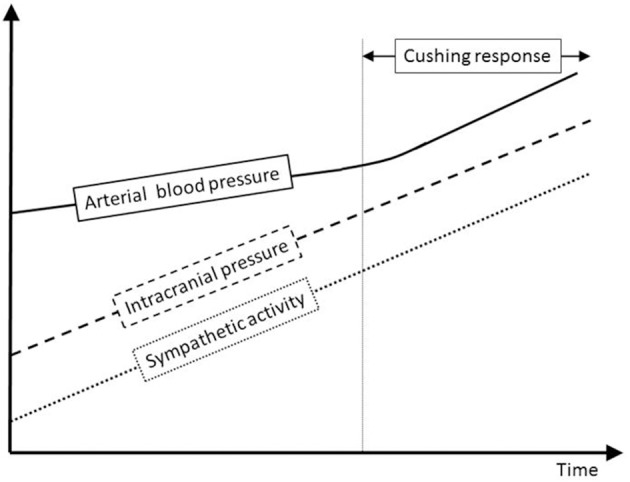
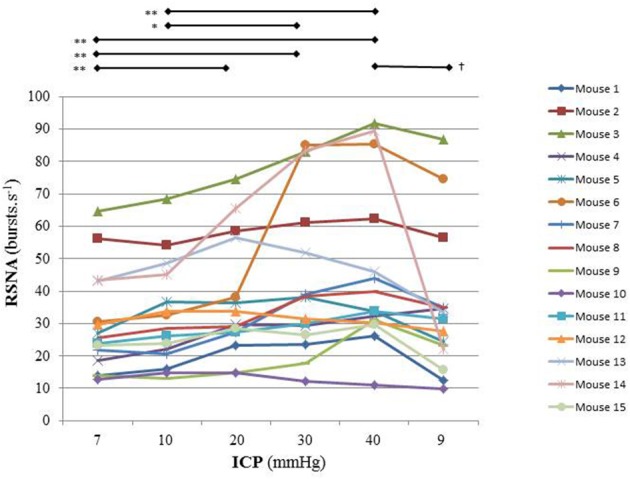
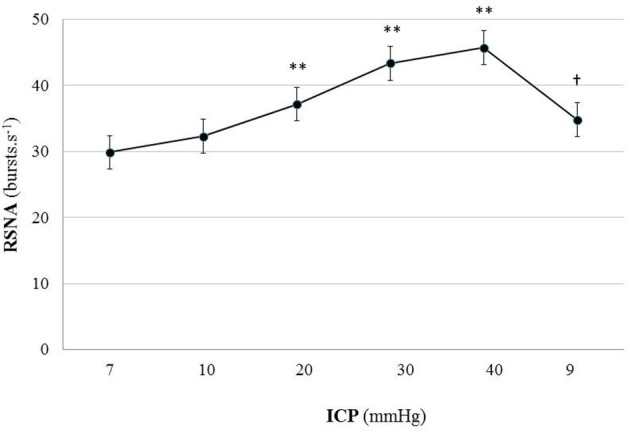
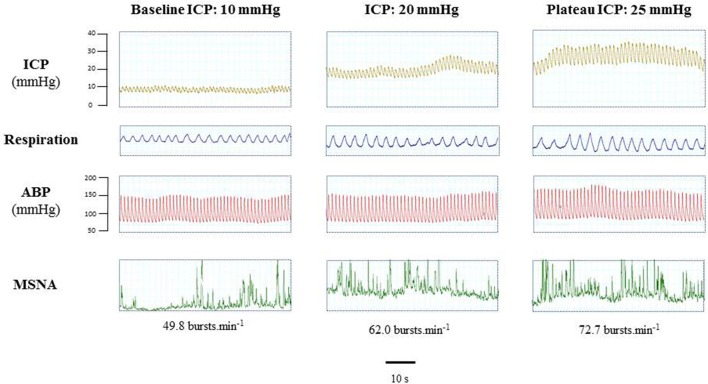
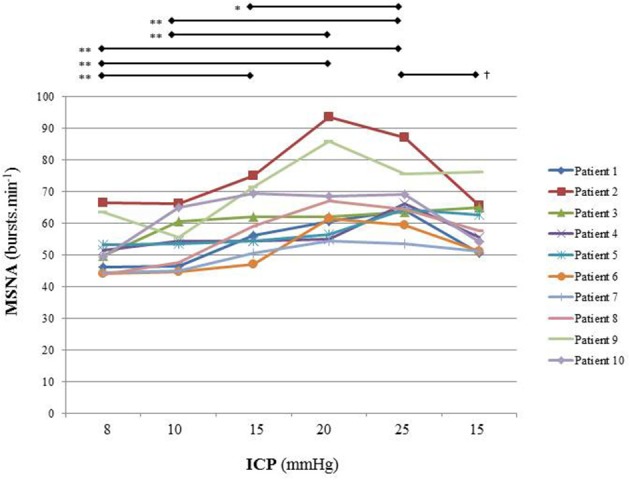
Intracranial pressure (ICP) is the pressure within the . ICP rise compresses brain vessels and reduces cerebral blood delivery. Massive ICP rise leads to cerebral ischemia, but it is also known to produce hypertension, bradycardia and respiratory irregularities due to a sympatho-adrenal mechanism termed Cushing response. One still unresolved question is whether the Cushing response is a non-synaptic acute brainstem ischemic mechanism or part of a larger physiological reflex for arterial blood pressure control and homeostasis regulation. We hypothesize that changes in ICP modulates sympathetic activity. Thus, modest ICP increase and decrease were achieved in mice and patients with respectively intra-ventricular and lumbar fluid infusion. Sympathetic activity was gauged directly by microneurography, recording renal sympathetic nerve activity in mice and muscle sympathetic nerve activity in patients, and gauged indirectly in both species by heart-rate variability analysis. In mice ( = 15), renal sympathetic activity increased from 29.9 ± 4.0 bursts.s (baseline ICP 6.6 ± 0.7 mmHg) to 45.7 ± 6.4 bursts.s (plateau ICP 38.6 ± 1.0 mmHg) and decreased to 34.8 ± 5.6 bursts.s (post-infusion ICP 9.1 ± 0.8 mmHg). In patients ( = 10), muscle sympathetic activity increased from 51.2 ± 2.5 bursts.min (baseline ICP 8.3 ± 1.0 mmHg) to 66.7 ± 2.9 bursts.min (plateau ICP 25 ± 0.3 mmHg) and decreased to 58.8 ± 2.6 bursts.min (post-infusion ICP 14.8 ± 0.9 mmHg). In patients 7 mmHg ICP rise significantly increases sympathetic activity by 17%. Heart-rate variability analysis demonstrated a significant vagal withdrawal during the ICP rise, in accordance with the microneurography findings. Mice and human results are alike. We demonstrate in animal and human that ICP is a reversible determinant of efferent sympathetic outflow, even at relatively low ICP levels. ICP is a biophysical stress related to the forces within the brain. But ICP has also to be considered as a physiological stressor, driving sympathetic activity. The results suggest a novel physiological ICP-mediated sympathetic modulation circuit and the existence of a possible intracranial (i.e., central) baroreflex. Modest ICP rise might participate to the pathophysiology of cardio-metabolic homeostasis imbalance with sympathetic over-activity, and to the pathogenesis of sympathetically-driven diseases.
颅内压(ICP)是指脑内的压力。颅内压升高会压迫脑血管并减少脑血流量。大量颅内压升高会导致脑缺血,但由于一种称为库欣反应的交感 - 肾上腺机制,它也会引起高血压、心动过缓和呼吸不规则。一个尚未解决的问题是,库欣反应是一种非突触性急性脑干缺血机制,还是动脉血压控制和内环境稳态调节的更大生理反射的一部分。我们假设颅内压的变化会调节交感神经活动。因此,分别通过向小鼠脑室内和向患者腰椎内输注液体,实现了小鼠和患者颅内压的适度升高和降低。交感神经活动通过微神经ography直接测量,记录小鼠的肾交感神经活动和患者的肌肉交感神经活动,并通过心率变异性分析在两种动物中进行间接测量。在小鼠(n = 15)中,肾交感神经活动从29.9±4.0次/秒(基线颅内压6.6±0.7 mmHg)增加到45.7±6.4次/秒(平台期颅内压38.6±1.0 mmHg),并降至34.8±5.6次/秒(输注后颅内压9.1±0.8 mmHg)。在患者(n = 10)中,肌肉交感神经活动从51.2±2.5次/分钟(基线颅内压8.3±1.0 mmHg)增加到66.7±2.9次/分钟(平台期颅内压25±0.3 mmHg),并降至58.8±2.6次/分钟(输注后颅内压14.8±0.9 mmHg)。在患者中,颅内压升高7 mmHg会使交感神经活动显著增加17%。心率变异性分析表明,颅内压升高期间迷走神经显著撤离,这与微神经ography的结果一致。小鼠和人类的结果相似。我们在动物和人类中证明,颅内压是传出交感神经输出的可逆决定因素,即使在相对较低的颅内压水平也是如此。颅内压是一种与脑内压力相关的生物物理应激。但颅内压也应被视为一种生理应激源,驱动交感神经活动。结果提示了一种新的由颅内压介导的生理性交感神经调节回路以及可能存在的颅内(即中枢)压力反射。适度的颅内压升高可能参与了交感神经活动过度导致的心 - 代谢内环境稳态失衡的病理生理过程,以及交感神经驱动性疾病的发病机制。