Centre for International Health, University of Bergen, Bergen, Norway.
Division of Global HIV & TB, U.S Centers for Disease Control and Prevention (CDC), Nairobi, Kenya.
J Acquir Immune Defic Syndr. 2018 Jun 1;78(2):144-154. doi: 10.1097/QAI.0000000000001652.
In a spatially well known and dispersed HIV epidemic, identifying geographic clusters with significantly higher HIV prevalence is important for focusing interventions for people living with HIV (PLHIV).
We used Kulldorff spatial-scan Poisson model to identify clusters with high numbers of HIV-infected persons 15-64 years old. We classified PLHIV as belonging to either higher prevalence or lower prevalence (HP/LP) clusters, then assessed distributions of sociodemographic and biobehavioral HIV risk factors and associations with clustering.
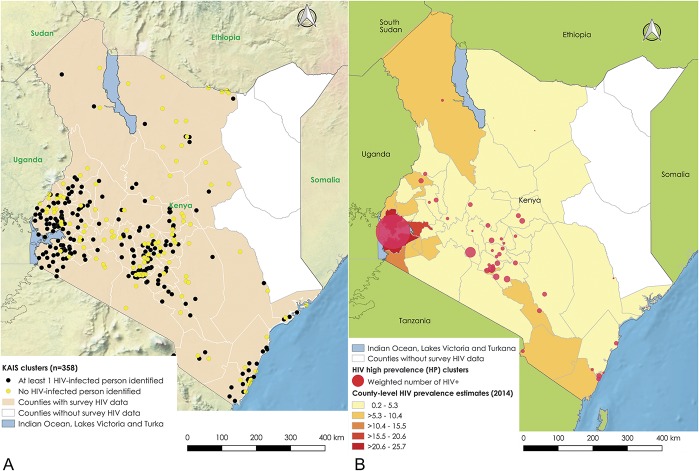
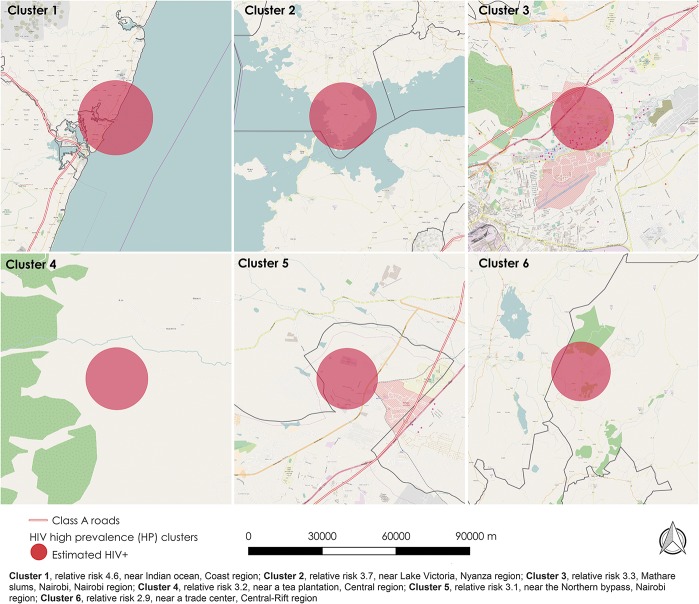
About half of survey locations, 112/238 (47%) had high rates of HIV (HP clusters), with 1.1-4.6 times greater PLHIV adults observed than expected. Richer persons compared with respondents in lowest wealth index had higher odds of belonging to a HP cluster, adjusted odds ratio (aOR) 1.61 [95% confidence interval (CI): 1.13 to 2.3], aOR 1.66 (95% CI: 1.09 to 2.53), aOR 3.2 (95% CI: 1.82 to 5.65), and aOR 2.28 (95% CI: 1.09 to 4.78) in second, middle, fourth, and highest quintiles, respectively. Respondents who perceived themselves to have greater HIV risk or were already HIV-infected had higher odds of belonging to a HP cluster, aOR 1.96 (95% CI: 1.13 to 3.4) and aOR 5.51 (95% CI: 2.42 to 12.55), respectively; compared with perceived low risk. Men who had ever been clients of female sex worker had higher odds of belonging to a HP cluster than those who had never been, aOR 1.47 (95% CI: 1.04 to 2.08); and uncircumcised men vs circumcised, aOR 3.2 (95% CI: 1.74 to 5.8).
HIV infection in Kenya exhibits localized geographic clustering associated with sociodemographic and behavioral factors, suggesting disproportionate exposure to higher HIV risk. Identification of these clusters reveals the right places for targeting priority-tailored HIV interventions.
在一个空间分布明确且广泛的 HIV 流行地区,识别 HIV 感染率显著较高的地理聚集区对于将干预措施集中在 HIV 感染者(PLHIV)身上非常重要。
我们使用 Kulldorff 空间扫描泊松模型来识别 HIV 感染者(15-64 岁)数量较多的聚集区。我们将 PLHIV 分为高流行率(HP)和低流行率(LP)两类聚集区,然后评估社会人口统计学和生物行为学 HIV 风险因素的分布情况,并评估这些因素与聚集区的关联。
大约一半的调查地点(112/238,47%)的 HIV 感染率较高(HP 聚集区),观察到的 PLHIV 成人比预期高出 1.1-4.6 倍。与处于最低财富指数的受访者相比,较富裕的人更有可能属于 HP 聚集区,调整后的优势比(aOR)为 1.61(95%置信区间(CI):1.13 至 2.3),aOR 为 1.66(95%CI:1.09 至 2.53),aOR 为 3.2(95%CI:1.82 至 5.65),aOR 为 2.28(95%CI:1.09 至 4.78),分别在第二、中、第四和最高五分位数中。认为自己 HIV 风险较高或已经感染 HIV 的受访者属于 HP 聚集区的可能性更高,aOR 为 1.96(95%CI:1.13 至 3.4)和 aOR 为 5.51(95%CI:2.42 至 12.55),与低风险相比。曾经是女性性工作者客户的男性比从未有过的男性更有可能属于 HP 聚集区,aOR 为 1.47(95%CI:1.04 至 2.08);未割礼的男性与割礼的男性相比,aOR 为 3.2(95%CI:1.74 至 5.8)。
肯尼亚的 HIV 感染呈局部地理聚集性,与社会人口统计学和行为因素有关,表明接触更高 HIV 风险的比例不成比例。识别这些聚集区揭示了针对重点定制 HIV 干预措施的正确地点。