Bernard Lise, Eljezi Teuta, Clauson Hélène, Lambert Céline, Bouattour Yassine, Chennell Philip, Pereira Bruno, Sautou Valérie
Université Clermont Auvergne, CHU Clermont-Ferrand, CNRS, SIGMA Clermont, ICCF, Clermont-Ferrand, France.
CHU Clermont-Ferrand, Service Pharmacie, Clermont-Ferrand, France.
PLoS One. 2018 Feb 23;13(2):e0192369. doi: 10.1371/journal.pone.0192369. eCollection 2018.
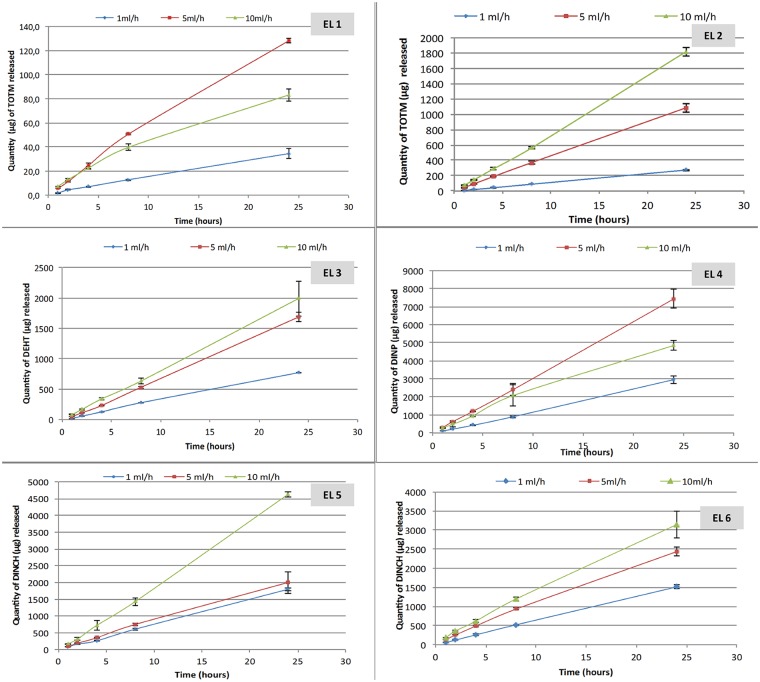
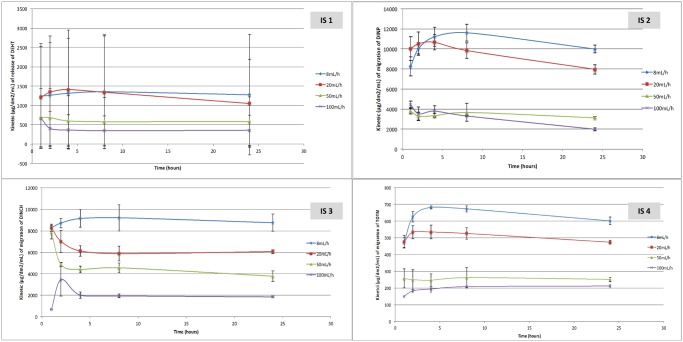
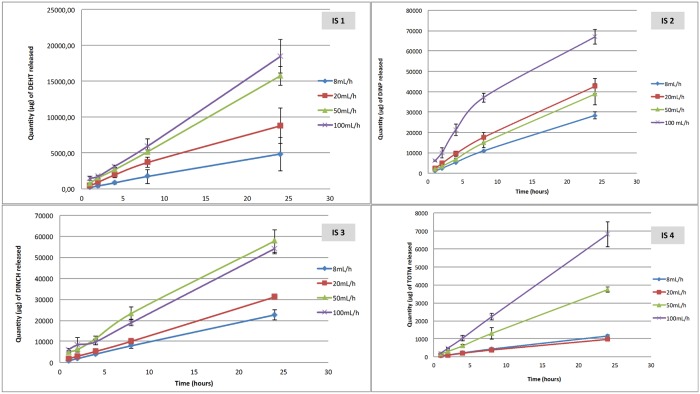
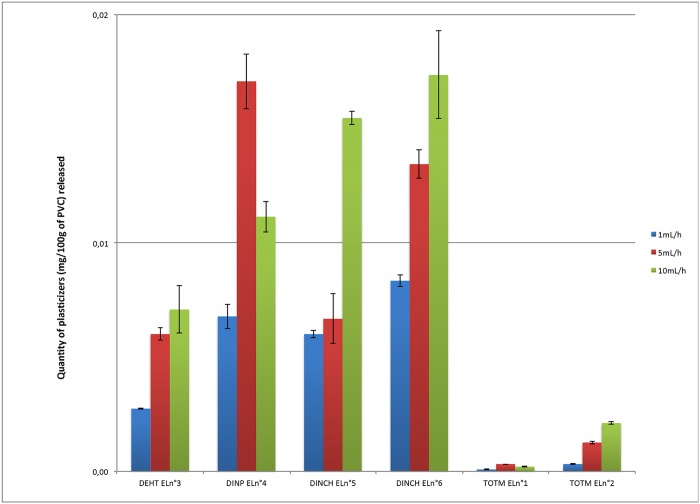
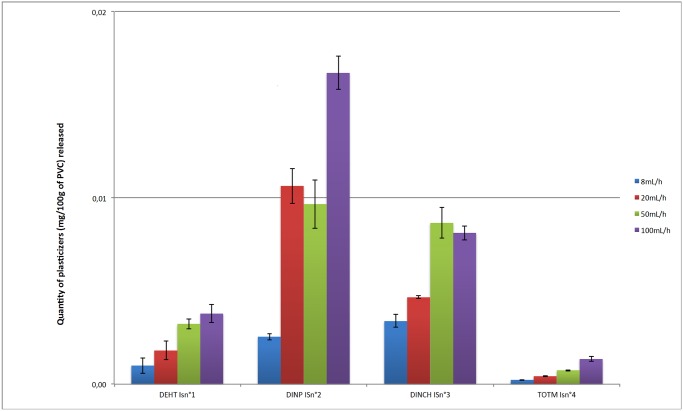
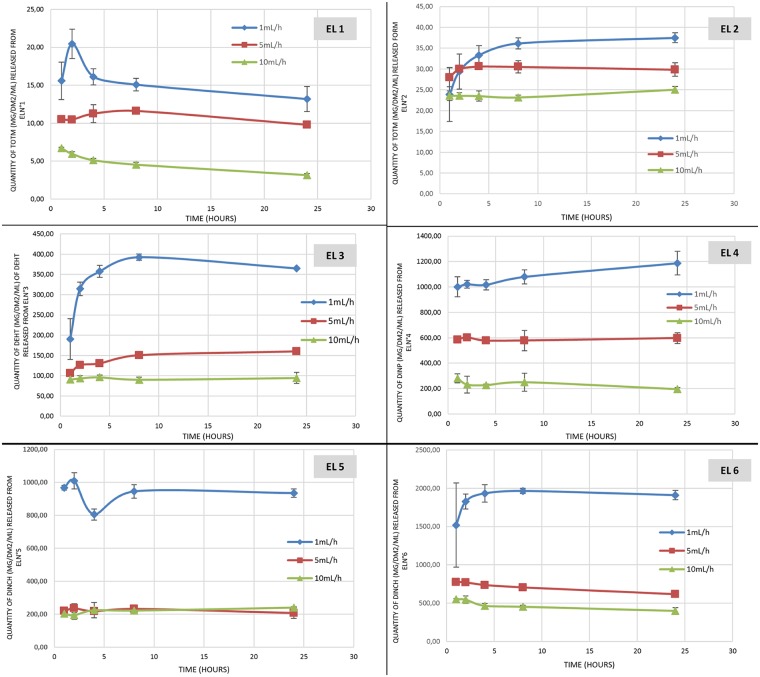
Infusion medical devices (MDs) used in hospitals are often made of plasticized polyvinylchloride (PVC). These plasticizers may leach out into infused solutions during clinical practice, especially during risk-situations, e.g multiple infusions in Intensive Care Units and thus may enter into contact with the patients. The migrability of the plasticizers is dependent of several clinical parameters such as temperature, contact time, nature of the simulant, etc… However, no data is available about the influence of the flow rate at which drug solutions are administrated. In this study, we evaluated the impact of different flow rates on the release of the different plasticizers during an infusion procedure in order to assess if they could expose the patients to more toxic amounts of plasticizers. Migration assays with different PVC infusion sets and extension lines were performed with different flow rates that are used in clinical practice during 1h, 2h, 4h, 8h and 24h, using a lipophilic drug simulant. From a clinical point of view, the results showed that, regardless of the plasticizer, the faster the flow rate, the higher the infused volume and the higher the quantities of plasticizers released, both from infusion sets and extension lines, leading to higher patient exposure. However, physically, there was no significant difference of the migration kinetics linked to the flow rate for a same medical device, reflecting complex interactions between the PVC matrix and the simulant. The migration was especially dependent on the nature and the composition of the medical device.
医院使用的输液医疗器械(MDs)通常由增塑聚氯乙烯(PVC)制成。这些增塑剂在临床实践中可能会渗入输液溶液中,尤其是在风险情况下,例如重症监护病房的多次输液,从而可能与患者接触。增塑剂的迁移性取决于几个临床参数,如温度、接触时间、模拟物的性质等……然而,关于给药溶液流速的影响尚无数据。在本研究中,我们评估了不同流速对输液过程中不同增塑剂释放的影响,以评估它们是否会使患者接触到更多有毒量的增塑剂。使用亲脂性药物模拟物,以临床实践中使用的不同流速,对不同的PVC输液器和延长管进行了1小时、2小时、4小时、8小时和24小时的迁移试验。从临床角度来看,结果表明,无论增塑剂如何,流速越快,输液量越高,输液器和延长管释放的增塑剂数量就越高,导致患者接触量增加。然而,从物理角度来看,同一医疗器械的迁移动力学与流速并无显著差异,这反映了PVC基质与模拟物之间复杂的相互作用。迁移尤其取决于医疗器械的性质和组成。