Escola Nacional de Saúde Pública, Universidade NOVA de Lisboa, Lisboa, Portugal.
Instituto de Higiene e Medicina Tropical, Universidade NOVA de Lisboa, Lisboa, Portugal.
PLoS One. 2018 Feb 23;13(2):e0193165. doi: 10.1371/journal.pone.0193165. eCollection 2018.
Although socioeconomic inequalities in health have long been observed in Europe, few studies have analysed their recent patterning. In this paper, we examined how educational inequalities in self-reported health have evolved in different European countries and welfare state regimes over the last decade, which was troubled by the Great Recession.
We used cross-sectional data from the EU-SILC survey for adults from 26 European countries, from 2005 to 2014 (n = 3,030,595). We first calculated education-related absolute (SII) and relative (RII) inequalities in poor self-reported health by country-year, adjusting for age, sex, and EU-SILC survey weights. We then regressed the year- and country-specific RII and SII on a yearly time trend, globally and by welfare regime, adjusting for country fixed effects. We further adjusted the analysis for the economic cycle using GDP growth, unemployment, and income inequality.
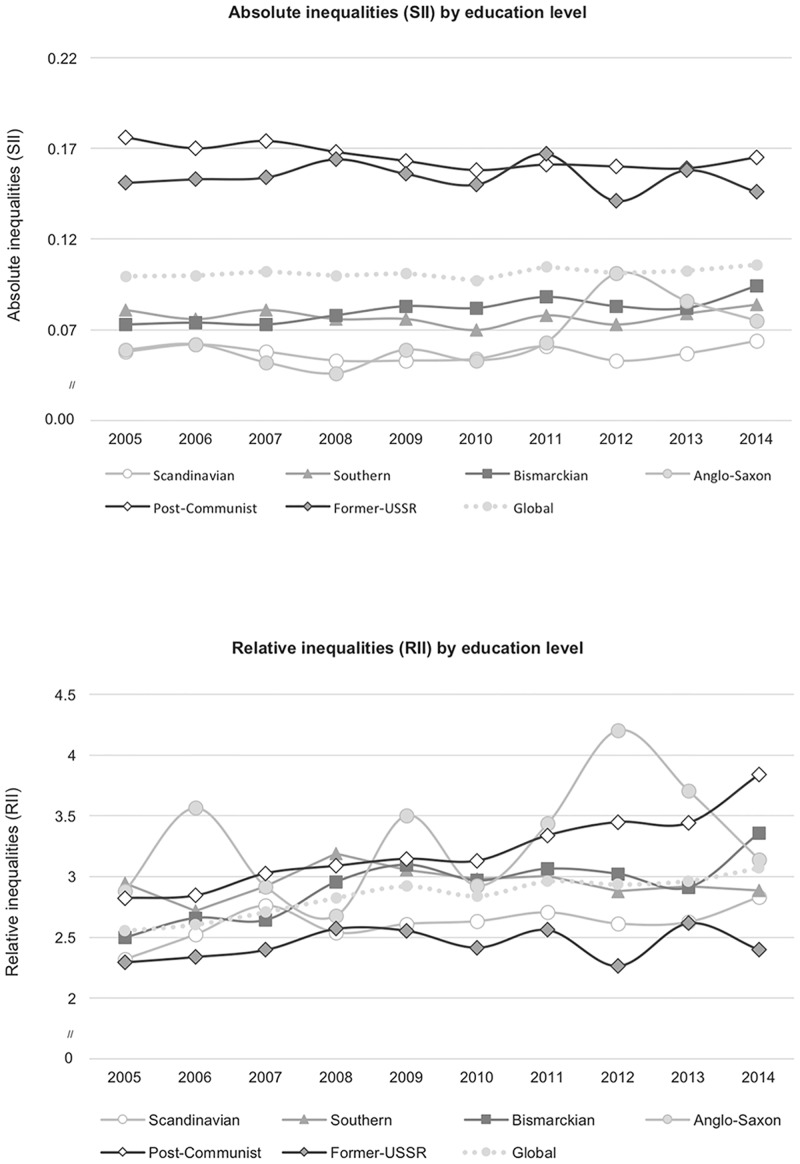
Overall, absolute inequalities persisted and relative inequalities slightly widened (betaRII = 0.0313, p<0.05). There were substantial differences by welfare regime: Anglo-Saxon countries experienced the largest increase in absolute inequalities (betaSII = 0.0032, p<0.05), followed by Bismarkian countries (betaSII = 0.0024, p<0.001), while they reduced in Post-Communist countries (betaSII = -0.0022, p<0.001). Post-Communist countries also experienced a widening in relative inequalities (betaRII = 0.1112, p<0.001), which were found to be stable elsewhere. Adjustment for income inequality only explained such trend in Anglo-Saxon countries.
Educational inequalities in health have overall persisted across European countries over the last decade. However, there is considerable variation across welfare regimes, possibly related to underpinning social safety nets and to austerity measures implemented during this 10-year period.
尽管欧洲长期以来一直存在健康方面的社会经济不平等现象,但很少有研究分析其近期的模式。本文研究了过去十年中,在经历大衰退的困扰下,不同欧洲国家和福利国家制度中,自我报告健康状况的教育不平等现象是如何演变的。
我们使用来自 26 个欧洲国家欧盟社会融合调查(EU-SILC)的成年人的横断面数据,时间范围为 2005 年至 2014 年(n=3030595)。我们首先根据国家/年份计算了与教育相关的不良自我报告健康状况的绝对不平等(SII)和相对不平等(RII),并调整了年龄、性别和欧盟社会融合调查权重。然后,我们根据每年的时间趋势,在全球范围内以及按福利制度对特定国家/年份的 RII 和 SII 进行回归分析,并调整了国家固定效应。我们还使用 GDP 增长、失业率和收入不平等来进一步调整分析以适应经济周期。
总体而言,绝对不平等仍然存在,相对不平等略有扩大(betaRII=0.0313,p<0.05)。不同福利制度之间存在很大差异:盎格鲁-撒克逊国家的绝对不平等程度增加最大(betaSII=0.0032,p<0.05),其次是俾斯麦式国家(betaSII=0.0024,p<0.001),而在后共产主义国家则有所减少(betaSII=-0.0022,p<0.001)。后共产主义国家的相对不平等也有所扩大(betaRII=0.1112,p<0.001),而其他地方的这一趋势则保持稳定。对收入不平等的调整仅能解释在盎格鲁-撒克逊国家中存在的这种趋势。
过去十年,欧洲各国的健康方面的教育不平等现象总体上持续存在。然而,在福利制度方面存在相当大的差异,这可能与基本的社会安全网有关,也可能与这十年期间实施的紧缩措施有关。