Service de Gériatrie à orientation Cardiologique et Neurologique, Hôpital Charles Foix, Hôpitaux universitaires Pitie-Salpêtrière-Charles Foix, APHP, Paris, France.
Service de Gériatrie aiguë, Hôpital Charles Foix, Hôpitaux universitaires Pitie-Salpêtrière-Charles Foix, APHP, Paris, France.
PLoS One. 2018 Feb 23;13(2):e0193034. doi: 10.1371/journal.pone.0193034. eCollection 2018.
Factors associated with delirium among community-dwelling older adults have been poorly studied. Our aim was to describe the prevalence of predisposing and precipitating factors for delirium among patients admitted for delirium and to assess whether these factors were appropriately recognized at the first patient assessment at hospital.
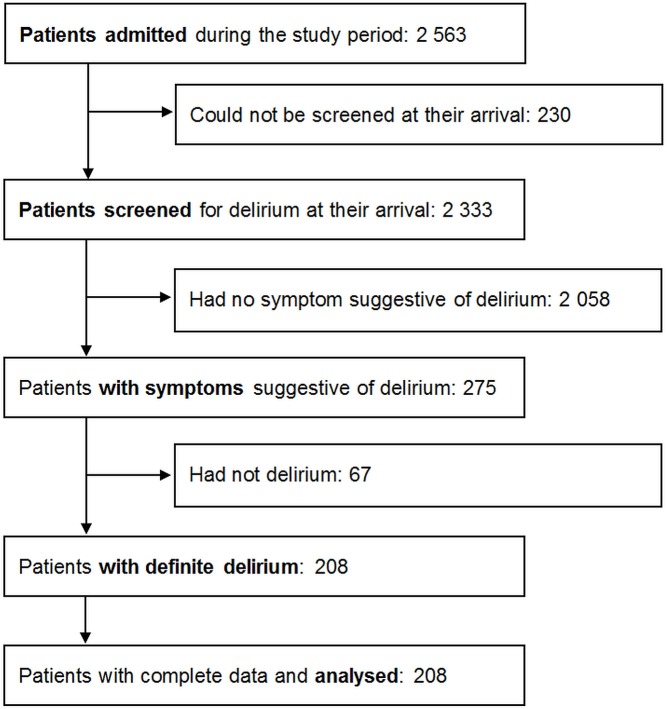
Consecutive community-dwelling individuals admitted to three geriatric acute care units with a confirmed initial diagnosis of delirium were prospectively included. An independent investigator recorded, using a predefined form, any acute medical condition considered by the attending geriatrician to be a precipitating factor, at the first patient assessment and at the end of his stay in acute care.
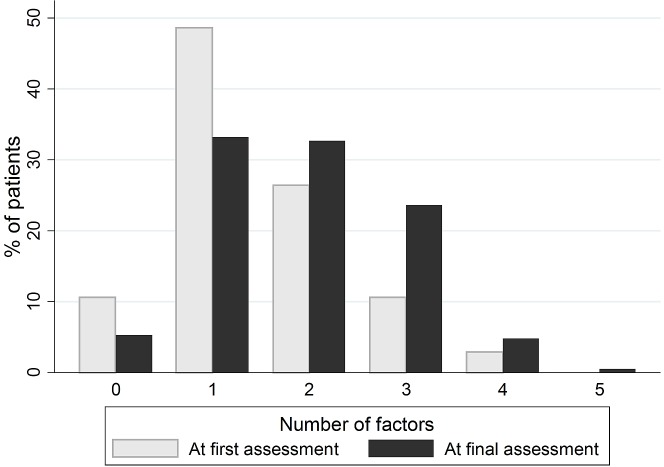
A total of 208 patients were included, 80.0% had a pre-existing cognitive or neurological disorder, or both. The most frequent precipitating factor found were infections (49.0% of all patients, mainly lung and urinary tract infections), followed by drugs (30.8%), dehydration (26.4%) and electrolytic disturbances (18.7%, mostly hyponatremia). 91% of patients had a cerebral imagery, but acute neurological conditions were found in only 18.3%. Fewer precipitating factors were found at first than at final assessment (1.4 (95%CI 1.3-1.6) versus 1.9 (95%CI 1.8-2.0) respectively, p<0.001). This difference was significant for all main categories of precipitating factors.
Infections, followed by drugs and hydro-electrolytic disorders seem to be the most frequent precipitating factors for delirium in community-dwelling elderly individuals. Early diagnostic and management of precipitating factors in these patients should be improved, as a significant number of them are missed at the initial assessment.
社区居住的老年人发生谵妄的相关因素研究较少。我们的目的是描述入住谵妄病房患者的谵妄发生的易患因素和诱发因素的流行情况,并评估这些因素在患者入院的首次评估时是否得到了适当识别。
连续纳入了 3 个老年急性护理病房的 208 例社区居住的、有明确初始谵妄诊断的患者。一名独立研究者使用预定义的表格记录主治老年医生在首次患者评估时和患者在急性护理期间结束时认为是诱发因素的任何急性医学情况。
共纳入 208 例患者,80.0%的患者存在预先存在的认知或神经疾病,或两者兼有。最常见的诱发因素是感染(49.0%的患者,主要是肺部和尿路感染),其次是药物(30.8%)、脱水(26.4%)和电解质紊乱(18.7%,主要是低钠血症)。91%的患者进行了脑部影像学检查,但仅发现 18.3%的急性神经系统疾病。首次评估时发现的诱发因素少于最终评估时(分别为 1.4(95%CI 1.3-1.6)和 1.9(95%CI 1.8-2.0),p<0.001)。所有主要类别的诱发因素均存在这种差异。
感染、其次是药物和水电解质紊乱似乎是社区居住的老年患者发生谵妄的最常见诱发因素。应改进对这些患者的诱发因素的早期诊断和管理,因为在初始评估时,有相当数量的因素被遗漏。