Detweiler Neil D, Vigil Kenneth G, Resta Thomas C, Walker Benjimen R, Jernigan Nikki L
Vascular Physiology Group, Department of Cell Biology and Physiology, University of New Mexico Health Sciences Center, Albuquerque, NM, United States of America.
PLoS One. 2018 Feb 23;13(2):e0192724. doi: 10.1371/journal.pone.0192724. eCollection 2018.
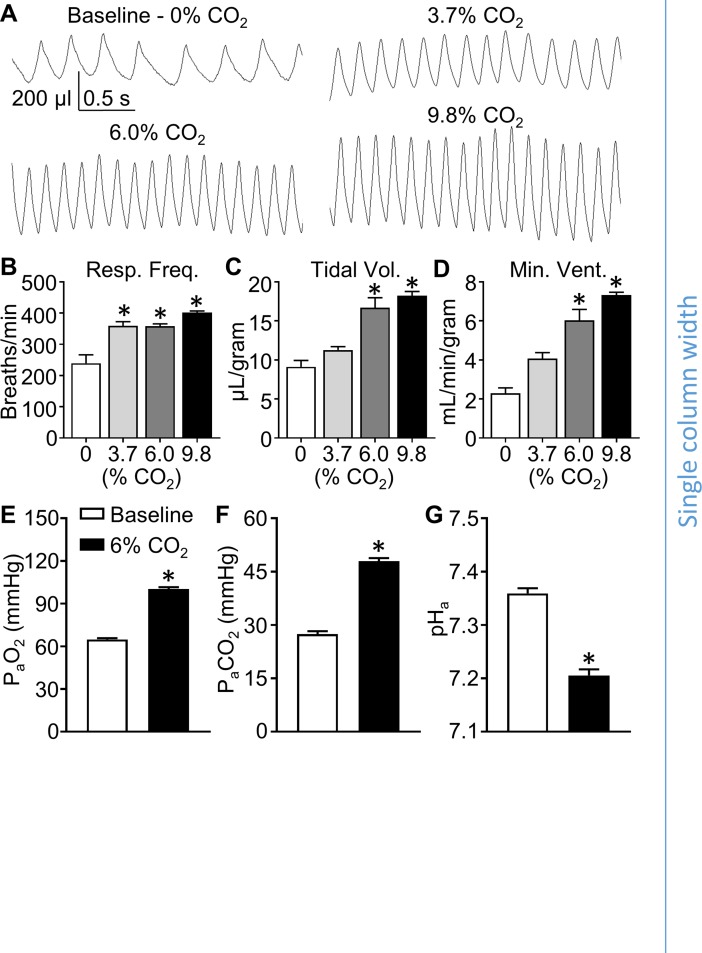
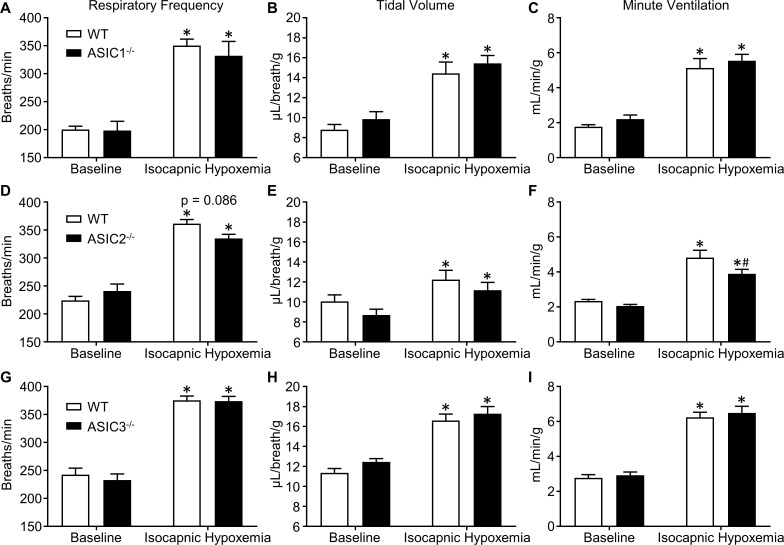
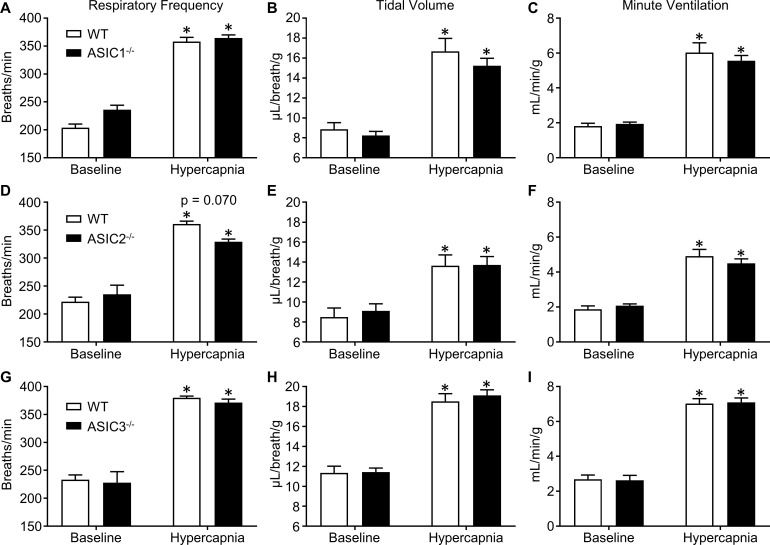
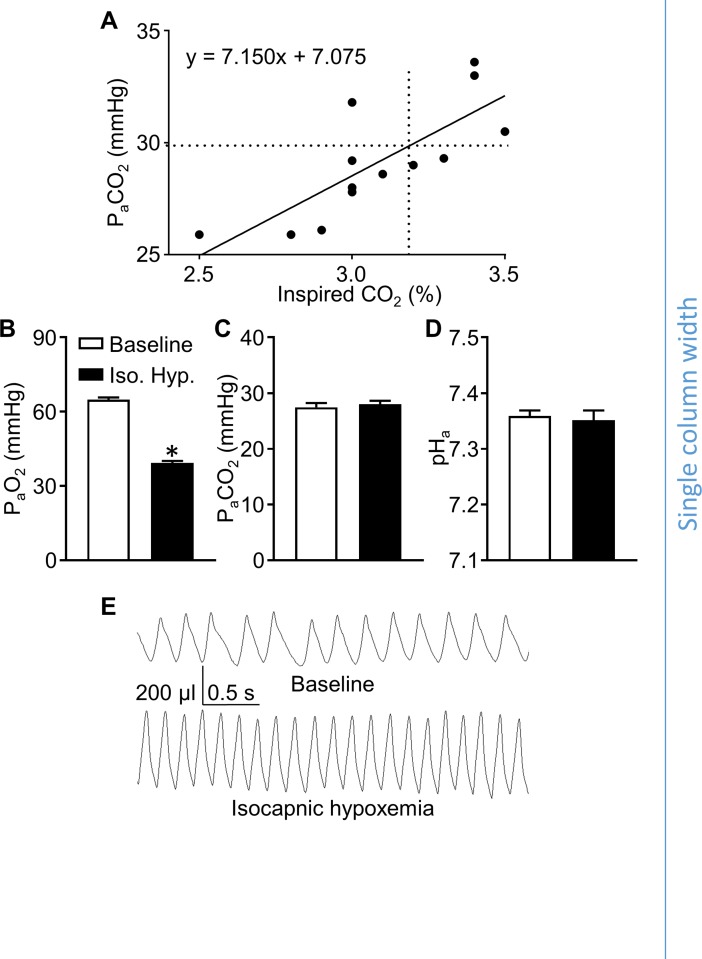
Previous reports indicate roles for acid-sensing ion channels (ASICs) in both peripheral and central chemoreception, but the contributions of ASICs to ventilatory drive in conscious, unrestrained animals remain largely unknown. We tested the hypotheses that ASICs contribute to hypoxic- and hypercapnic-ventilatory responses. Blood samples taken from conscious, unrestrained mice chronically instrumented with femoral artery catheters were used to assess arterial O2, CO2, and pH levels during exposure to inspired gas mixtures designed to cause isocapnic hypoxemia or hypercapnia. Whole-body plethysmography was used to monitor ventilatory parameters in conscious, unrestrained ASIC1, ASIC2, or ASIC3 knockout (-/-) and wild-type (WT) mice at baseline, during isocapnic hypoxemia and during hypercapnia. Hypercapnia increased respiratory frequency, tidal volume, and minute ventilation in all groups of mice, but there were no differences between ASIC1-/-, ASIC2-/-, or ASIC3-/- and WT. Isocapnic hypoxemia also increased respiratory frequency, tidal volume, and minute ventilation in all groups of mice. Minute ventilation in ASIC2-/- mice during isocapnic hypoxemia was significantly lower compared to WT, but there were no differences in the responses to isocapnic hypoxemia between ASIC1-/- or ASIC3-/- compared to WT. Surprisingly, these findings show that loss of individual ASIC subunits does not substantially alter hypercapnic or hypoxic ventilatory responses.
先前的报告表明,酸敏感离子通道(ASICs)在外周和中枢化学感受中均发挥作用,但在清醒、不受束缚的动物中,ASICs对通气驱动的作用仍 largely 未知。我们测试了以下假设:ASICs 对低氧和高碳酸血症通气反应有贡献。从长期植入股动脉导管的清醒、不受束缚的小鼠采集血样,用于评估在暴露于旨在引起等碳酸血症性低氧血症或高碳酸血症的吸入气体混合物期间的动脉氧、二氧化碳和 pH 水平。在基线、等碳酸血症性低氧血症期间和高碳酸血症期间,使用全身体积描记法监测清醒、不受束缚的 ASIC1、ASICs2 或 ASIC3 基因敲除(-/-)和野生型(WT)小鼠的通气参数。高碳酸血症使所有组小鼠的呼吸频率、潮气量和分钟通气量增加,但 ASIC1-/-、ASIC2-/- 或 ASIC3-/- 与 WT 之间没有差异。等碳酸血症性低氧血症也使所有组小鼠的呼吸频率、潮气量和分钟通气量增加。与 WT 相比,ASIC2-/- 小鼠在等碳酸血症性低氧血症期间的分钟通气量显著降低,但与 WT 相比,ASIC1-/- 或 ASIC3-/- 对等碳酸血症性低氧血症的反应没有差异。令人惊讶的是,这些发现表明,单个 ASIC 亚基的缺失并不会显著改变高碳酸血症或低氧血症通气反应。