Departamento de Neuropatología Molecular, División de Neurociencias, Instituto de Fisiología Celular, Universidad Nacional Autónoma de México Mexico City, México.
Programa de Neurociencias, Facultad de Estudios Superiores Iztacala, Universidad Nacional Autónoma de México, Tlalnepantla de Baz, Estado de México, México.
PLoS One. 2018 Feb 23;13(2):e0193490. doi: 10.1371/journal.pone.0193490. eCollection 2018.
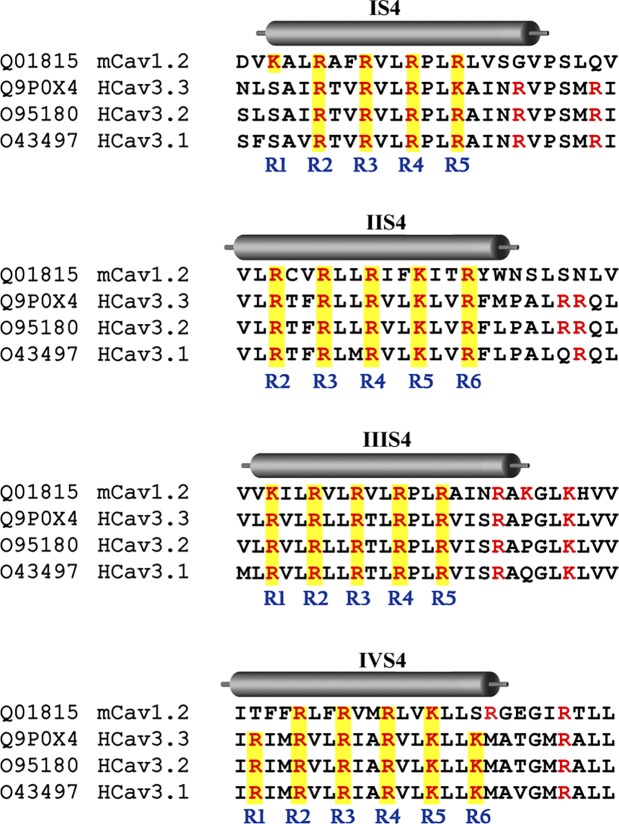
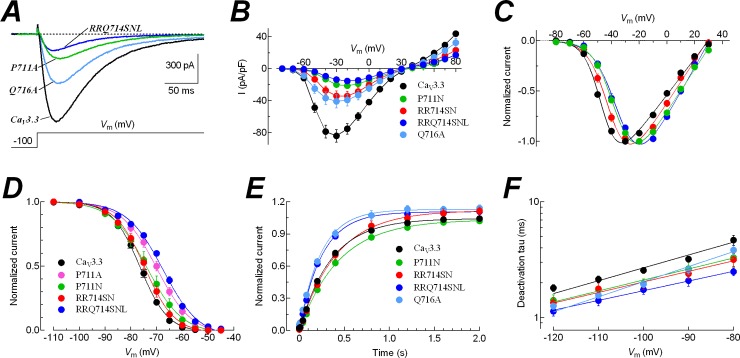
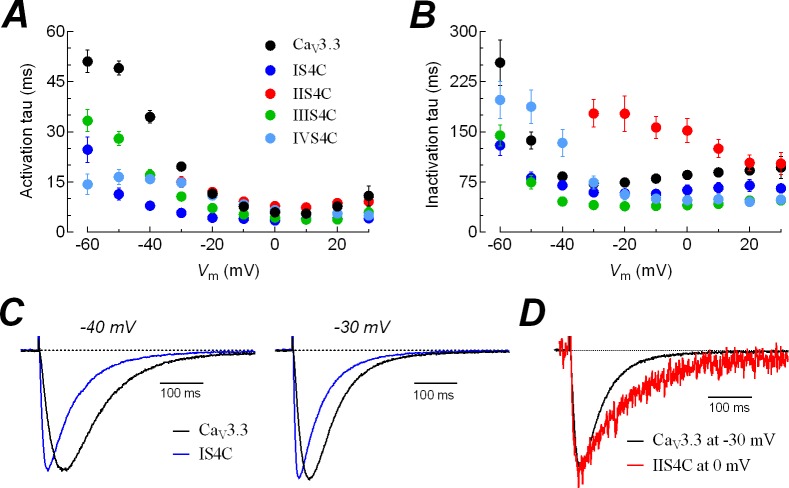
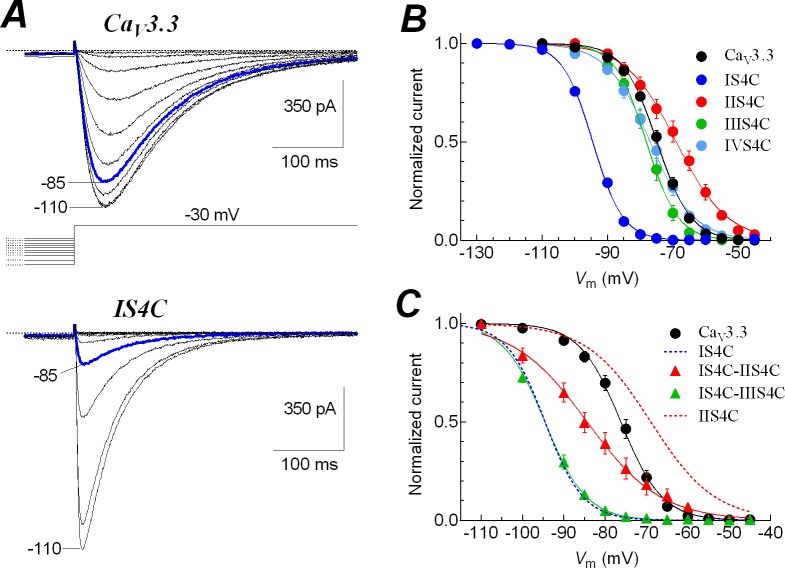
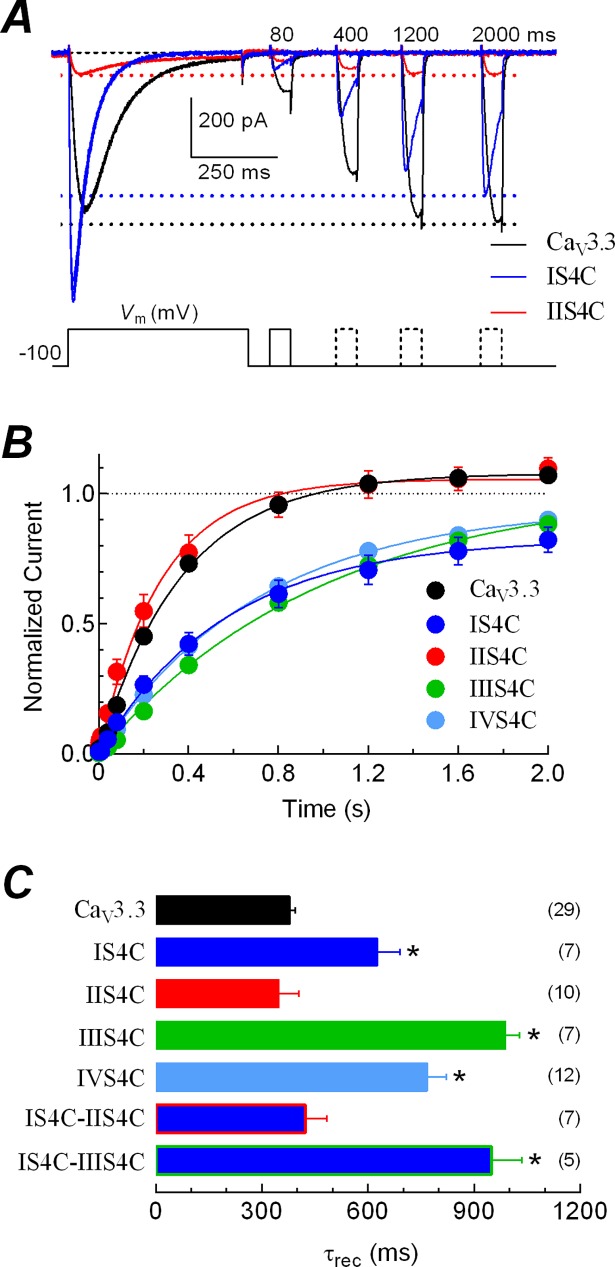
Voltage-gated calcium channels contain four highly conserved transmembrane helices known as S4 segments that exhibit a positively charged residue every third position, and play the role of voltage sensing. Nonetheless, the activation range between high-voltage (HVA) and low-voltage (LVA) activated calcium channels is around 30-40 mV apart, despite the high level of amino acid similarity within their S4 segments. To investigate the contribution of S4 voltage sensors for the low-voltage activation characteristics of CaV3.3 channels we constructed chimeras by swapping S4 segments between this LVA channel and the HVA CaV1.2 channel. The substitution of S4 segment of Domain II in CaV3.3 by that of CaV1.2 (chimera IIS4C) induced a ~35 mV shift in the voltage-dependence of activation towards positive potentials, showing an I-V curve that almost overlaps with that of CaV1.2 channel. This HVA behavior induced by IIS4C chimera was accompanied by a 2-fold decrease in the voltage-dependence of channel gating. The IVS4 segment had also a strong effect in the voltage sensing of activation, while substitution of segments IS4 and IIIS4 moved the activation curve of CaV3.3 to more negative potentials. Swapping of IIS4 voltage sensor influenced additional properties of this channel such as steady-state inactivation, current decay, and deactivation. Notably, Domain I voltage sensor played a major role in preventing CaV3.3 channels to inactivate from closed states at extreme hyperpolarized potentials. Finally, site-directed mutagenesis in the CaV3.3 channel revealed a partial contribution of the S4-S5 linker of Domain II to LVA behavior, with synergic effects observed in double and triple mutations. These findings indicate that IIS4 and, to a lesser degree IVS4, voltage sensors are crucial in determining the LVA properties of CaV3.3 channels, although the accomplishment of this function involves the participation of other structural elements like S4-S5 linkers.
电压门控钙通道包含四个高度保守的跨膜螺旋,称为 S4 片段,其每三个位置都有一个带正电荷的残基,起到电压感应的作用。尽管 S4 片段内的氨基酸相似度很高,但高电压(HVA)和低电压(LVA)激活钙通道的激活范围相差约 30-40 mV。为了研究 S4 电压传感器对 CaV3.3 通道低电压激活特性的贡献,我们通过在该 LVA 通道和 HVA CaV1.2 通道之间交换 S4 片段构建嵌合体。用 CaV1.2 的 S4 片段( chimera IIS4C)取代 CaV3.3 的 S4 片段( chimera IIS4C),使激活的电压依赖性向正电位移动约 35 mV,表明 I-V 曲线几乎与 CaV1.2 通道重叠。这种由 IIS4C 嵌合体诱导的 HVA 行为伴随着通道门控的电压依赖性降低 2 倍。IVS4 片段对激活的电压感应也有很强的影响,而 IS4 和 IIIIS4 片段的取代则使 CaV3.3 的激活曲线向更负的电位移动。IIS4 电压传感器的交换也影响了该通道的其他特性,如稳态失活、电流衰减和去激活。值得注意的是,域 I 电压传感器在防止 CaV3.3 通道在极端超极化电位下从关闭状态失活方面发挥了主要作用。最后,在 CaV3.3 通道中的定点突变显示了域 II 的 S4-S5 连接对 LVA 行为的部分贡献,并且在双突变和三突变中观察到协同效应。这些发现表明 IIS4 以及在较小程度上 IVS4 电压传感器对于确定 CaV3.3 通道的 LVA 特性至关重要,尽管完成此功能涉及其他结构元件的参与,如 S4-S5 连接。