Department of Genetics and Animal Breeding, Poznan University of Life Sciences, Wolynska 33, Poznan, Poland.
Institute of Human Nutrition and Dietetics, Poznan University of Life Sciences, Wojska Polskiego 31, Poznan, Poland.
PLoS One. 2018 Feb 23;13(2):e0193464. doi: 10.1371/journal.pone.0193464. eCollection 2018.
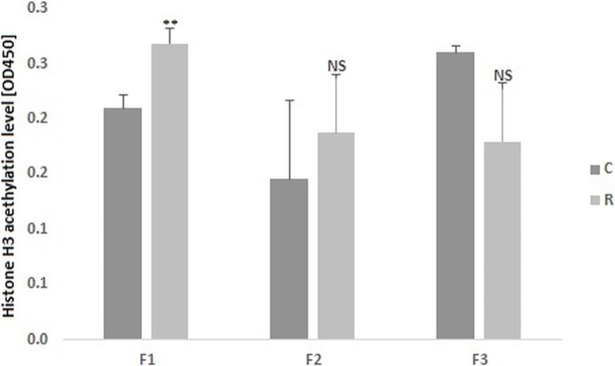
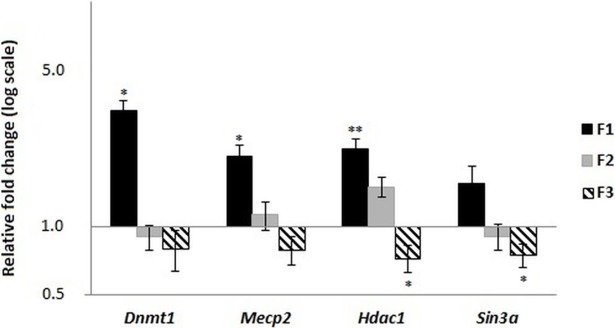
Dietary triggers acting on a developing fetus can affect the functioning of the body in later life; this can be observed on various levels, including epigenetic modifications and gene expression. Early-life programmed changes may be transmitted to successive generations. In this study, the impact of prenatal restricted diet was studied in four generations of rats. We hypothesized that this diet can induce changes in the expression of major genes involved in two epigenetic mechanisms: DNA methylation and histone modifications. The transcript level of six genes involved in these processes (Dnmt1, Dnmt3a, Dnmt3b, Mecp2, Hdac1, and Sin3a) was therefore determined in three tissues (liver, adipose, and muscle). This diet was found to have no effect on the F0 pregnant females. In the F1 progeny (fetuses at day 19 of pregnancy and 4-week-old rats) significant differences in the expression of the genes were observed mostly in the liver; in subsequent generations, we therefore studied only this tissue. Among the genes encoding DNA methyltransferases, significant changes were observed for Dnmt1 in the F1 animals from the restricted group, but these were no longer evident in F2 and F3. The Dnmt3a and Dnmt3b genes showed no differences in mRNA level in F1 fetuses. Concerning the transcript level of the Mecp2 gene only in F1 generation significant changes were found. For the histone modification genes, an increase in the expression of Hdac1 in fetus liver was found in F1 and F2, while its level decreased in F3. The abundance of the Sin3a transcript varied in all generations. It was also found that the mRNA levels of the studied genes correlated highly positive with each other, but only in fetuses from the F1 restricted group. The DNA methylation cell potential, defined as the ratio of SAM (S-adenosylmethionine) to SAH (S-adenosylhomocysteine), was measured in the liver, with no alterations being found in the restricted groups. Evaluation of global histone H3 acetylation showed that it underwent a significant increase in the fetal livers of F1, while during aging (four-week old animals) this difference was no longer maintained. A tendency of increased H3 acetylation in fetuses was also detected in F2 generation. In F1 fetuses from restricted group the increased H3 acetylation positively correlated with transcriptional status of the studied genes. Our results indicate that the prenatal restriction diet can affect the activity of genes involved in epigenetic mechanisms in the liver across generations. Moreover, this feeding type influenced the global histone H3 acetylation in fetal liver.
作用于发育中胎儿的饮食诱因会影响其日后的身体机能;这种影响可以在多个层面观察到,包括表观遗传修饰和基因表达。早期生活编程的变化可能会传递给后代。在这项研究中,研究人员研究了四代限制饮食的大鼠。我们假设这种饮食可以诱导与两种表观遗传机制(DNA 甲基化和组蛋白修饰)相关的主要基因表达的变化。因此,在三个组织(肝脏、脂肪和肌肉)中测定了六个参与这些过程的基因(Dnmt1、Dnmt3a、Dnmt3b、Mecp2、Hdac1 和 Sin3a)的转录水平。研究发现,这种饮食对 F0 怀孕母体没有影响。在 F1 后代(妊娠第 19 天的胎儿和 4 周龄大鼠)中,主要在肝脏中观察到基因表达的显著差异;因此,在随后的几代中,我们只研究了这个组织。在编码 DNA 甲基转移酶的基因中,限制组的 F1 动物中的 Dnmt1 发生了显著变化,但在 F2 和 F3 中不再明显。在 F1 胎儿中,Dnmt3a 和 Dnmt3b 基因的 mRNA 水平没有差异。仅在 F1 代中发现了 Mecp2 基因的转录水平的显著变化。对于组蛋白修饰基因,在 F1 和 F2 中发现胎儿肝脏中 Hdac1 的表达增加,而在 F3 中其水平降低。在所有世代中,Sin3a 转录物的丰度都有所不同。还发现,在所研究的基因的 mRNA 水平之间高度正相关,但仅在限制组的胎儿中。在肝脏中测量了 DNA 甲基化细胞潜能,定义为 SAM(S-腺苷甲硫氨酸)与 SAH(S-腺苷同型半胱氨酸)的比值,在限制组中未发现改变。对全局组蛋白 H3 乙酰化的评估表明,它在 F1 胎儿肝脏中显著增加,而在衰老(4 周龄动物)时,这种差异不再维持。在 F2 代胎儿中也检测到组蛋白 H3 乙酰化增加的趋势。在限制组的 F1 胎儿中,增加的组蛋白 H3 乙酰化与所研究基因的转录状态呈正相关。我们的结果表明,产前限制饮食可以影响跨代肝脏中参与表观遗传机制的基因的活性。此外,这种喂养类型还影响胎儿肝脏中的全局组蛋白 H3 乙酰化。