Center for Neurodegenerative Science, Van Andel Research Institute, 333 Bostwick Ave. NE, Grand Rapids, MI, 49503, USA.
Cell Tissue Res. 2018 Jul;373(1):161-173. doi: 10.1007/s00441-018-2814-1. Epub 2018 Feb 26.
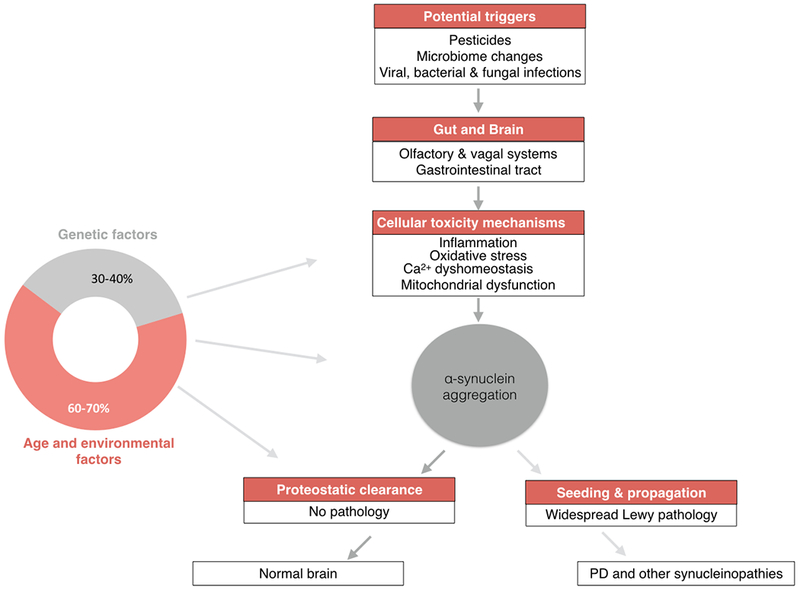
Parkinson's disease is characterized by the loss of nigrostriatal dopaminergic signaling and the presence of alpha-synuclein aggregates (also called Lewy bodies and neurites) throughout the brain. In 2003, Braak and colleagues created a staging system for Parkinson's disease describing the connection between the alpha-synuclein pathology and disease severity. Later, they suggested that the pathology might initially be triggered by exogenous insults targeting the gut and olfactory system. In 2008, we and other groups documented Lewy pathology in grafted neurons in people with Parkinson's disease who had been transplanted over a decade prior to autopsy. We proposed that the Lewy pathology in the grafted neurons was the result of permissive templating or prion-like spread of alpha-synuclein pathology from neurons in the host to those in the grafts. During the following ten years, several studies described the transmission of alpha-synuclein pathology between neurons, both in cell culture and in experimental animals. Recent research has also begun to identify underlying molecular mechanisms. Collectively, these experimental studies tentatively support the idea that the progression from one Braak stage to the next is the consequence of prion-like propagation of Lewy pathology. However, definitive proof that intercellular propagation of alpha-synuclein pathology occurs in Parkinson's disease cases has proven difficult to secure. In this review, we highlight several open questions that currently prevent us from concluding with certainty that prion-like transfer of alpha-synuclein contributes to the progression of Parkinson's disease.
帕金森病的特征是黑质纹状体多巴胺能信号的丧失,以及大脑中存在α-突触核蛋白聚集物(也称为路易体和神经原纤维)。2003 年,Braak 及其同事创建了一个帕金森病分期系统,描述了α-突触核蛋白病理学与疾病严重程度之间的联系。后来,他们提出该病理学可能最初是由针对肠道和嗅觉系统的外源侵袭引发的。2008 年,我们和其他小组在接受移植 10 多年后进行尸检的帕金森病患者的移植神经元中记录到了路易体病理学。我们提出,移植神经元中的路易体病理学是由于宿主神经元中的α-突触核蛋白病理学通过允许模板或类朊病毒样传播到移植神经元中而产生的。在接下来的十年中,几项研究描述了α-突触核蛋白病理学在神经元之间的传递,无论是在细胞培养还是在实验动物中。最近的研究也开始识别潜在的分子机制。这些实验研究共同表明,从一个 Braak 阶段到下一个阶段的进展是类朊病毒样传播路易体病理学的结果。然而,确定细胞间α-突触核蛋白病理学传播发生在帕金森病病例中已被证明具有挑战性。在这篇综述中,我们强调了几个目前阻止我们确定类朊病毒样转移的α-突触核蛋白对帕金森病进展有贡献的悬而未决的问题。