Molendijk Marlieke, Hazes Johanna Mw, Lubberts Erik
Department of Rheumatology, Erasmus MC, University Medical Center, Rotterdam, The Netherlands.
RMD Open. 2018 Jan 12;4(1):e000256. doi: 10.1136/rmdopen-2016-000256. eCollection 2018.
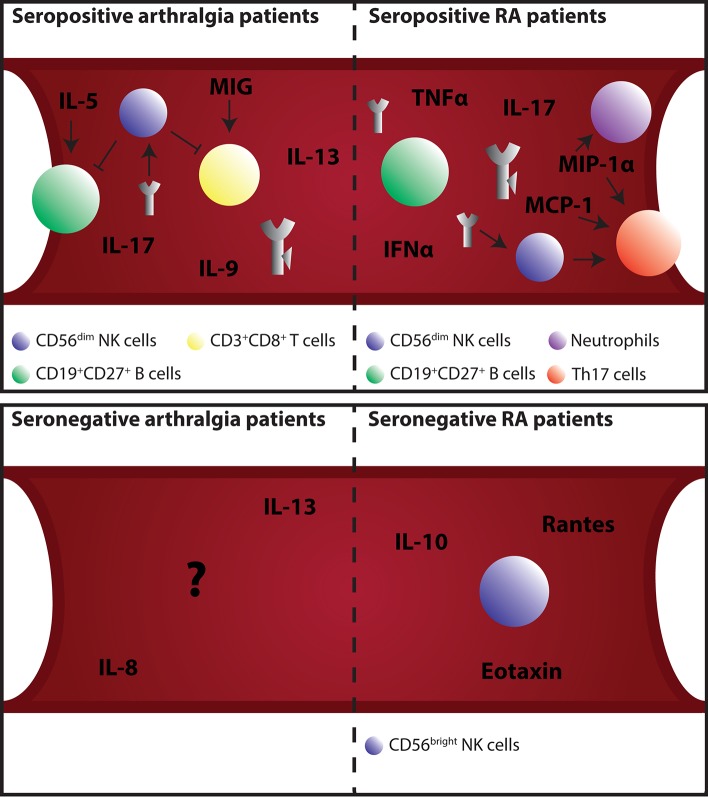
It is believed that therapy for rheumatoid arthritis (RA) is the most effective and beneficial within a short time frame around RA diagnosis. This insight has caused a shift from research in patients with established RA to patients at risk of developing RA and recently diagnosed patients. It is important for improvement of RA therapy to understand when and what changes occur in patients developing RA. This is true for both seropositive and seronegative patients. Activation of the immune system as presented by autoantibodies, increased cytokine and chemokine production, and alterations within several immune cells occur during RA development. In this review we describe RA pathogenesis with a focus on knowledge obtained from patients with arthralgia, pre-RA and recently diagnosed RA. Connections are proposed between altered immune cells, cytokines and chemokines, and events like synovial hyperplasia, pain and bone damage.
人们认为,类风湿性关节炎(RA)的治疗在RA诊断后的短时间内最为有效且有益。这一见解已导致研究重点从已确诊的RA患者转向有患RA风险的患者以及最近确诊的患者。了解RA患者何时以及发生了哪些变化对于改善RA治疗很重要。这对于血清阳性和血清阴性患者均适用。在RA发展过程中会出现自身抗体所呈现的免疫系统激活、细胞因子和趋化因子产生增加以及几种免疫细胞内的改变。在本综述中,我们描述RA的发病机制,重点关注从关节痛患者、RA前期患者和最近确诊的RA患者中获得的知识。我们提出了免疫细胞、细胞因子和趋化因子的改变与滑膜增生、疼痛和骨损伤等事件之间的联系。