Radovic Ana, Gmelin Theresa, Hua Jing, Long Cassandra, Stein Bradley D, Miller Elizabeth
Department of Pediatrics, Children's Hospital of Pittsburgh of UPMC, University of Pittsburgh School of Medicine, Pittsburgh, PA, United States.
Graduate School of Public Health, University of Pittsburgh, Pittsburgh, PA, United States.
JMIR Ment Health. 2018 Feb 26;5(1):e17. doi: 10.2196/mental.9441.
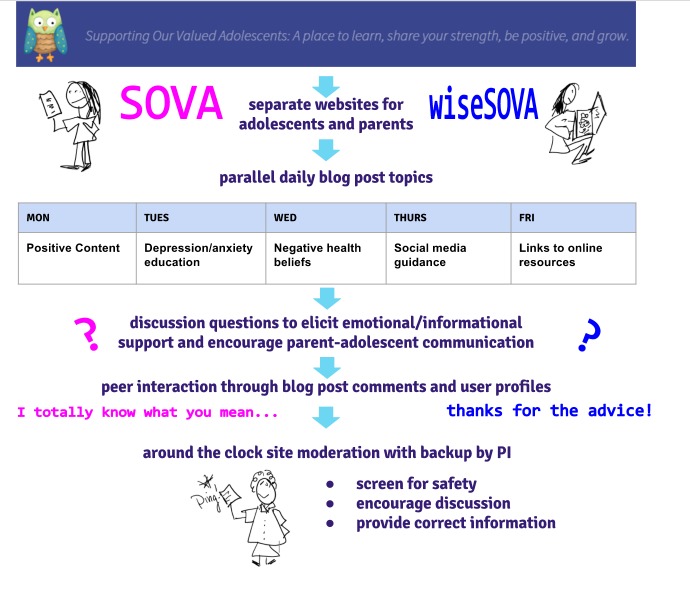
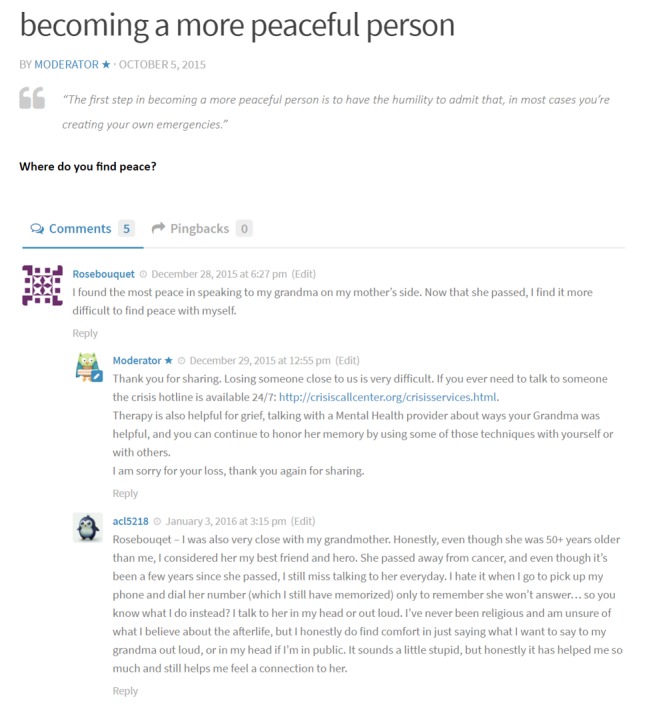
Supporting Our Valued Adolescents (SOVA), a social media website for adolescents, was designed to increase mental health literacy and address negative health beliefs toward depression and/or anxiety diagnosis and treatment. This stakeholder-informed site underwent iterative user testing to evolve into its current version with daily blog posts, round-the-clock site moderation, and Web-based peer interaction to create an online support community.
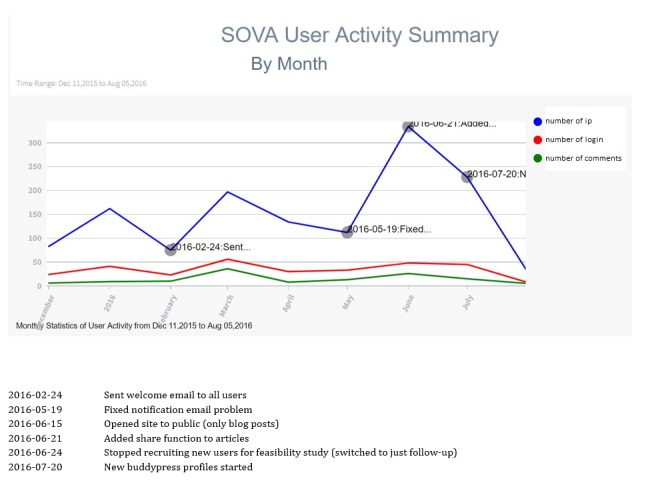
The aim of this study was to evaluate the technological feasibility (at least 100 users on the site, logging in 12 to 18 times in the first 6 weeks) and acceptability of the SOVA site determined by the System Usability Scale (SUS).
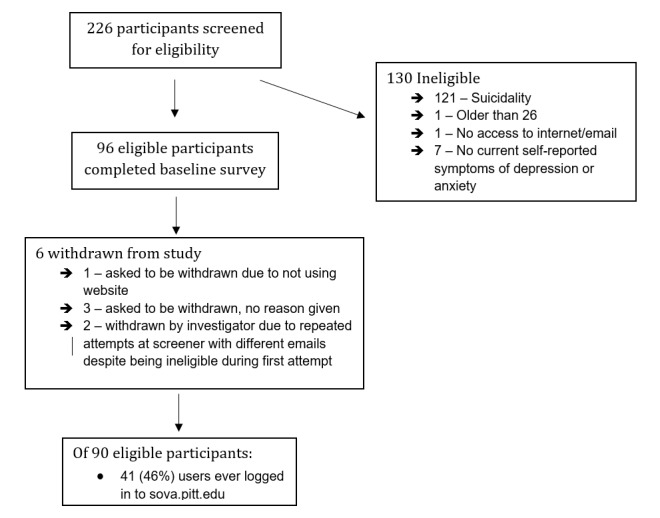
Adolescents and young adults (aged 14-26 years) with a self-reported history of depressive and/or anxiety symptoms were recruited to access the research website (sova.pitt.edu). Participants were screened out if they reported active suicidality or a prior suicide attempt. Baseline survey measures included demographics, symptomatology using the Patient Health Questionnaire-9 modified for adolescents (PHQ-9A) and Screen for Child Anxiety Related Disorders (SCARED-C), and mental health treatment history. The 6-week follow-up measures taken in addition to the symptomatology, included feasibility (total number of log-ins), usability, and acceptability of SOVA using SUS.
Most of the 96 participants identified as female (75% [72/96]) and white (67% [64/96]). Most participants (73% [70/96]) reported having taken prior professional psychological help. The average PHQ-9A score was 11.8 (SD 5.5), and for SCARED-C, 85% (80/94) of the participants reported a score consistent with being susceptible to a diagnosed anxiety disorder. There were 46% (41/90) of eligible users who ever logged in. Out of the total users who ever logged in, the mean of total log-ins over the entire study was 4.1 (SD 6.9). Median number of users rated the user-friendliness of the site as "good." The average SUS score was 71.2% (SD 18.7), or a "C-grade," which correlated to an acceptable range. The participants reported to have liked the "easy-to-understand format" and "positive, helpful atmosphere," but they also reported a desire for greater social interaction. Iterative recruitment resulted in incremental improvements to the site.
The SOVA site met feasibility goals of recruiting almost 100 users and establishing acceptable usability. Subsequent interventions are planned to increase site engagement and to evaluate efficacy in increasing uptake of primary care-recommended depression and/or anxiety treatment.
“支持我们珍贵的青少年”(SOVA)是一个面向青少年的社交媒体网站,旨在提高心理健康素养,并解决对抑郁症和/或焦虑症诊断与治疗的负面健康观念。这个由利益相关者提供信息的网站经过了反复的用户测试,发展成了当前版本,有每日博客文章、全天候的网站管理以及基于网络的同伴互动,以创建一个在线支持社区。
本研究的目的是评估SOVA网站的技术可行性(前6周至少有100名用户登录该网站,登录12至18次)以及由系统可用性量表(SUS)确定的该网站的可接受性。
招募有自我报告的抑郁和/或焦虑症状病史的青少年和青年(年龄在14 - 26岁之间)访问研究网站(sova.pitt.edu)。如果参与者报告有当前自杀倾向或既往自杀未遂史,则将其排除。基线调查措施包括人口统计学信息、使用针对青少年修改的患者健康问卷9(PHQ - 9A)和儿童焦虑相关障碍筛查量表(SCARED - C)进行的症状评估,以及心理健康治疗史。除症状评估外,6周随访措施还包括可行性(登录总数)、SOVA的可用性以及使用SUS进行的可接受性评估。
96名参与者中大多数为女性(75%[72/96])且为白人(67%[64/96])。大多数参与者(73%[70/96])报告曾接受过专业心理帮助。PHQ - 9A的平均得分为11.8(标准差5.5),对于SCARED - C,85%(80/94)的参与者报告得分与易患诊断为焦虑症相符。有46%(41/90)的符合条件用户曾登录过。在所有曾登录的用户中,整个研究期间登录总数的平均值为4.1(标准差6.9)。将网站用户友好性评为“良好”的用户数量中位数。SUS的平均得分为71.2%(标准差18.7),即“C级”,这与可接受范围相关。参与者报告喜欢“易于理解的格式”和“积极、有益的氛围”,但他们也表示希望有更多的社交互动。反复招募导致网站逐步改进。
SOVA网站达到了招募近100名用户并建立可接受可用性的可行性目标。计划随后进行干预以增加网站参与度,并评估在增加初级保健推荐的抑郁症和/或焦虑症治疗采用率方面的效果。