Exner-Cortens Deinera, Baker Elizabeth, Gray Shawna, Fernandez Conde Cristina, Rivera Rocio Ramirez, Van Bavel Marisa, Vezina Elisabeth, Ambrose Aleta, Pawluk Chris, Schwartz Kelly D, Arnold Paul D
Department of Psychology, University of Calgary, Calgary, AB, Canada.
Werklund School of Education, University of Calgary, Calgary, AB, Canada.
JMIR Ment Health. 2021 Sep 21;8(9):e29454. doi: 10.2196/29454.
Suicide is a leading cause of death among youth and a prominent concern for school mental health providers. Indeed, schools play a key role in suicide prevention, including participating in risk assessments with students expressing suicidal ideation. In the context of the COVID-19 pandemic, many schools now need to offer mental health services, including suicide risk assessment, via eHealth platforms. Post pandemic, the use of eHealth risk assessments will support more accessible services for youth living in rural and remote areas. However, as the remote environment is a new context for many schools, guidance is needed on best practices for eHealth suicide risk assessment among youth.
This study aims to conduct a rapid, systematic scoping review to explore promising practices for conducting school-based suicide risk assessment among youth via eHealth (ie, information technologies that allow for remote communication).
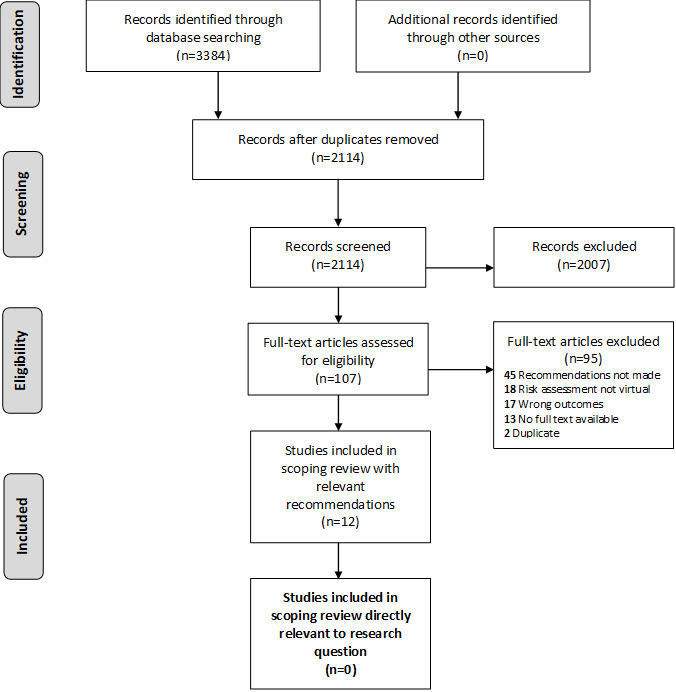
This review included peer-reviewed articles and gray literature published in English between 2000 and 2020. Although we did not find studies that specifically explored promising practices for school-based suicide risk assessment among youth via eHealth platforms, we found 12 peer-reviewed articles and 23 gray literature documents that contained relevant information addressing our broader study purpose; thus, these 35 sources were included in this review.
We identified five key recommendation themes for school-based suicide risk assessment among youth via eHealth platforms in the 12 peer-reviewed studies. These included accessibility, consent procedures, session logistics, safety planning, and internet privacy. Specific recommendation themes from the 23 gray literature documents substantially overlapped with and enhanced three of the themes identified in the peer-reviewed literature-consent procedures, session logistics, and safety planning. In addition, based on findings from the gray literature, we expanded the accessibility theme to a broader theme termed youth engagement, which included information on accessibility and building rapport, establishing a therapeutic space, and helping youth prepare for remote sessions. Finally, a new theme was identified in the gray literature findings, specifically concerning school mental health professional boundaries. A second key difference between the gray and peer-reviewed literature was the former's focus on issues of equity and access and how technology can reinforce existing inequalities.
For school mental health providers in need of guidance, we believe that these six recommendation themes (ie, youth engagement, school mental health professional boundaries, consent procedures, session logistics, safety planning, and internet privacy) represent the most promising directions for school-based suicide risk assessment among youth using eHealth tools. However, suicide risk assessment among youth via eHealth platforms in school settings represents a critical research gap. On the basis of the findings of this review, we provide specific recommendations for future research, including the need to focus on the needs of diverse youth.
自杀是青少年死亡的主要原因,也是学校心理健康服务提供者极为关注的问题。事实上,学校在预防自杀方面发挥着关键作用,包括对有自杀意念的学生进行风险评估。在新冠疫情背景下,许多学校现在需要通过电子健康平台提供心理健康服务,包括自杀风险评估。疫情过后,使用电子健康风险评估将为农村和偏远地区的青少年提供更易获得的服务。然而,由于远程环境对许多学校来说是新情况,因此需要有关青少年电子健康自杀风险评估最佳实践的指导。
本研究旨在进行快速、系统的范围综述,以探索通过电子健康(即允许远程通信的信息技术)对青少年进行基于学校的自杀风险评估的有前景的做法。
本综述纳入了2000年至2020年间以英文发表的同行评审文章和灰色文献。虽然我们没有找到专门探索通过电子健康平台对青少年进行基于学校的自杀风险评估的有前景做法的研究,但我们找到了12篇同行评审文章和23份灰色文献文件,其中包含了与我们更广泛的研究目的相关的信息;因此,这35个来源被纳入了本综述。
我们在12篇同行评审研究中确定了通过电子健康平台对青少年进行基于学校的自杀风险评估的五个关键建议主题。这些主题包括可及性、同意程序、会话安排、安全规划和网络隐私。23份灰色文献文件中的具体建议主题与同行评审文献中确定的三个主题——同意程序、会话安排和安全规划——有很大重叠并对其进行了补充。此外,根据灰色文献的研究结果,我们将可及性主题扩展为一个更广泛的主题,称为青少年参与,其中包括有关可及性和建立融洽关系、建立治疗空间以及帮助青少年为远程会话做准备的信息。最后,在灰色文献研究结果中确定了一个新主题,特别涉及学校心理健康专业人员的界限。灰色文献和同行评审文献之间的第二个关键区别在于,前者关注公平和可及性问题以及技术如何强化现有的不平等。
对于需要指导的学校心理健康服务提供者,我们认为这六个建议主题(即青少年参与、学校心理健康专业人员的界限、同意程序、会话安排、安全规划和网络隐私)代表了使用电子健康工具对青少年进行基于学校的自杀风险评估最有前景的方向。然而,在学校环境中通过电子健康平台对青少年进行自杀风险评估是一个关键的研究空白。基于本综述的结果,我们为未来的研究提供了具体建议,包括需要关注不同青少年的需求。