Wang Yanmao, Dai Jiezhi, Zhu Yu, Zhong Wanrun, Lu Shengdi, Chen Hua, Chai Yimin
Department of Orthopedic Surgery, Shanghai Jiao Tong University Affiliated Sixth People's Hospital, Shanghai 200233, PR China.
Oncotarget. 2017 Dec 27;9(7):7372-7388. doi: 10.18632/oncotarget.23677. eCollection 2018 Jan 26.
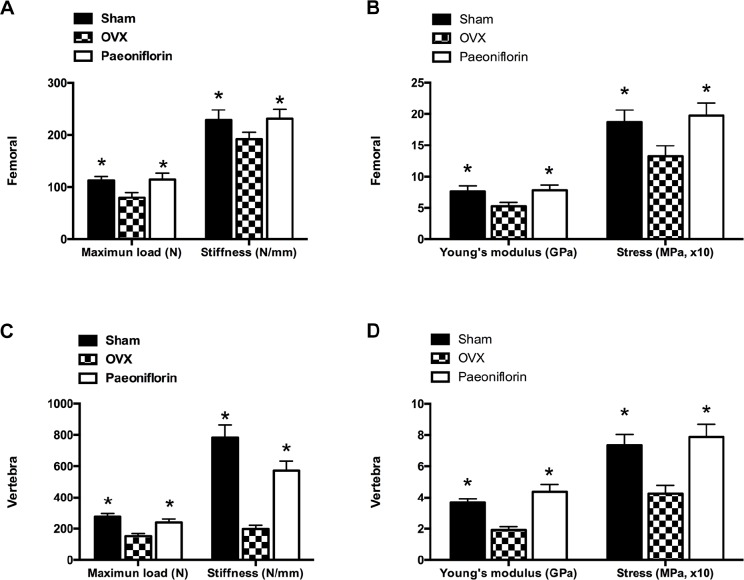
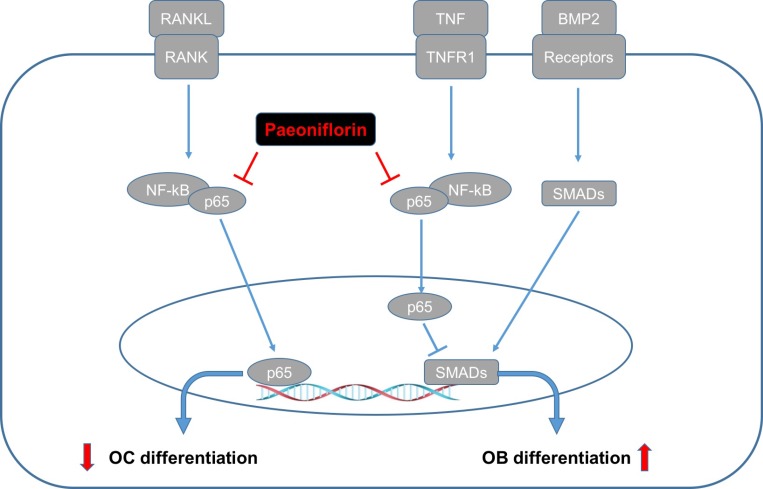
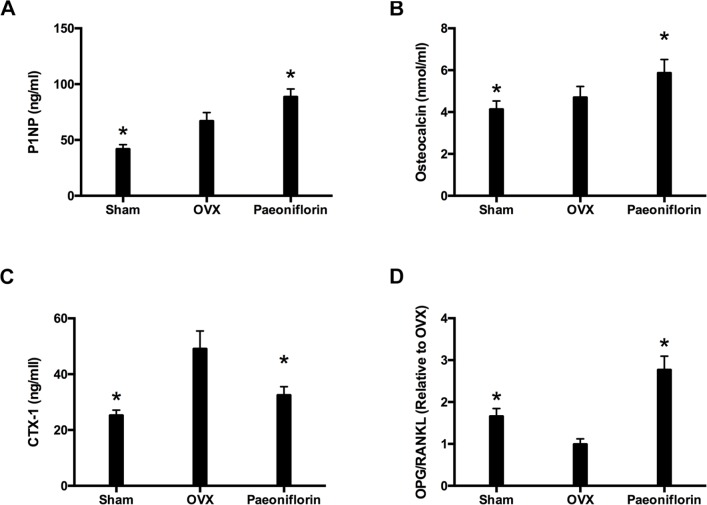
The metabolic balance between synthesis and resorption of the bone is maintained by osteoblasts and osteoclasts, respectively. Identification of agents that stimulate bone formation and suppress excessive osteoclast formation, may aid in preventing and treating conditions like osteoporosis and periprosthetic loosening. Paeoniflorin is a natural product derived from Pall with anti-inflammatory, analgesic, and diuretic properties. However, the effect of paeoniflorin on osteoclastogenesis and osteoblastogenesis is unknown. Herein, we demonstrated that paeoniflorin has a dose-dependent suppressive action on RANKL-evoked osteoclast differentiation and bone resorption, achieved by inhibiting the NF-κB pathway and subunit p65 nuclear translocation. Simultaneously, paeoniflorin was also found to stimulate osteoblast differentiation and bone mineralization, in addition to rescuing TNFα-impaired osteoblastogenesis. At the molecular level, paeoniflorin was found to inhibit NF-κB transcriptional activity and stimulate osteoblastogenesis-related marker gene expression (ALP, osteocalcin, OPN and Runx2), a trend that was inhibited by p65 overexpression. In ovariectomized mice, paeoniflorin was found to improve osteoblast activity, inhibit osteoclast activity, and thus, reduce ovariectomy-induced osteoporosis. Our study demonstrated that paeoniflorin simultaneously suppressed osteoclastogenesis and facilitated osteoblastogenesis by manipulating the actions of NF-κB. Therefore, paeoniflorin may serve as an ideal therapeutic antidote for osteoporosis.
骨的合成与重吸收之间的代谢平衡分别由成骨细胞和破骨细胞维持。鉴定能够刺激骨形成并抑制过度破骨细胞形成的药物,可能有助于预防和治疗骨质疏松症和假体周围松动等病症。芍药苷是一种从芍药中提取的天然产物,具有抗炎、镇痛和利尿特性。然而,芍药苷对破骨细胞生成和成骨细胞生成的影响尚不清楚。在此,我们证明芍药苷对RANKL诱导的破骨细胞分化和骨吸收具有剂量依赖性抑制作用,这是通过抑制NF-κB途径和亚基p65核转位实现的。同时,除了挽救TNFα受损的成骨细胞生成外,还发现芍药苷能刺激成骨细胞分化和骨矿化。在分子水平上,发现芍药苷抑制NF-κB转录活性并刺激成骨细胞生成相关标记基因表达(碱性磷酸酶、骨钙素、骨桥蛋白和Runx2),p65过表达抑制了这一趋势。在去卵巢小鼠中,发现芍药苷能改善成骨细胞活性,抑制破骨细胞活性,从而减轻去卵巢诱导的骨质疏松症。我们的研究表明,芍药苷通过操纵NF-κB的作用同时抑制破骨细胞生成并促进成骨细胞生成。因此,芍药苷可能是治疗骨质疏松症的理想药物。