Jiang Qi, Xie Mixue, He Mengye, Yan Feifei, Zhang Xiaochen, Yu Sufen
Department of Medical Oncology, The First Affiliated Hospital, College of Medicine, Zhejiang University, Hangzhou, Zhejiang Province, 310003, China.
Senior Department of Haematology, The First Affiliated Hospital, College of Medicine, Zhejiang University, Hangzhou, Zhejiang Province, 310003, China.
Oncotarget. 2017 Dec 21;9(7):7672-7683. doi: 10.18632/oncotarget.23584. eCollection 2018 Jan 26.
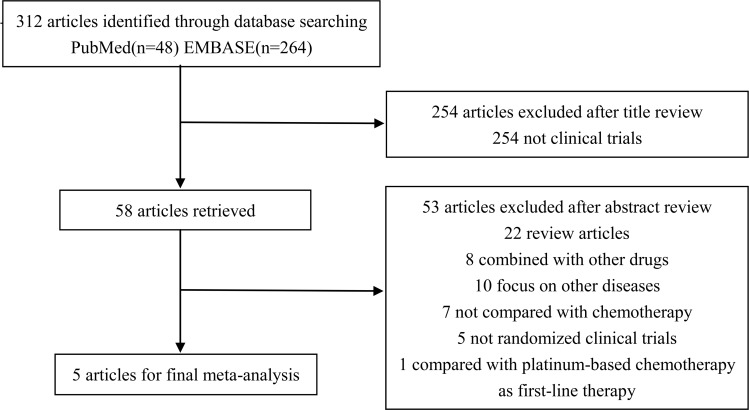
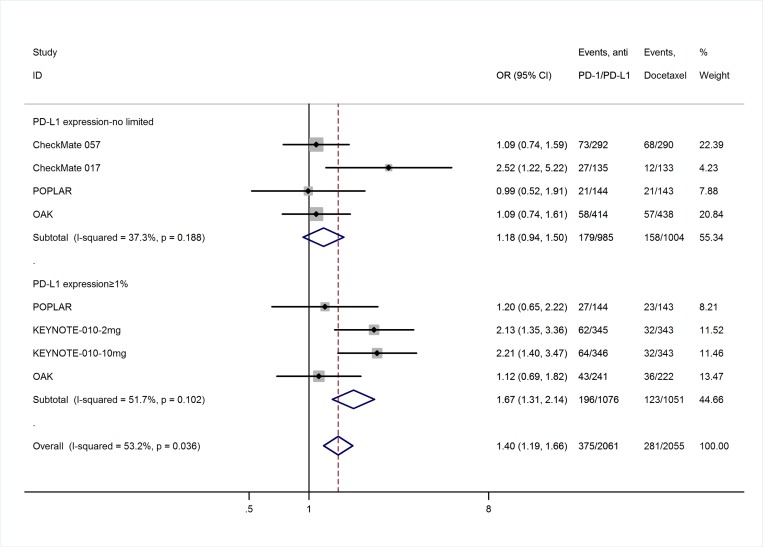
Anti-PD-1/PD-L1 antibodies have been proved one of the most promising treatments against non-small cell lung cancer (NSCLC); however, whether anti-PD-1/PD-L1 antibodies can provide added benefits for pretreated patients with advanced NSCLC and which patients are most likely to benefit from anti-PD-1/PD-L1 therapy remain controversial. This meta-analysis evaluated the efficacy and safety between anti-PD-1/PD-L1 antibodies and docetaxel in previously treated, advanced NSCLC. PubMed, EMBASE and Cochrane library databases were systematically searched for eligible studies. Five studies with a total of 3,025 patients were included. Our results showed that, for all patients, anti-PD-1/PD-L1 therapy prolonged overall survival (OS) (hazard ratio [HR] = 0.69; 95% CI, 0.63-0.75) and progression-free survival (PFS) (HR = 0.87; 95% CI, 0.80-0.94). For patients with PD-L1 expression ≥1%, anti-PD-1/PD-L1 therapy had higher objective response rates. In subgroup analysis according to the tumor PD-L1 expression level, anti-PD-1/PD-L1 therapy was associated with longer OS and PFS in patients with high PD-L1 expression (≥1%, ≥5%, ≥10% and ≥50%), but not in those with low expressions. In subgroup analysis of patients' characteristics, anti-PD-1/PD-L1 antibodies showed OS benefits across most prespecified subgroups, except for patients with mutation-positive and never smokers. For patients with mutation, anti-PD-1/PD-L1 therapy was an unfavorable factor of PFS. The grade 3 or 4 adverse events rates of anti-PD-1/PD-L1 treatment were significantly lower than that of docetaxel. Our results suggest that anti-PD-1/PD-L1 therapy significantly improves survival compared with docetaxel in patients with previously treated, PD-L1-positive, advanced NSCLC, and has a distinct safety profile from chemotherapy.
抗程序性死亡蛋白1(PD-1)/程序性死亡配体1(PD-L1)抗体已被证明是治疗非小细胞肺癌(NSCLC)最有前景的方法之一;然而,抗PD-1/PD-L1抗体能否为经预处理的晚期NSCLC患者带来额外益处以及哪些患者最有可能从抗PD-1/PD-L1治疗中获益仍存在争议。这项荟萃分析评估了抗PD-1/PD-L1抗体与多西他赛在先前接受治疗的晚期NSCLC患者中的疗效和安全性。系统检索了PubMed、EMBASE和Cochrane图书馆数据库以查找符合条件的研究。纳入了五项研究,共3025例患者。我们的结果表明,对于所有患者,抗PD-1/PD-L1治疗延长了总生存期(OS)(风险比[HR]=0.69;95%置信区间[CI],0.63-0.75)和无进展生存期(PFS)(HR=0.87;95%CI,0.80-0.94)。对于PD-L1表达≥1%的患者,抗PD-1/PD-L1治疗具有更高的客观缓解率。在根据肿瘤PD-L1表达水平进行的亚组分析中,抗PD-1/PD-L1治疗与高PD-L1表达(≥1%、≥5%、≥10%和≥50%)患者的OS和PFS延长相关,但与低表达患者无关。在患者特征的亚组分析中,抗PD-1/PD-L1抗体在大多数预先指定的亚组中显示出OS益处,但携带特定基因突变的患者和从不吸烟者除外。对于携带特定基因突变的患者,抗PD-1/PD-L1治疗是PFS的不利因素。抗PD-1/PD-L1治疗的3级或4级不良事件发生率显著低于多西他赛。我们的结果表明,在先前接受治疗、PD-L1阳性的晚期NSCLC患者中,与多西他赛相比,抗PD-1/PD-L1治疗显著提高了生存率,并且与化疗相比具有明显不同的安全性。