You Wei, Liu Mei, Miao Ji-Dong, Liao Yu-Qian, Song Yi-Bing, Cai Dian-Kun, Gao Yang, Peng Hao
Department of Oncology, Zigong NO.4 People's Hospital, Zigong, Sichuan Province, 643000, People's Republic of China.
Department of Medical Oncology, Jiangxi Cancer Hospital, Nanchang, Jiangxi Province, 330029, People's Republic of China.
J Cancer. 2018 Mar 10;9(7):1200-1206. doi: 10.7150/jca.22361. eCollection 2018.
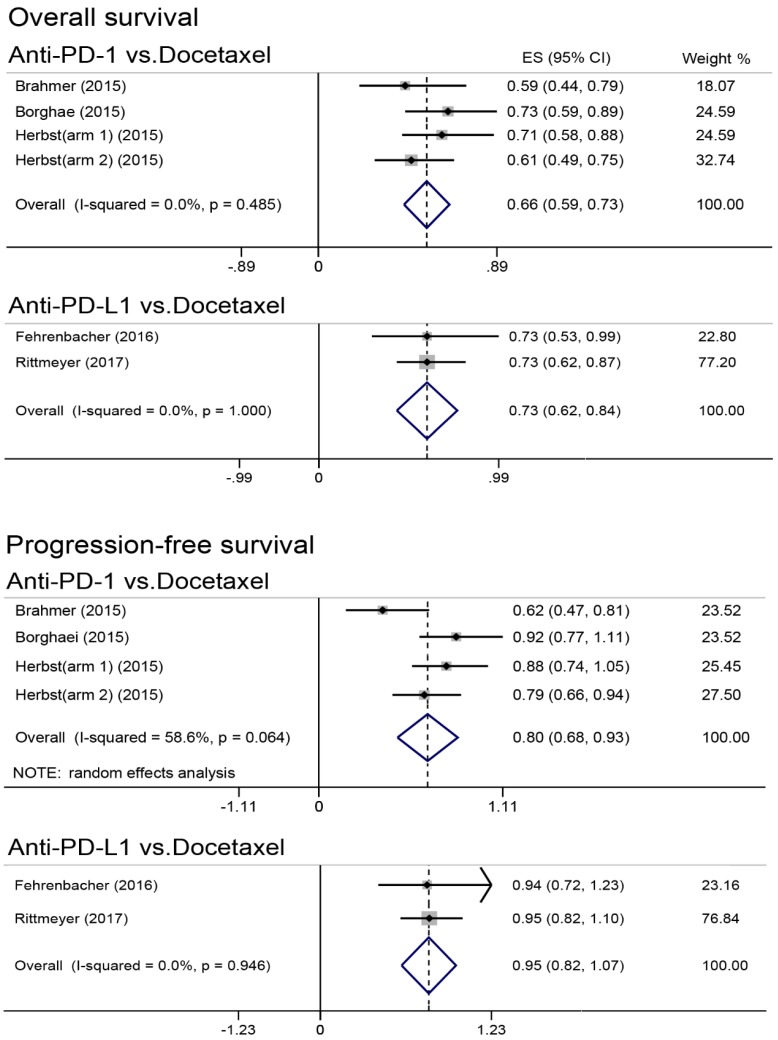
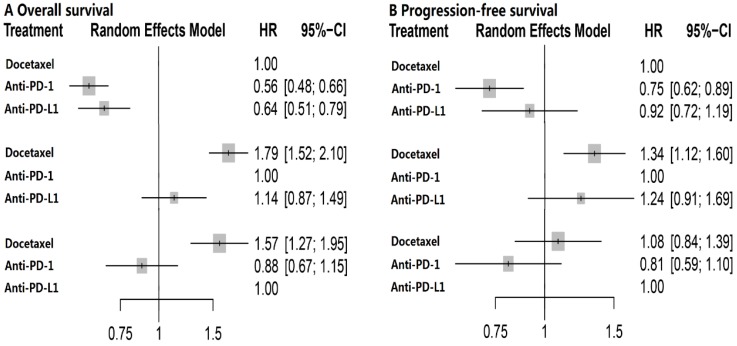
: This network meta-analysis aimed at comparing anti-programmed death 1 (anti-PD-1) with anti-programmed death ligand 1(anti-PD-L1) immunotherapy in patients with metastatic, previously treated non-small cell lung cancer (NSCLC) who failed first-line treatment. : We searched electronic databases to identify all eligible clinical trials. End-points included overall survival (OS), progression-free survival (PFS) and objective response. Hazard ratios (HRs) or odds ratios (ORs) and corresponding 95% confidence intervals (CIs) were extracted. Network meta-analysis was performed using the frequentist approach for multiple treatment comparisons. : In total, 3024 patients were randomly assigned: 1117 received anti-PD-1 therapy (nivolumab + pembrolizumab), 569 received anti-PD-L1 (atezolizumab) and 1338 received docetaxel. Anti-PD-1 (HR, 0.56; 95% CI, 0.48-0.66) and anti-PD-L1 (HR, 0.64; 95% CI, 0.51-0.79) achieved better OS than docetaxel, and anti-PD-1 was superior to docetaxel in terms of PFS (HR, 0.75; 95% CI, 0.62-0.89). Moreover, anti-PD-1 achieved the highest effect on OS and PFS, with a P-score of 91.2% and 95.5%, respectively. With regard to tumor response, anti-PD-1 group had a higher rate of responders than that in anti-PD-L1 (HR, 0.35; 95% CI, 0.19-0.65) and docetaxel (HR, 0.36; 95% CI, 0.25-0.52) groups. Undoubtedly, anti-PD-1 and anti-PD-L1 obtained less toxicity profile than docetaxel, and no significant difference was observed between anti-PD-1 and anti-PD-L1 groups. : Anti-PD-1 may be a better choice for patients with metastatic and previously treated NSCLC who failed first-line treatment in terms of the treatment ranking.
本网络荟萃分析旨在比较抗程序性死亡蛋白1(anti-PD-1)与抗程序性死亡配体1(anti-PD-L1)免疫疗法在一线治疗失败的转移性、既往接受过治疗的非小细胞肺癌(NSCLC)患者中的疗效。我们检索电子数据库以识别所有符合条件的临床试验。终点指标包括总生存期(OS)、无进展生存期(PFS)和客观缓解率。提取风险比(HRs)或比值比(ORs)以及相应的95%置信区间(CIs)。采用频率学派方法进行网络荟萃分析以比较多种治疗方法。总共3024例患者被随机分组:1117例接受anti-PD-1治疗(纳武单抗+帕博利珠单抗),569例接受anti-PD-L1治疗(阿特珠单抗),1338例接受多西他赛治疗。anti-PD-1(HR,0.56;95%CI,0.48 - 0.66)和anti-PD-L1(HR,0.64;95%CI,0.51 - 0.79)在OS方面比多西他赛疗效更好,且anti-PD-1在PFS方面优于多西他赛(HR,0.75;95%CI,0.62 - 0.89)。此外,anti-PD-1在OS和PFS方面效果最佳,P值分别为91.2%和95.5%。在肿瘤反应方面,anti-PD-1组的缓解率高于anti-PD-L1组(HR,0.35;95%CI,0.19 - 0.65)和多西他赛组(HR,0.36;95%CI,0.25 - 0.52)。毫无疑问,anti-PD-1和anti-PD-L1的毒性比多西他赛小,且anti-PD-1组和anti-PD-L1组之间未观察到显著差异。就治疗排名而言,对于一线治疗失败的转移性、既往接受过治疗的NSCLC患者,anti-PD-1可能是更好的选择。