Duncan Ryan P, Van Dillen Linda R, Garbutt Jane M, Earhart Gammon M, Perlmutter Joel S
1Program in Physical Therapy, Washington University School of Medicine in Saint Louis, Campus Box 8502, 4444 Forest Park Blvd, St. Louis, MO 63108 USA.
2Department of Neurology, Washington University School of Medicine in Saint Louis, St. Louis, MO USA.
Pilot Feasibility Stud. 2018 Feb 21;4:54. doi: 10.1186/s40814-018-0243-2. eCollection 2018.
Subthalamic nucleus deep brain stimulation (STN-DBS) reduces tremor, muscle stiffness, and bradykinesia in people with Parkinson's Disease (PD). Walking speed, known to be reduced in PD, typically improves after surgery; however, other important aspects of gait may not improve. Furthermore, balance may worsen and falls may increase after STN-DBS. Thus, interventions to improve balance and gait could reduce morbidity and improve quality of life following STN-DBS. Physical therapy (PT) effectively improves balance and gait in people with PD, but studies on the effects of PT have not been extended to those treated with STN-DBS. As such, the efficacy, safety, and feasibility of PT in this population remain to be determined. The purpose of this pilot study is to address these unmet needs. We hypothesize that PT designed to target balance and gait impairment will be effective, safe, and feasible in this population.
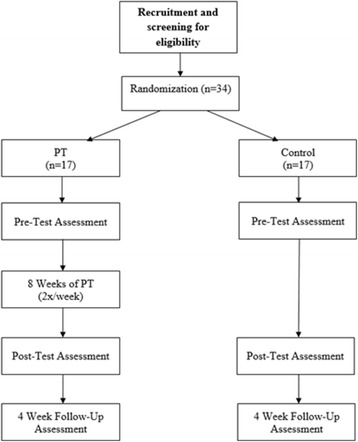
METHODS/DESIGN: Participants with PD treated with STN-DBS will be randomly assigned to either a PT or control group. Participants assigned to PT will complete an 8-week, twice-weekly PT program consisting of exercises designed to improve balance and gait. Control group participants will receive the current standard of care following STN-DBS, which does not include prescription of PT. The primary aim is to assess preliminary efficacy of PT on balance (Balance Evaluation Systems Test). A secondary aim is to assess efficacy of PT on gait (GAITRite instrumented walkway). Participants will be assessed OFF medication/OFF stimulation and ON medication/ON stimulation at baseline and at 8 and 12 weeks after baseline. Adverse events will be measured over the duration of the study, and adherence to PT will be measured to determine feasibility.
To our knowledge, this will be the first study to explore the preliminary efficacy, safety, and feasibility of PT for individuals with PD with STN-DBS. If the study suggests potential efficacy, then this would justify larger trials to test effectiveness and safety of PT for those with PD with STN-DBS.
NCT03181282 (clinicaltrials.gov). Registered on 7 June 2017.
丘脑底核深部脑刺激(STN-DBS)可减轻帕金森病(PD)患者的震颤、肌肉僵硬和运动迟缓。众所周知,PD患者的步行速度会降低,术后通常会有所改善;然而,步态的其他重要方面可能并未改善。此外,STN-DBS术后平衡能力可能会恶化,跌倒风险可能会增加。因此,改善平衡和步态的干预措施可以降低STN-DBS术后的发病率并提高生活质量。物理治疗(PT)可有效改善PD患者的平衡和步态,但关于PT效果的研究尚未扩展到接受STN-DBS治疗的患者。因此,PT在该人群中的疗效、安全性和可行性仍有待确定。这项初步研究的目的是满足这些未被满足的需求。我们假设,针对平衡和步态障碍设计的PT在该人群中将是有效、安全且可行的。
方法/设计:接受STN-DBS治疗的PD患者将被随机分配到PT组或对照组。分配到PT组的参与者将完成一个为期8周、每周两次的PT项目,该项目包括旨在改善平衡和步态的运动。对照组参与者将接受STN-DBS术后的当前标准护理,其中不包括PT处方。主要目的是评估PT对平衡的初步疗效(平衡评估系统测试)。次要目的是评估PT对步态的疗效(GAITRite仪器化步道)。参与者将在基线时以及基线后8周和12周时进行停药/停刺激和服药/刺激状态下的评估。在研究期间将测量不良事件,并测量对PT的依从性以确定可行性。
据我们所知,这将是第一项探索PT对接受STN-DBS治疗的PD患者的初步疗效、安全性和可行性的研究。如果该研究表明存在潜在疗效,那么这将为更大规模的试验提供依据,以测试PT对接受STN-DBS治疗的PD患者的有效性和安全性。
NCT03181282(clinicaltrials.gov)。于2017年6月7日注册。