Bedi Prabhjot K, Castro-Codesal Maria Luisa, Featherstone Robin, AlBalawi Mohammed M, Alkhaledi Bashar, Kozyrskyj Anita L, Flores-Mir Carlos, MacLean Joanna E
Department of Pediatrics, Faculty of Medicine and Dentistry, University of Alberta, Edmonton, AB, Canada.
Alberta Research Centre for Health Evidence, University of Alberta, Knowledge Translation Platform, Alberta SPOR SUPPORT Unit, Edmonton, AB, Canada.
Front Pediatr. 2018 Feb 12;6:13. doi: 10.3389/fped.2018.00013. eCollection 2018.
The use of long-term non-invasive ventilation (NIV) to treat sleep and breathing disorders in children has increased substantially in the last decade; however, less data exist about its use in infants. Given that infants have distinct sleep and breathing patterns when compared to older children, the outcomes of infants on long-term NIV may differ as well. The aim of this study is to systematically review the use and outcomes of long-term NIV in infants.
Ovid Medline, Ovid Embase, CINAHL (via EbscoHOST), PubMed, and Wiley Cochrane Library were systematically searched from January 1990 to July 2017. Studies on infants using long-term NIV outside of an acute care setting were included. Data were extracted on study design, population characteristics, and NIV outcomes.
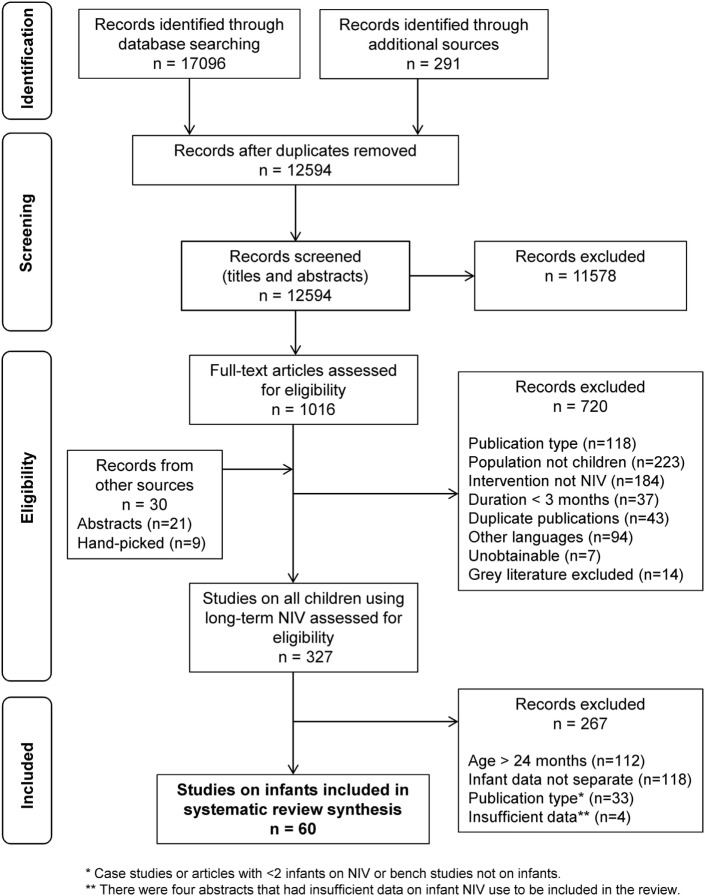
A total of 327 studies were full-text reviewed, with final inclusion of 60. Studies were distributed across airway (40%), neuromuscular (28%), central nervous system (10%), cardio-respiratory (2%), and multiple (20%) disease categories. Of the 18 airway studies reporting on NIV outcomes, 13 (72%) reported improvements in respiratory parameters. Of the 12 neuromuscular studies exclusively on spinal muscular atrophy type 1 (SMA1), six (50%) reported decreased hospitalizations and nine (75%) reported on mortality outcomes. Risk of bias was moderate to serious, and quality of the evidence was low to very low for all studies. Most studies had an observational design with no control group, limiting the potential for a meta-analysis.
The outcomes reported in studies differed by the disease category being studied. Studies on airway conditions showed improvements in respiratory parameters for infants using NIV. Studies on neuromuscular disorder, which were almost exclusively on SMA1, reported decreased hospitalizations and prolonged survival. Overall, it appears that NIV is an effective long-term therapy for infants. However, the high risk of bias and low quality of the available evidence limited strong conclusions.
在过去十年中,长期无创通气(NIV)用于治疗儿童睡眠和呼吸障碍的情况大幅增加;然而,关于其在婴儿中的应用数据较少。鉴于与大龄儿童相比,婴儿具有独特的睡眠和呼吸模式,长期接受NIV治疗的婴儿的治疗效果可能也有所不同。本研究的目的是系统评价长期NIV在婴儿中的应用及治疗效果。
系统检索了1990年1月至2017年7月期间的Ovid Medline、Ovid Embase、CINAHL(通过EbscoHOST)、PubMed和Wiley Cochrane图书馆。纳入在急性护理环境之外使用长期NIV治疗婴儿的研究。提取了关于研究设计、人群特征和NIV治疗效果的数据。
共对327项研究进行了全文审查,最终纳入60项。研究分布在气道疾病(40%)、神经肌肉疾病(28%)、中枢神经系统疾病(10%)、心肺疾病(2%)和多种疾病(20%)类别中。在18项报告NIV治疗效果的气道疾病研究中,13项(72%)报告呼吸参数有所改善。在12项专门针对1型脊髓性肌萎缩症(SMA1)的神经肌肉疾病研究中,6项(50%)报告住院次数减少,9项(75%)报告了死亡率结果。所有研究的偏倚风险为中度至重度,证据质量为低至极低。大多数研究采用观察性设计,没有对照组,限制了进行荟萃分析的可能性。
研究报告的治疗效果因所研究的疾病类别而异。关于气道疾病的研究表明,使用NIV治疗的婴儿呼吸参数有所改善。关于神经肌肉疾病的研究(几乎均为SMA1)报告住院次数减少,生存期延长。总体而言,NIV似乎是治疗婴儿的一种有效长期疗法。然而,偏倚风险高和现有证据质量低限制了得出强有力的结论。