Department of Pediatrics, Shu Yang Union Medical College Hospital, Suqian, Jiangsu 223600, P.R. China.
Department of Clinical Laboratory, The 82nd Hospital of Chinese People's Liberation Army, Huaian, Jiangsu 223001, P.R. China.
Mol Med Rep. 2018 Apr;17(4):5635-5641. doi: 10.3892/mmr.2018.8633. Epub 2018 Feb 26.
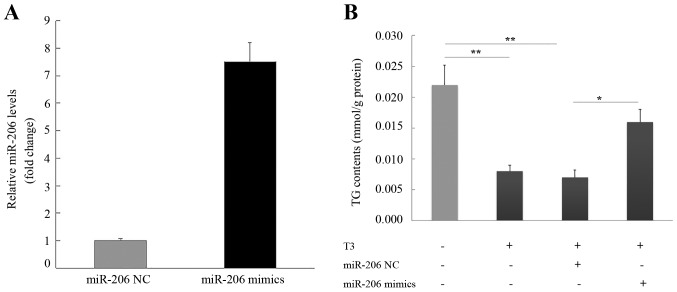
The actions of thyroid hormone (TH) on lipid metabolism in the liver are associated with a number of genes involved in lipogenesis and lipid metabolism; however, the underlying mechanisms through which TH impacts on lipid metabolism remain to be elucidated. The present study aimed to investigate the effects of hyperthyroidism on the serum levels of the microRNA (miR) miR‑206 and the role of miR‑206 on TH‑regulated lipid metabolism in liver cells. Serum was obtained from 12 patients diagnosed with hyperthyroidism and 10 healthy control subjects. Human hepatoblastoma (HepG2) cells were used to study the effects of triiodothyronine (T3) and miR‑206 on lipid metabolism. Expression of miR‑206 in serum and cells was determined by reverse transcription‑quantitative polymerase chain reaction analysis. Lipid accumulation in HepG2 cells was assessed with Oil Red O staining. Suppression or overexpression of miR‑206 was performed via transfection with a miR‑206 mimic or miR‑206 inhibitor. Serum miR‑206 was significantly decreased in patients with hyperthyroidism compared with euthyroid controls. Treatment of HepG2 cells with T3 led to reduced total cholesterol (TC) and triglyceride (TG) content, accompanied by reduced miR‑206 expression. Inhibition of endogenous miR‑206 expression decreased intracellular TG and TC content in HepG2 cells. By contrast, overexpression of miR‑206 in HepG2 partially prevented the reduction in TG content induced by treatment with T3. In conclusion, serum miR‑206 expression is reduced in patients with hyperthyroidism. In addition, miR‑206 is involved in T3‑mediated regulation of lipid metabolism in HepG2 cells, indicating a role for miR‑206 in thyroid hormone‑induced disorders of lipid metabolism in the liver.
甲状腺激素 (TH) 对肝脏脂质代谢的作用与参与脂生成和脂质代谢的许多基因有关;然而,TH 影响脂质代谢的潜在机制仍有待阐明。本研究旨在探讨甲状腺功能亢进症对血清微小 RNA (miR) miR-206 水平的影响,以及 miR-206 在 TH 调节肝细胞脂质代谢中的作用。从 12 名被诊断为甲状腺功能亢进症的患者和 10 名健康对照者中获取血清。用人肝癌细胞 (HepG2) 细胞研究三碘甲状腺原氨酸 (T3) 和 miR-206 对脂质代谢的影响。通过逆转录-定量聚合酶链反应分析检测血清和细胞中 miR-206 的表达。用油红 O 染色评估 HepG2 细胞中的脂质积累。通过转染 miR-206 模拟物或 miR-206 抑制剂来抑制或过表达 miR-206。与甲状腺功能正常的对照组相比,甲状腺功能亢进症患者的血清 miR-206 显著降低。用 T3 处理 HepG2 细胞导致总胆固醇 (TC) 和甘油三酯 (TG) 含量减少,同时 miR-206 表达减少。抑制内源性 miR-206 表达可降低 HepG2 细胞内的 TG 和 TC 含量。相反,在 HepG2 中转染 miR-206 可部分阻止 T3 处理引起的 TG 含量减少。综上所述,甲状腺功能亢进症患者的血清 miR-206 表达降低。此外,miR-206 参与 T3 介导的 HepG2 细胞脂质代谢调节,表明 miR-206 在甲状腺激素诱导的肝脏脂质代谢紊乱中起作用。