Department of Cardiology, the Xiamen Cardiovascular Hospital of Xiamen University, Xiamen, Fujian, China.
Bosn J Basic Med Sci. 2022 Jun 1;22(3):326-339. doi: 10.17305/bjbms.2021.6606.
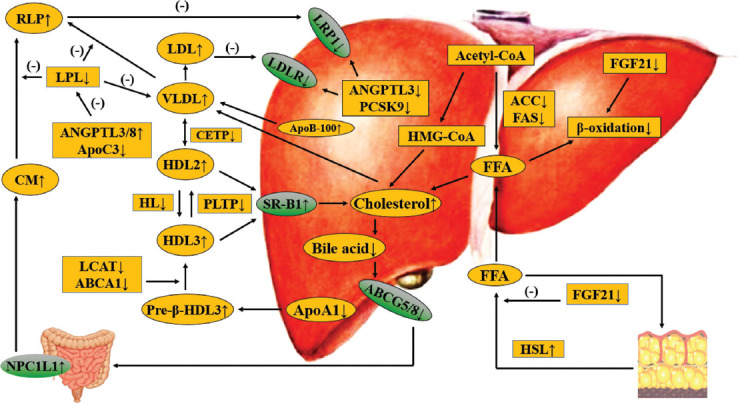
According to the previous reports, hypothyroidism has been shown to be strongly correlated with increased circulating concentrations of total cholesterol, low-density lipoprotein cholesterol (LDL-C), and triglycerides (TG). Notably, thyroid hormones are confirmed to modulate the production, clearance, and transformation process of cholesterol within circulation of mammals. Moreover, emerging evidence suggests that the thyroid-stimulating hormone could also participate in modulating serum lipid metabolism independently of thyroid hormones, which further induces the pathological development of dyslipidemia. However, the underlying mechanism is still not fully elucidated. Recently, several research studies have demonstrated that the pathogenic progression of hypothyroidism-related dyslipidemia might be correlated with the decreased serum concentrations of thyroid hormones and the increased serum concentrations of thyroid-stimulating hormones. Thus, this indicates that hypothyroidism could induce dyslipidemia and its related cardio-metabolic disorder diseases. In addition, several newly identified modulatory biomarkers, such as proprotein convertase subtilisin/kexin type 9 (PCSK9), angiopoietin-like protein (ANGPTLs), and fibroblast growth factors (FGFs), might play an important role in the regulation of dyslipidemia induced by hypothyroidism. Furthermore, under the status of hypothyroidism, significantly dysfunctional HDL particles could also be observed. In the current review, we summarized the recent knowledge of the relationship between the development of hypothyroidism with dyslipidemia. We also discussed the updated understanding of the mechanisms whereby hypothyroidism induces the risk and the development of dyslipidemia and cardio-metabolic diseases.
根据之前的报告,甲状腺功能减退症与总胆固醇、低密度脂蛋白胆固醇 (LDL-C) 和甘油三酯 (TG) 的循环浓度升高呈强相关。值得注意的是,甲状腺激素被证实可调节哺乳动物循环中胆固醇的生成、清除和转化过程。此外,新出现的证据表明,促甲状腺激素也可以独立于甲状腺激素参与调节血清脂质代谢,这进一步导致了血脂异常的病理发展。然而,其潜在机制尚未完全阐明。最近,几项研究表明,甲状腺功能减退症相关血脂异常的发病进展可能与血清甲状腺激素浓度降低和促甲状腺激素浓度升高有关。因此,这表明甲状腺功能减退症可导致血脂异常及其相关的心脏代谢紊乱疾病。此外,一些新鉴定的调节生物标志物,如前蛋白转化酶枯草溶菌素/凝血酶 9 (PCSK9)、血管生成素样蛋白 (ANGPTLs) 和成纤维细胞生长因子 (FGFs),可能在甲状腺功能减退症引起的血脂异常调节中发挥重要作用。此外,在甲状腺功能减退症状态下,还可以观察到明显功能失调的高密度脂蛋白颗粒。在本综述中,我们总结了甲状腺功能减退症与血脂异常发展之间关系的最新知识。我们还讨论了甲状腺功能减退症引起血脂异常和心脏代谢疾病风险和发展的机制的最新认识。