Massachusetts General Hospital, 55 Fruit St, Boston, MA, 02114, USA.
University of North Carolina at Chapel Hill School of Medicine, 321 South Columbia St, Chapel Hill, NC, 27516, USA.
Malar J. 2018 Feb 27;17(1):99. doi: 10.1186/s12936-018-2241-5.
Village health workers (VHWs) in five villages in Bugoye subcounty (Kasese District, Uganda) provide integrated community case management (iCCM) services, in which VHWs evaluate and treat malaria, pneumonia, and diarrhoea in children under 5 years of age. VHWs use a "Sick Child Job Aid" that guides them through the evaluation and treatment of these illnesses. A retrospective observational study was conducted to measure the quality of iCCM care provided by 23 VHWs in 5 villages in Bugoye subcounty over a 2-year period.
Patient characteristics and clinical services were summarized using existing aggregate programme data. Lot quality assurance sampling of individual patient records was used to estimate adherence to the iCCM algorithm, VHW-level quality (based on adherence to the iCCM protocol), and change over time in quality of care (using generalized estimating equations regression modelling).
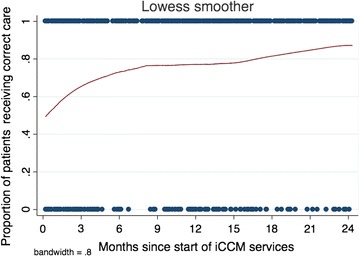
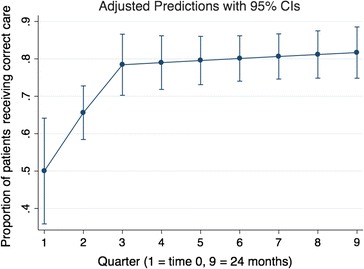
For each of 23 VHWs, 25 patient visits were randomly selected from a 2-year period after iCCM care initiation. In these visits, 97% (150) of patients with diarrhoea were treated with oral rehydration and zinc, 95% (216) of patients with pneumonia were treated with amoxicillin, and 94% (240) of patients with malaria were treated with artemisinin-based combination therapy or rectal artesunate. However, only 44% (44) of patients with a negative rapid test for malaria were appropriately referred to a health facility. Overall, 75% (434) of patients received all the correct evaluation and management steps. Only 9 (39%) of the 23 VHWs met the pre-determined LQAS threshold for high-quality care over the 2-year observation period. Quality of care increased significantly in the first 6 months after initiation of iCCM services (p = 0.003), and then plateaued during months 7-24.
Quality of care was high for uncomplicated malaria, pneumonia and diarrhoea. Overall quality of care was lower, in part because VHWs often did not follow the guidelines to refer patients with fever who tested negative for malaria. Quality of care appears to improve in the initial months after iCCM implementation, as VHWs gain initial experience in iCCM care.
在布戈耶县(乌干达卡塞塞区)的五个村庄,乡村卫生工作者(VHW)提供综合社区病例管理(iCCM)服务,其中 VHW 评估和治疗 5 岁以下儿童的疟疾、肺炎和腹泻。VHW 使用“患病儿童工作辅助工具”来指导他们评估和治疗这些疾病。对布戈耶县五个村庄的 23 名 VHW 在 2 年内提供的 iCCM 护理质量进行了回顾性观察研究。
使用现有汇总计划数据总结患者特征和临床服务。对个体患者记录进行批量质量保证抽样,以估计对 iCCM 算法的依从性、VHW 级别的质量(基于对 iCCM 方案的依从性)以及护理质量随时间的变化(使用广义估计方程回归模型)。
对于 23 名 VHW 中的每一名,从 iCCM 护理开始后的 2 年期间随机选择 25 次患者就诊。在这些就诊中,97%(150)的腹泻患者接受了口服补液盐和锌治疗,95%(216)的肺炎患者接受了阿莫西林治疗,94%(240)的疟疾患者接受了青蒿素为基础的联合治疗或直肠青蒿琥酯治疗。然而,只有 44%(44)的快速检测疟疾呈阴性的患者被适当转诊到医疗机构。总体而言,75%(434)的患者接受了所有正确的评估和管理步骤。只有 9 名(39%)VHW 在 2 年观察期间达到了高质量护理的预先确定的 LQAS 阈值。在 iCCM 服务开始后的头 6 个月,护理质量显著提高(p=0.003),然后在第 7 至 24 个月期间趋于平稳。
对无并发症的疟疾、肺炎和腹泻,护理质量较高。总体护理质量较低,部分原因是 VHW 经常不遵循指南,对快速检测疟疾呈阴性但发热的患者不进行转诊。随着 VHW 在 iCCM 护理方面获得初步经验,在 iCCM 实施后的最初几个月,护理质量似乎有所提高。