Maryland Psychiatric Research Center, Department of Psychiatry, University of Maryland School of Medicine, Baltimore, Maryland.
Department of Biomedical Engineering, Duke University, Durham, North Carolina.
Biol Psychiatry Cogn Neurosci Neuroimaging. 2018 Mar;3(3):239-247. doi: 10.1016/j.bpsc.2017.07.008. Epub 2017 Aug 12.
The current study was designed to test the hypothesis that motivational deficits in schizophrenia (SZ) are tied to a reduced ability to differentially signal gains and instances of loss-avoidance in the brain, leading to reduced ability to form adaptive representations of expected value.
We administered a reinforcement learning paradigm to 27 medicated SZ patients and 27 control subjects in which participants learned three probabilistic discriminations. In regions of interest in reward networks identified a priori, we examined contrasts between trial types with different expected values (e.g., expected gain-nonmonetary) and between outcomes with the same prediction error valence but different experienced values (e.g., gain-loss-avoidance outcome, miss-loss outcome).
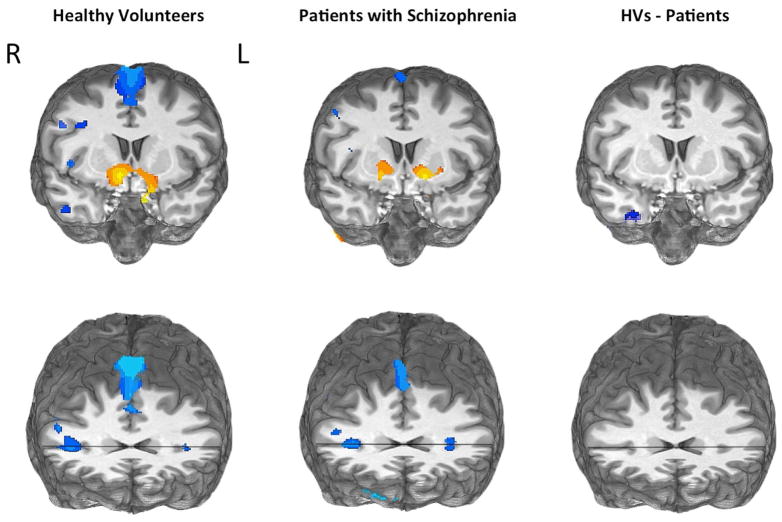
Both whole-brain and region of interest analyses revealed that SZ patients showed reduced differentiation between gain and loss-avoidance outcomes in the dorsal anterior cingulate cortex and bilateral anterior insula. That is, SZ patients showed reduced contrasts between positive prediction errors of different objective values in these areas. In addition, we observed significant correlations between gain-loss-avoidance outcome contrasts in the ventral striatum and ratings for avolition/anhedonia and between expected gain-nonmonetary contrasts in the ventral striatum and ventromedial prefrontal cortex.
These results provide further evidence for intact prediction error signaling in medicated SZ patients, especially with regard to loss-avoidance. By contrast, components of frontostriatal circuits appear to show reduced sensitivity to the absolute valence of expected and experienced outcomes, suggesting a mechanism by which motivational deficits may emerge.
本研究旨在验证一个假设,即精神分裂症(SZ)患者的动机缺陷与大脑对收益和损失规避的信号差异能力降低有关,导致对预期价值的适应性表示的形成能力降低。
我们对 27 名服用药物的 SZ 患者和 27 名对照受试者进行了强化学习范式测试,参与者学习了三种概率判别。在预先确定的奖励网络感兴趣区域中,我们检查了具有不同预期值(例如,预期收益-非货币)的试验类型之间以及具有相同预测误差值但不同经验值的结果之间(例如,收益-损失规避结果,错过-损失结果)的对比。
全脑和感兴趣区域分析均表明,SZ 患者在前扣带回皮质和双侧前岛叶中对收益和损失规避结果的区分能力降低。也就是说,SZ 患者在这些区域中显示出不同客观值的正预测误差之间的对比度降低。此外,我们观察到腹侧纹状体中的收益-损失规避结果对比与意志缺失/快感缺失评分之间存在显著相关性,以及腹侧纹状体中的预期收益-非货币对比与腹内侧前额叶皮质之间存在显著相关性。
这些结果进一步证明了服用药物的 SZ 患者的预测误差信号完好,特别是在损失规避方面。相比之下,额纹状体回路的成分似乎对预期和经验结果的绝对值的敏感性降低,这表明了动机缺陷出现的机制。