Brown Elliot C, Hack Samantha M, Gold James M, Carpenter William T, Fischer Bernard A, Prentice Kristen P, Waltz James A
Maryland Psychiatric Research Center (MPRC), Department of Psychiatry, University of Maryland School of Medicine, Baltimore, MD, USA.
Veterans Affairs Capital Network (VISN 5) Mental Illness Research, Education, and Clinical Center (MIRECC), Baltimore, MD, USA.
J Psychiatr Res. 2015 Jul-Aug;66-67:16-23. doi: 10.1016/j.jpsychires.2015.04.007. Epub 2015 Apr 28.
The Iowa Gambling Task (IGT; Bechara et al., 1994) has frequently been used to assess risky decision making in clinical populations, including patients with schizophrenia (SZ). Poor performance on the IGT is often attributed to reduced sensitivity to punishment, which contrasts with recent findings from reinforcement learning studies in schizophrenia.
In order to investigate possible sources of IGT performance deficits in SZ patients, we combined data from the IGT from 59 SZ patients and 43 demographically-matched controls with data from the Balloon Analog Risk Task (BART) in the same participants. Our analyses sought to specifically uncover the role of punishment sensitivity and delineate the capacity to integrate frequency and magnitude information in decision-making under risk.
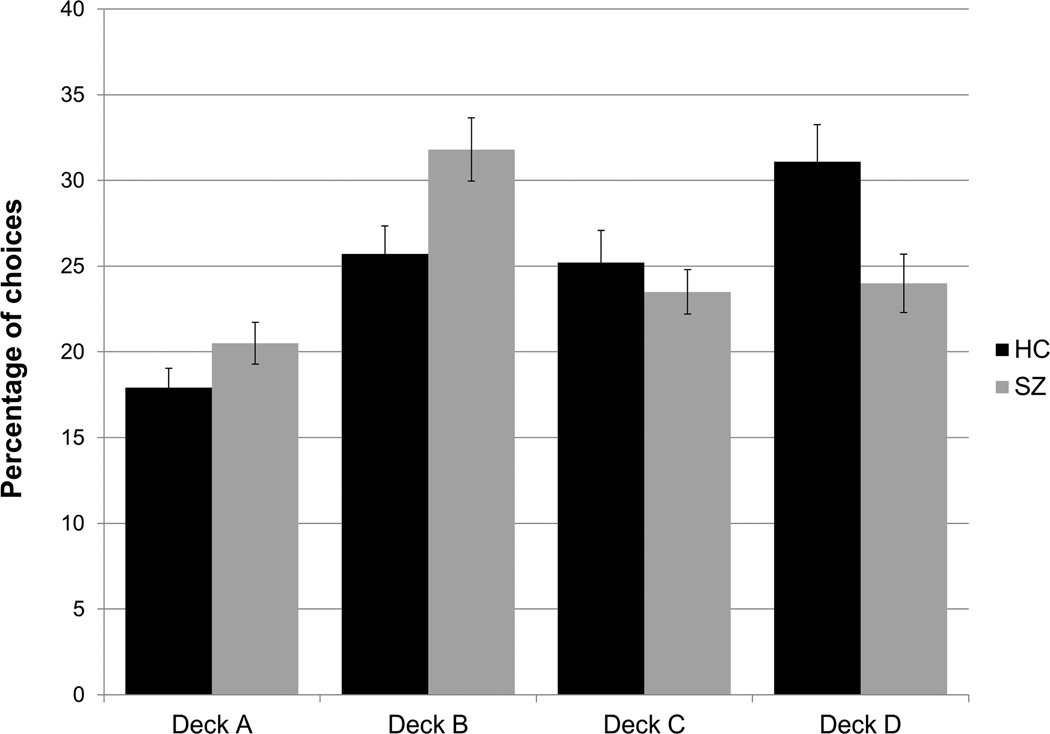
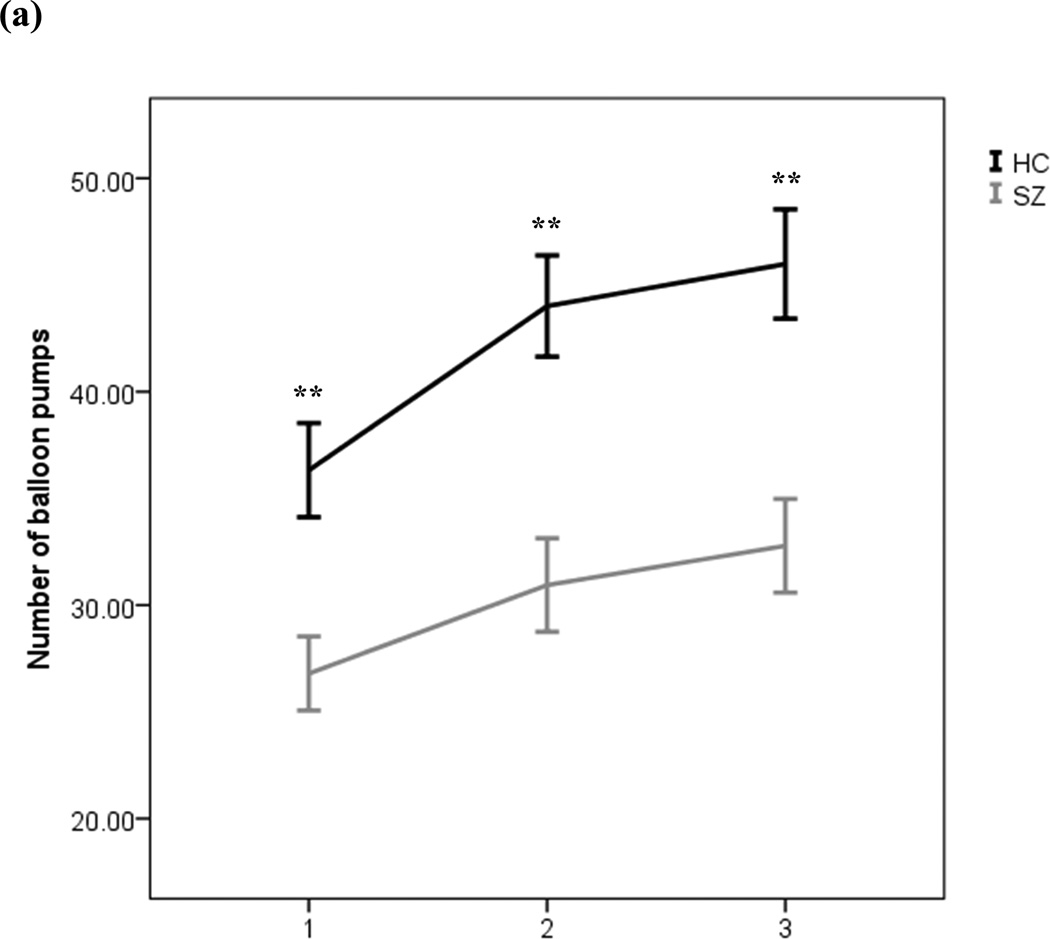
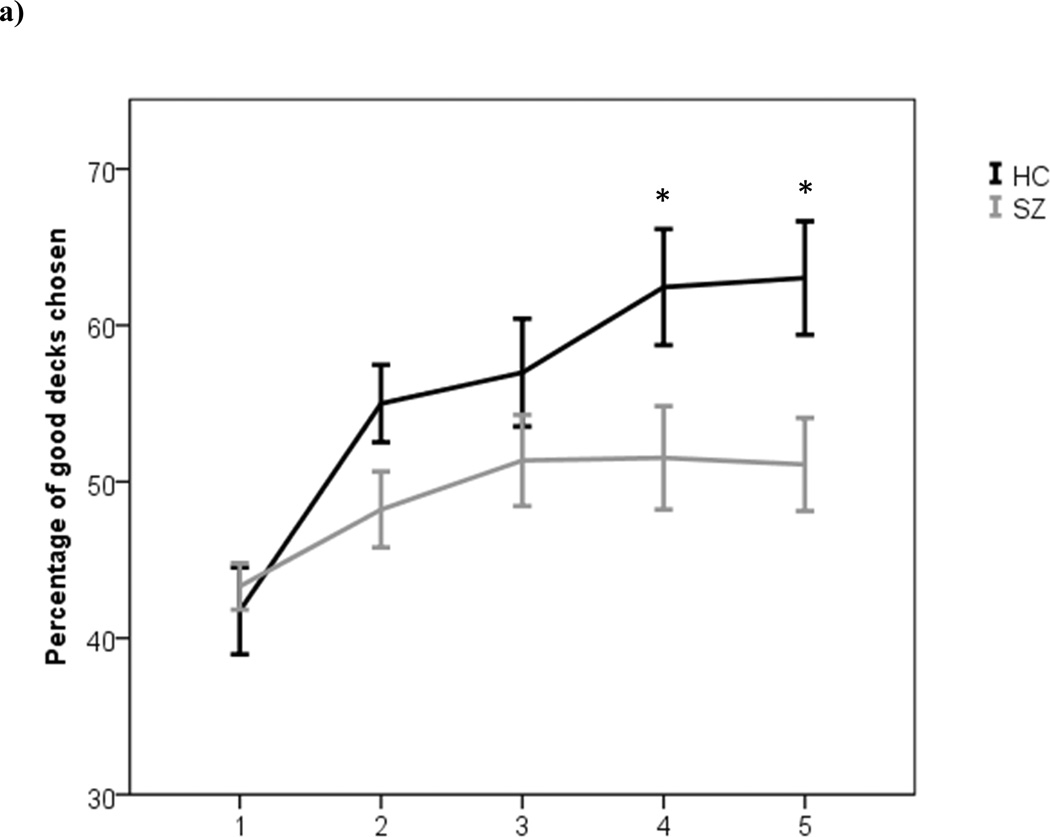
Although SZ patients, on average, made more choices from disadvantageous decks than controls did on the IGT, they avoided decks with frequent punishments at a rate similar to controls. Patients also exhibited excessive loss-avoidance behavior on the BART.
We argue that, rather than stemming from reduced sensitivity to negative consequences, performance deficits on the IGT in SZ patients are more likely the result of a reinforcement learning deficit, specifically involving the integration of frequencies and magnitudes of rewards and punishments in the trial-by-trial estimation of expected value.
爱荷华赌博任务(IGT;Bechara等人,1994年)经常被用于评估临床人群的风险决策,包括精神分裂症(SZ)患者。IGT表现不佳通常归因于对惩罚的敏感度降低,这与精神分裂症强化学习研究的最新发现形成对比。
为了调查SZ患者IGT表现缺陷的可能来源,我们将59名SZ患者和43名人口统计学匹配的对照组的IGT数据与同一参与者的气球模拟风险任务(BART)数据相结合。我们的分析旨在特别揭示惩罚敏感度的作用,并描绘在风险决策中整合频率和量级信息的能力。
虽然平均而言,SZ患者在IGT上从不利牌组中做出的选择比对照组更多,但他们以与对照组相似的比率避开了频繁出现惩罚的牌组。患者在BART上也表现出过度的损失规避行为。
我们认为,SZ患者IGT表现缺陷并非源于对负面后果的敏感度降低,而更可能是强化学习缺陷的结果,具体涉及在逐次试验的期望值估计中对奖励和惩罚的频率和量级进行整合。