Huang Yating, He Jiayu, Zhang Xinyue, Chen Ji, Yi Zhenghui, Lv Qinyu, Yan Chao
School of Psychology and Cognitive Science, https://ror.org/02n96ep67East China Normal University, Shanghai, China.
Center for Brain Health and Brain Technology, Global Institute of Future Technology, Shanghai Jiao Tong University, Shanghai, China.
Psychol Med. 2025 Jul 23;55:e211. doi: 10.1017/S0033291725101207.
Anhedonia, a transdiagnostic feature common to both Major Depressive Disorder (MDD) and Schizophrenia (SCZ), is characterized by abnormalities in hedonic experience. Previous studies have used machine learning (ML) algorithms without focusing on disorder-specific characteristics to independently classify SCZ and MDD. This study aimed to classify MDD and SCZ using ML models that integrate components of hedonic processing.
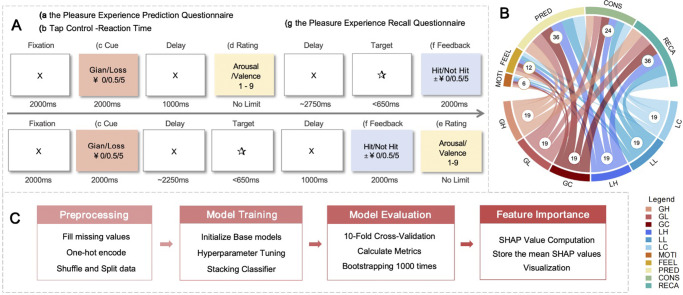
We recruited 99 patients with MDD, 100 patients with SCZ, and 113 healthy controls (HC) from four sites. The patient groups were allocated to distinct training and testing datasets. All participants completed a modified Monetary Incentive Delay (MID) task, which yielded features categorized into five hedonic components, two reward consequences, and three reward magnitudes. We employed a stacking ensemble model with SHapley Additive exPlanations (SHAP) values to identify key features distinguishing MDD, SCZ, and HC across binary and multi-class classifications.
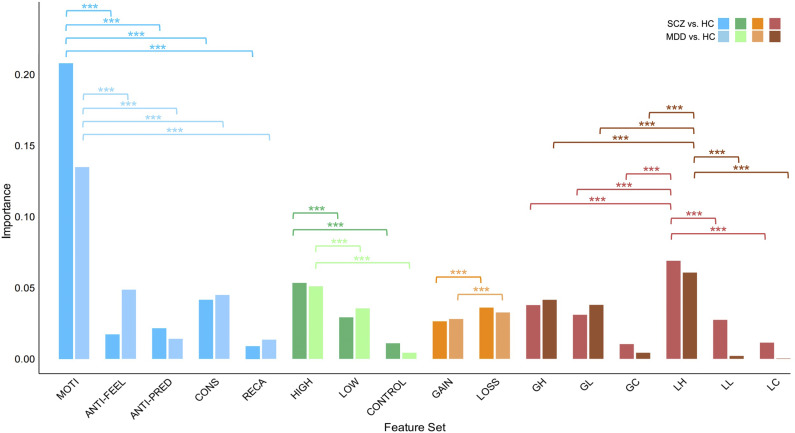
The stacking model demonstrated high classification accuracy, with Area Under the Curve (AUC) values of 96.08% (MDD versus HC) and 91.77% (SCZ versus HC) in the main dataset. However, the MDD versus SCZ classification had an AUC of 57.75%. The motivation reward component, loss reward consequence, and high reward magnitude were the most influential features within respective categories for distinguishing both MDD and SCZ from HC ( < 0.001). A refined model using only the top eight features maintained robust performance, achieving AUCs of 96.06% (MDD versus HC) and 95.18% (SCZ versus HC).
The stacking model effectively classified SCZ and MDD from HC, contributing to understanding transdiagnostic mechanisms of anhedonia.
快感缺失是重度抑郁症(MDD)和精神分裂症(SCZ)共有的一种跨诊断特征,其特点是享乐体验异常。以往的研究使用机器学习(ML)算法,但未关注疾病特异性特征,以独立区分SCZ和MDD。本研究旨在使用整合享乐加工成分的ML模型对MDD和SCZ进行分类。
我们从四个地点招募了99名MDD患者、100名SCZ患者和113名健康对照(HC)。将患者组分配到不同的训练和测试数据集。所有参与者都完成了一项改良的金钱激励延迟(MID)任务,该任务产生的特征分为五个享乐成分、两个奖励结果和三个奖励幅度。我们采用了具有SHapley加性解释(SHAP)值的堆叠集成模型,以识别在二元和多类分类中区分MDD、SCZ和HC的关键特征。
堆叠模型显示出较高的分类准确率,在主要数据集中,曲线下面积(AUC)值分别为96.08%(MDD与HC对比)和91.77%(SCZ与HC对比)。然而,MDD与SCZ分类的AUC为57.75%。动机奖励成分、损失奖励结果和高奖励幅度是在各自类别中区分MDD和SCZ与HC的最具影响力的特征(<0.001)。仅使用前八个特征的优化模型保持了稳健的性能,MDD与HC对比的AUC为96.06%,SCZ与HC对比的AUC为95.18%。
堆叠模型有效地将SCZ和MDD与HC区分开来,有助于理解快感缺失的跨诊断机制。