• 文献检索
  • 文档翻译
  • 深度研究
  • 学术资讯
  • Suppr Zotero 插件Zotero 插件
  • 邀请有礼
  • 套餐&价格
  • 历史记录
应用&插件
Suppr Zotero 插件Zotero 插件浏览器插件Mac 客户端Windows 客户端微信小程序
定价
高级版会员购买积分包购买API积分包
服务
文献检索文档翻译深度研究API 文档MCP 服务
关于我们
关于 Suppr公司介绍联系我们用户协议隐私条款
关注我们

Suppr 超能文献

核心技术专利:CN118964589B侵权必究
粤ICP备2023148730 号-1Suppr @ 2026

文献检索

告别复杂PubMed语法,用中文像聊天一样搜索,搜遍4000万医学文献。AI智能推荐,让科研检索更轻松。

立即免费搜索

文件翻译

保留排版,准确专业,支持PDF/Word/PPT等文件格式,支持 12+语言互译。

免费翻译文档

深度研究

AI帮你快速写综述,25分钟生成高质量综述,智能提取关键信息,辅助科研写作。

立即免费体验

用于早期精神病临床监测的移动健康平台:在社区门诊早期精神病护理中的应用

A Mobile Health Platform for Clinical Monitoring in Early Psychosis: Implementation in Community-Based Outpatient Early Psychosis Care.

作者信息

Kumar Divya, Tully Laura M, Iosif Ana-Maria, Zakskorn Lauren N, Nye Kathleen E, Zia Aqsa, Niendam Tara Ann

机构信息

Department of Psychiatry and Behavioral Sciences, University of California, Davis, Sacramento, CA, United States.

Division of Biostatistics, Department of Public Health Sciences, University of California, Davis, Sacramento, CA, United States.

出版信息

JMIR Ment Health. 2018 Feb 27;5(1):e15. doi: 10.2196/mental.8551.

DOI:10.2196/mental.8551
PMID:29487044
原文链接:https://pmc.ncbi.nlm.nih.gov/articles/PMC5849797/
Abstract

BACKGROUND

A growing body of literature indicates that smartphone technology is a feasible add-on tool in the treatment of individuals with early psychosis (EP) . However, most studies to date have been conducted independent of outpatient care or in a research clinic setting, often with financial incentives to maintain user adherence to the technology. Feasibility of dissemination and implementation of smartphone technology into community mental health centers (CMHCs) has yet to be tested, and whether young adults with EP will use this technology for long periods of time without incentive is unknown. Furthermore, although EP individuals willingly adopt smartphone technology as part of their treatment, it remains unclear whether providers are amenable to integrating smartphone technology into treatment protocols.

OBJECTIVE

This study aimed to establish the feasibility of implementing a smartphone app and affiliated Web-based dashboard in 4 community outpatient EP clinics in Northern California.

METHODS

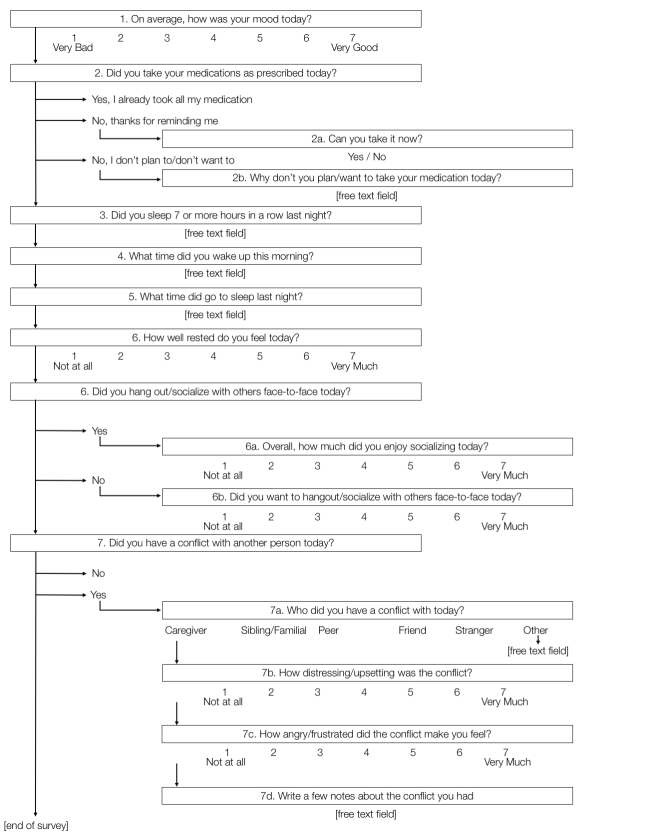
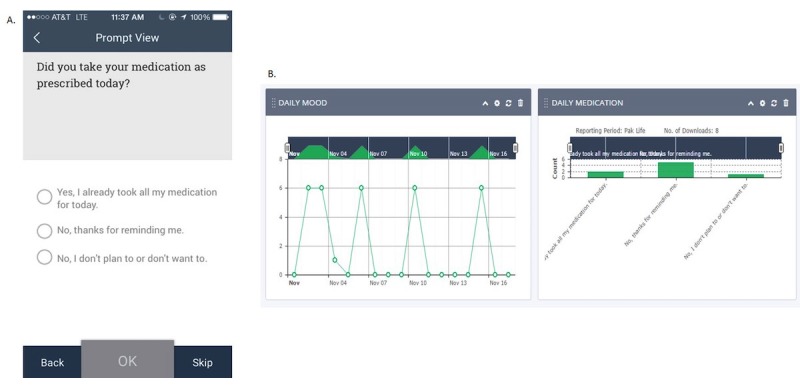
EP individuals in 4 clinics downloaded an app on their smartphone and responded to daily surveys regarding mood and symptoms for up to 5 months. Treatment providers at the affiliated clinics viewed survey responses on a secure Web-based dashboard in sessions with their clients and between appointments. EP clients and treatment providers filled out satisfaction surveys at study end regarding usability of the app.

RESULTS

Sixty-one EP clients and 20 treatment providers enrolled in the study for up to 5 months. Forty-one EP clients completed the study, and all treatment providers remained in the study for their duration in the clinic. Survey completion for all 61 EP clients was moderate: 40% and 39% for daily and weekly surveys, respectively. Completion rates were slightly higher in the participants who completed the study: 44% and 41% for daily and weekly surveys, respectively. Twenty-seven of 41 (66%) EP clients who completed the study and 11 of 13 (85%) treatment providers who responded to satisfaction surveys reported they would continue to use the app as part of treatment services. Six (15%; 6/41) clients and 3 providers (23%; 3/13) stated that technological glitches impeded their engagement with the platform.

CONCLUSIONS

EP clients and treatment providers in community-based outpatient clinics are responsive to integrating smartphone technology into treatment services. There were logistical and technical challenges associated with enrolling individuals in CMHCs. To be most effective, implementing smartphone technology in CMHC EP care necessitates adequate technical staff and support for utilization of the platform.

摘要

背景

越来越多的文献表明,智能手机技术是治疗早期精神病(EP)患者的一种可行的辅助工具。然而,迄今为止,大多数研究都是在独立于门诊护理的情况下进行的,或者是在研究诊所环境中进行的,通常还会提供经济激励措施以维持用户对该技术的使用依从性。将智能手机技术推广并应用于社区心理健康中心(CMHC)的可行性尚未得到检验,而且患有早期精神病的年轻人在没有激励措施的情况下是否会长期使用该技术也尚不清楚。此外,尽管患有早期精神病的患者愿意将智能手机技术作为其治疗的一部分来采用,但目前尚不清楚医疗服务提供者是否愿意将智能手机技术纳入治疗方案。

目的

本研究旨在确定在北加利福尼亚州的4家社区门诊早期精神病诊所实施一款智能手机应用程序及附属的基于网络的仪表板的可行性。

方法

4家诊所的早期精神病患者在其智能手机上下载了一款应用程序,并对情绪和症状进行了长达5个月的每日调查。附属诊所的治疗提供者在与患者的会诊期间以及预约之间,通过一个安全的基于网络的仪表板查看调查回复。早期精神病患者和治疗提供者在研究结束时填写了关于该应用程序可用性的满意度调查问卷。

结果

61名早期精神病患者和20名治疗提供者参与了该研究,为期长达5个月。41名早期精神病患者完成了研究,所有治疗提供者在其诊所工作期间都留在了研究中。所有61名早期精神病患者的调查完成情况一般:每日调查和每周调查的完成率分别为40%和39%。完成研究的参与者的完成率略高:每日调查和每周调查的完成率分别为44%和41%。完成研究的41名患者中有27名(66%)以及回复满意度调查的13名治疗提供者中有11名(85%)报告称他们会继续将该应用程序作为治疗服务的一部分来使用。6名(15%;6/41)患者和3名提供者(23%;3/13)表示技术故障妨碍了他们与该平台的互动。

结论

社区门诊诊所的早期精神病患者和治疗提供者对将智能手机技术纳入治疗服务持积极态度。在社区心理健康中心招募患者存在后勤和技术方面的挑战。为了达到最佳效果,在社区心理健康中心的早期精神病护理中实施智能手机技术需要有足够的技术人员以及对平台使用的支持。
https://cdn.ncbi.nlm.nih.gov/pmc/blobs/33c7/5849797/da857dff7236/mental_v5i1e15_fig2.jpg
https://cdn.ncbi.nlm.nih.gov/pmc/blobs/33c7/5849797/1ac718980438/mental_v5i1e15_fig1.jpg
https://cdn.ncbi.nlm.nih.gov/pmc/blobs/33c7/5849797/da857dff7236/mental_v5i1e15_fig2.jpg
https://cdn.ncbi.nlm.nih.gov/pmc/blobs/33c7/5849797/1ac718980438/mental_v5i1e15_fig1.jpg
https://cdn.ncbi.nlm.nih.gov/pmc/blobs/33c7/5849797/da857dff7236/mental_v5i1e15_fig2.jpg

相似文献

1
A Mobile Health Platform for Clinical Monitoring in Early Psychosis: Implementation in Community-Based Outpatient Early Psychosis Care.用于早期精神病临床监测的移动健康平台:在社区门诊早期精神病护理中的应用
JMIR Ment Health. 2018 Feb 27;5(1):e15. doi: 10.2196/mental.8551.
2
Enhancing early psychosis treatment using smartphone technology: A longitudinal feasibility and validity study.利用智能手机技术增强早期精神病治疗:一项纵向可行性和有效性研究。
J Psychiatr Res. 2018 Jan;96:239-246. doi: 10.1016/j.jpsychires.2017.10.017. Epub 2017 Oct 21.
3
A Smartphone App to Foster Power in the Everyday Management of Living With Schizophrenia: Qualitative Analysis of Young Adults' Perspectives.一款用于促进精神分裂症患者日常生活管理能力的智能手机应用程序:对年轻人观点的定性分析
JMIR Ment Health. 2018 Oct 1;5(4):e10157. doi: 10.2196/10157.
4
Smartphone Apps to Support Coordinated Specialty Care for Prodromal and Early Course Schizophrenia Disorders: Systematic Review.支持前驱期和早期精神分裂症障碍协调专科护理的智能手机应用程序:系统评价
J Med Internet Res. 2019 Nov 12;21(11):e16393. doi: 10.2196/16393.
5
Using Smartphone Apps to Promote Psychiatric Rehabilitation in a Peer-Led Community Support Program: Pilot Study.在同伴主导的社区支持项目中使用智能手机应用程序促进精神疾病康复:试点研究
JMIR Ment Health. 2018 Aug 15;5(3):e10092. doi: 10.2196/10092.
6
Client Perceptions of the Mental Health Engagement Network: A Secondary Analysis of an Intervention Using Smartphones and Desktop Devices for Individuals Experiencing Mood or Psychotic Disorders in Canada.客户端对心理健康参与网络的认知:利用智能手机和台式设备对加拿大情绪或精神病患者进行干预的二次分析。
JMIR Ment Health. 2015 Jan 21;2(1):e1. doi: 10.2196/mental.3926. eCollection 2015 Jan-Mar.
7
Incorporating Community Partner Perspectives on eHealth Technology Data Sharing Practices for the California Early Psychosis Intervention Network: Qualitative Focus Group Study With a User-Centered Design Approach.将社区合作伙伴对电子健康技术数据共享实践的观点纳入加利福尼亚早期精神病干预网络:采用以用户为中心的设计方法的定性焦点小组研究。
JMIR Hum Factors. 2023 Nov 14;10:e44194. doi: 10.2196/44194.
8
Use of a Mobile App to Augment Psychotherapy in a Community Psychiatric Clinic: Feasibility and Fidelity Trial.在社区精神病诊所使用移动应用程序辅助心理治疗:可行性与保真度试验
JMIR Form Res. 2020 Jul 3;4(7):e17722. doi: 10.2196/17722.
9
Feasibility of using a smartphone app to assess early signs, basic symptoms and psychotic symptoms over six months: A preliminary report.使用智能手机应用程序评估六个月内早期迹象、基本症状和精神病症状的可行性:初步报告。
Schizophr Res. 2019 Jun;208:105-113. doi: 10.1016/j.schres.2019.04.003. Epub 2019 Apr 9.
10
Automated Mobile Phone-Based Mental Health Resource for Homeless Youth: Pilot Study Assessing Feasibility and Acceptability.面向无家可归青少年的基于手机的自动化心理健康资源:评估可行性和可接受性的试点研究
JMIR Ment Health. 2019 Oct 11;6(10):e15144. doi: 10.2196/15144.

引用本文的文献

1
Smartphone-Based Self-Monitoring in First Episode Psychosis: Mixed-Methods Study of Barriers and Facilitators to Engagement.首发精神病中基于智能手机的自我监测:参与障碍与促进因素的混合方法研究
J Med Internet Res. 2025 Aug 26;27:e71989. doi: 10.2196/71989.
2
Co-Designing a Web-Based and Tablet App to Evaluate Clinical Outcomes of Early Psychosis Service Users in a Learning Health Care Network: User-Centered Design Workshop and Pilot Study.在学习型医疗网络中共同设计基于网络和平板电脑的应用程序,以评估早期精神病服务使用者的临床结果:以用户为中心的设计研讨会和试点研究。
JMIR Hum Factors. 2025 Apr 9;12:e65889. doi: 10.2196/65889.
3
Development, Implementation, and Evaluation Methods for Dashboards in Health Care: Scoping Review.

本文引用的文献

1
Enhancing early psychosis treatment using smartphone technology: A longitudinal feasibility and validity study.利用智能手机技术增强早期精神病治疗:一项纵向可行性和有效性研究。
J Psychiatr Res. 2018 Jan;96:239-246. doi: 10.1016/j.jpsychires.2017.10.017. Epub 2017 Oct 21.
2
Technology to assess and support self-management in serious mental illness.评估和支持严重精神疾病患者自我管理的技术。
Dialogues Clin Neurosci. 2016 Jun;18(2):171-83. doi: 10.31887/DCNS.2016.18.2/cdepp.
3
mHealth for Schizophrenia: Patient Engagement With a Mobile Phone Intervention Following Hospital Discharge.
医疗保健中仪表板的开发、实施和评估方法:范围审查
JMIR Med Inform. 2024 Dec 10;12:e59828. doi: 10.2196/59828.
4
Incorporating Community Partner Perspectives on eHealth Technology Data Sharing Practices for the California Early Psychosis Intervention Network: Qualitative Focus Group Study With a User-Centered Design Approach.将社区合作伙伴对电子健康技术数据共享实践的观点纳入加利福尼亚早期精神病干预网络:采用以用户为中心的设计方法的定性焦点小组研究。
JMIR Hum Factors. 2023 Nov 14;10:e44194. doi: 10.2196/44194.
5
Comparing Adherence to the Experience Sampling Method Among Patients With Schizophrenia Spectrum Disorder and Unaffected Individuals: Observational Study From the Multicentric DiAPAson Project.比较精神分裂谱系障碍患者和未受影响个体对经验采样法的依从性:来自多中心 DiAPAson 项目的观察性研究。
J Med Internet Res. 2023 Jul 18;25:e42093. doi: 10.2196/42093.
6
A Mobile Health App (ChillTime) Promoting Emotion Regulation in Dual Disorders: Acceptability and Feasibility Pilot Study.一款促进双相情感障碍情绪调节的移动健康应用程序(ChillTime):可接受性和可行性试点研究。
JMIR Form Res. 2023 Jan 27;7:e37293. doi: 10.2196/37293.
7
User engagement in mobile apps for people with schizophrenia: A scoping review.精神分裂症患者对移动应用程序的用户参与度:一项范围综述。
Front Digit Health. 2023 Jan 10;4:1023592. doi: 10.3389/fdgth.2022.1023592. eCollection 2022.
8
Accessibility and availability of smartphone apps for schizophrenia.用于精神分裂症的智能手机应用程序的可及性和可用性。
Schizophrenia (Heidelb). 2022 Nov 16;8(1):98. doi: 10.1038/s41537-022-00313-0.
9
Digital smartphone intervention to recognise and manage early warning signs in schizophrenia to prevent relapse: the EMPOWER feasibility cluster RCT.数字化智能手机干预识别和管理精神分裂症早期预警信号以预防复发:EMPOWER 可行性聚类 RCT。
Health Technol Assess. 2022 May;26(27):1-174. doi: 10.3310/HLZE0479.
10
Measurement invariance between online and paper-and-pencil formats of the Launay-Slade Hallucinations scale-extended (LSHS-E) in the Chilean population: Invariance between LSHS-E formats.智利人群中在线版与纸笔版扩展版劳内-斯莱德幻觉量表(LSHS-E)之间的测量不变性:LSHS-E两种版本之间的不变性
Curr Psychol. 2022 Jan 17:1-12. doi: 10.1007/s12144-021-02497-7.
精神分裂症的移动医疗:手机干预在出院后的患者参与度。
JMIR Ment Health. 2016 Jul 27;3(3):e34. doi: 10.2196/mental.6348.
4
Feasibility of PRIME: A Cognitive Neuroscience-Informed Mobile App Intervention to Enhance Motivated Behavior and Improve Quality of Life in Recent Onset Schizophrenia.PRIME的可行性:一种基于认知神经科学的移动应用程序干预措施,旨在增强近期发病精神分裂症患者的动机行为并改善其生活质量。
JMIR Res Protoc. 2016 Apr 28;5(2):e77. doi: 10.2196/resprot.5450.
5
Smartphone Apps for Schizophrenia: A Systematic Review.智能手机应用程序治疗精神分裂症:系统评价。
JMIR Mhealth Uhealth. 2015 Nov 6;3(4):e102. doi: 10.2196/mhealth.4930.
6
Client Perceptions of the Mental Health Engagement Network: A Secondary Analysis of an Intervention Using Smartphones and Desktop Devices for Individuals Experiencing Mood or Psychotic Disorders in Canada.客户端对心理健康参与网络的认知:利用智能手机和台式设备对加拿大情绪或精神病患者进行干预的二次分析。
JMIR Ment Health. 2015 Jan 21;2(1):e1. doi: 10.2196/mental.3926. eCollection 2015 Jan-Mar.
7
Implementing Coordinated Specialty Care for Early Psychosis: The RAISE Connection Program.实施早期精神病的协调专科护理:RAISE 连接项目。
Psychiatr Serv. 2015 Jul;66(7):691-8. doi: 10.1176/appi.ps.201400281. Epub 2015 Mar 16.
8
Lateral prefrontal cortex activity during cognitive control of emotion predicts response to social stress in schizophrenia.精神分裂症患者在情绪认知控制过程中前额叶外侧皮质的活动可预测其对社会应激的反应。
Neuroimage Clin. 2014 Aug 20;6:43-53. doi: 10.1016/j.nicl.2014.08.012. eCollection 2014.
9
Smartphone ownership and interest in mobile applications to monitor symptoms of mental health conditions.智能手机拥有率以及使用移动应用程序监测心理健康状况的意愿。
JMIR Mhealth Uhealth. 2014 Jan 21;2(1):e2. doi: 10.2196/mhealth.2994.
10
Neural activity to positive expressions predicts daily experience of schizophrenia-spectrum symptoms in adults with high social anhedonia.对积极表情的神经活动可预测社交快感缺失程度高的成年人精神分裂症谱系症状的日常体验。
J Abnorm Psychol. 2014 Feb;123(1):190-204. doi: 10.1037/a0035223.