Division of Pharmacotherapy and Experimental Therapeutics, UNC Eshelman School of Pharmacy, University of North Carolina at Chapel Hill, Chapel Hill, North Carolina (C.G., K.L.R.B.); Intercept Pharmaceuticals, San Diego, California (C.L., J.E.E.); and Qualyst Transporter Solutions, Durham, North Carolina (K.R.B.).
Division of Pharmacotherapy and Experimental Therapeutics, UNC Eshelman School of Pharmacy, University of North Carolina at Chapel Hill, Chapel Hill, North Carolina (C.G., K.L.R.B.); Intercept Pharmaceuticals, San Diego, California (C.L., J.E.E.); and Qualyst Transporter Solutions, Durham, North Carolina (K.R.B.)
J Pharmacol Exp Ther. 2018 May;365(2):413-421. doi: 10.1124/jpet.117.246033. Epub 2018 Feb 27.
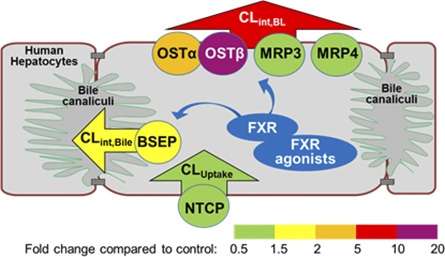
The farnesoid X receptor (FXR) is a nuclear receptor that regulates genes involved in bile acid homeostasis. FXR agonists, obeticholic acid (OCA) and chenodeoxycholic acid (CDCA), increase mRNA expression of efflux transporters in sandwich-cultured human hepatocytes (SCHH). This study evaluated the effects of OCA and CDCA treatment on the uptake, basolateral efflux, and biliary excretion of a model bile acid, taurocholate (TCA), in SCHH. In addition, changes in the protein expression of TCA uptake and efflux transporters were investigated. SCHH were treated with 1 M OCA, 100 M CDCA, or vehicle control for 72 hours followed by quantification of deuterated TCA uptake and efflux over time in Ca-containing and Ca-free conditions ( = 3 donors). A mechanistic pharmacokinetic model was fit to the TCA mass-time data to obtain estimates for total uptake clearance (CL), total intrinsic basolateral efflux clearance (CL), and total intrinsic biliary clearance (CL). Modeling results revealed that FXR agonists significantly increased CL by >6-fold and significantly increased CL by 2-fold, with minimal effect on CL Immunoblotting showed that protein levels of the basolateral transporter subunits organic solute transporter and (OST and OST) in FXR agonist-treated SCHH were significantly induced by >2.5- and 10-fold, respectively. FXR agonist-mediated changes in the expression of other TCA transporters in SCHH were modest. In conclusion, this is the first report demonstrating that OCA and CDCA increased TCA efflux in SCHH, which contributed to reduced intracellular TCA concentrations. Increased basolateral efflux of TCA was consistent with increased OST/ protein expression in OCA- and CDCA-treated SCHH.
法尼醇 X 受体 (FXR) 是一种核受体,可调节胆汁酸动态平衡相关基因的表达。FXR 激动剂,如奥贝胆酸 (OCA) 和鹅去氧胆酸 (CDCA),可增加人肝实质细胞 (SCHH) 中胆汁酸流出转运体的 mRNA 表达。本研究评估了 OCA 和 CDCA 处理对 SCHH 中模型胆汁酸牛磺胆酸 (TCA) 摄取、基底外侧外排和胆汁排泄的影响。此外,还研究了 TCA 摄取和外排转运体蛋白表达的变化。SCHH 用 1 M OCA、100 M CDCA 或载体对照处理 72 小时,然后在含有 Ca2+和不含 Ca2+的条件下(= 3 个供体)测定时间点上 TCA 的摄取和外排( = 3 个供体)。用一个机制性药代动力学模型拟合 TCA 质量-时间数据,以获得总摄取清除率 (CL)、总内在基底外侧外排清除率 (CL) 和总内在胆汁清除率 (CL) 的估计值。模型结果表明,FXR 激动剂使 CL 增加了 >6 倍,使 CL 增加了 2 倍,而对 CL 的影响最小。免疫印迹显示,FXR 激动剂处理的 SCHH 中基底外侧转运体亚基有机溶质转运蛋白 和 (OST 和 OST)的蛋白水平分别显著诱导增加了 >2.5 倍和 10 倍。FXR 激动剂介导的 SCHH 中其他 TCA 转运体表达的变化较小。总之,这是第一项表明 OCA 和 CDCA 增加 SCHH 中 TCA 外排的报告,这有助于降低细胞内 TCA 浓度。OCA 和 CDCA 处理的 SCHH 中 TCA 基底外侧外排的增加与 OST/蛋白表达的增加一致。