Division of Gastroenterology and Hepatology, Department of Internal Medicine III, Medical University of Vienna, Vienna, Austria.
Vienna Hepatic Hemodynamic Lab, Medical University of Vienna, Vienna, Austria.
Aliment Pharmacol Ther. 2021 Nov;54(10):1243-1262. doi: 10.1111/apt.16602. Epub 2021 Sep 23.
Bile acids are important endocrine modulators of intestinal and hepatic signalling cascades orchestrating critical pathophysiological processes in various liver diseases. Increasing knowledge on bile acid signalling has stimulated the development of synthetic ligands of nuclear bile acid receptors and other bile acid analogues.
This review summarises important aspects of bile acid-mediated crosstalk between the gut and the liver ("gut-liver axis") as well as recent findings from experimental and clinical studies.
We performed a literature review on bile acid signalling, and therapeutic applications in chronic liver disease.
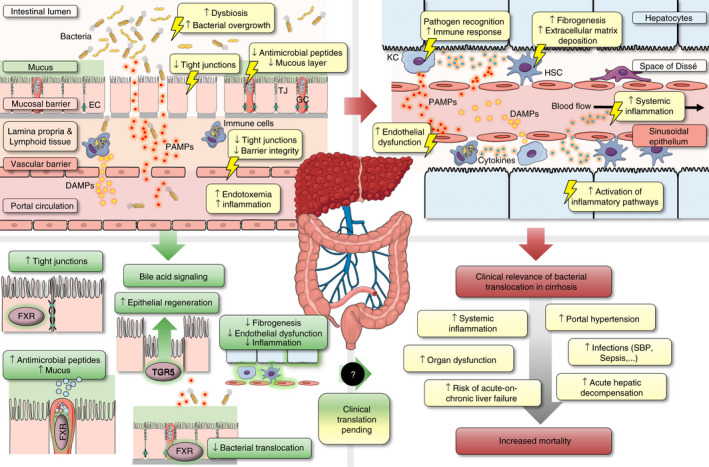
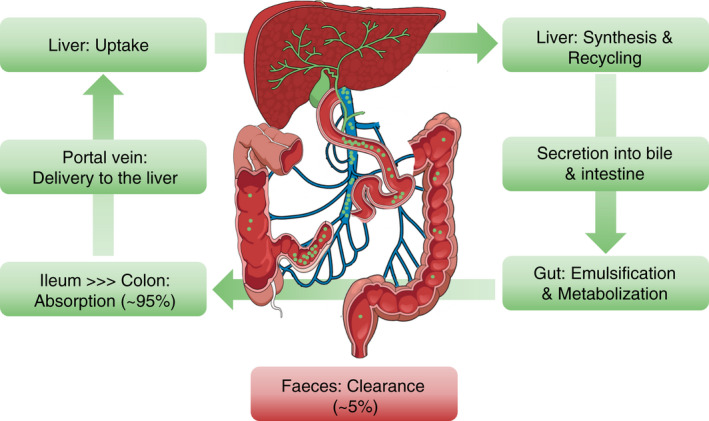
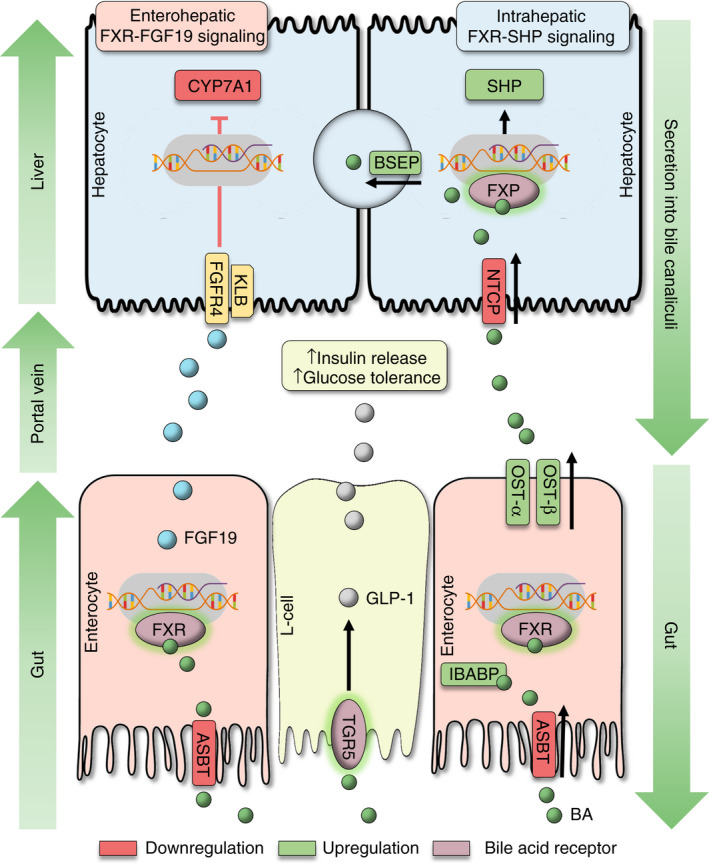
Intestinal and hepatic bile acid signalling pathways maintain bile acid homeostasis. Perturbations of bile acid-mediated gut-liver crosstalk dysregulate transcriptional networks involved in inflammation, fibrosis and endothelial dysfunction. Bile acids induce enterohepatic feedback signalling by the release of intestinal hormones, and regulate enterohepatic circulation. Importantly, bile acid signalling plays a central role in maintaining intestinal barrier integrity and antibacterial defense, which is particularly relevant in cirrhosis, where bacterial translocation has a profound impact on disease progression. The nuclear bile acid farnesoid X receptor (FXR) is a central intersection in bile acid signalling and has emerged as a relevant therapeutic target.
Experimental evidence suggests that bile acid signalling improves the intestinal barrier and protects against bacterial translocation in cirrhosis. FXR agonists have displayed efficacy for the treatment of cholestatic and metabolic liver disease in randomised controlled clinical trials. However, similar effects remain to be shown in advanced liver disease, particularly in patients with decompensated cirrhosis.
胆汁酸是调节肠道和肝脏信号级联的重要内源性调节剂,可调控多种肝脏疾病中的关键病理生理过程。对胆汁酸信号的深入了解,刺激了核胆汁酸受体的合成配体和其他胆汁酸类似物的发展。
本文总结了胆汁酸介导的肠-肝轴(gut-liver axis)相互作用的重要方面,以及来自实验和临床研究的最新发现。
我们对胆汁酸信号转导及其在慢性肝病中的治疗应用进行了文献回顾。
肠道和肝脏的胆汁酸信号通路维持胆汁酸的动态平衡。胆汁酸介导的肠-肝相互作用的紊乱会破坏参与炎症、纤维化和内皮功能障碍的转录网络。胆汁酸通过释放肠激素诱导肠肝反馈信号,并调节肠肝循环。重要的是,胆汁酸信号在维持肠道屏障完整性和抗菌防御中起着核心作用,这在肝硬化中尤为重要,因为细菌易位对疾病进展有深远影响。核胆汁酸法尼醇 X 受体(farnesoid X receptor,FXR)是胆汁酸信号的中心交汇点,已成为相关的治疗靶点。
实验证据表明,胆汁酸信号转导可改善肝硬化患者的肠道屏障功能并防止细菌易位。FXR 激动剂在随机对照临床试验中显示出对治疗胆汁淤积性和代谢性肝病的疗效。然而,在晚期肝病中,特别是在失代偿性肝硬化患者中,仍需要证明类似的效果。