Ji Ying, Mestrot Adrien, Schulin Rainer, Tandy Susan
Department of Environmental System Science, Institute of Terrestrial Ecosystems, ETH Zürich, Zürich, Switzerland.
Institute of Geography, Faculty of Science, University of Bern, Bern, Switzerland.
Front Plant Sci. 2018 Feb 13;9:140. doi: 10.3389/fpls.2018.00140. eCollection 2018.
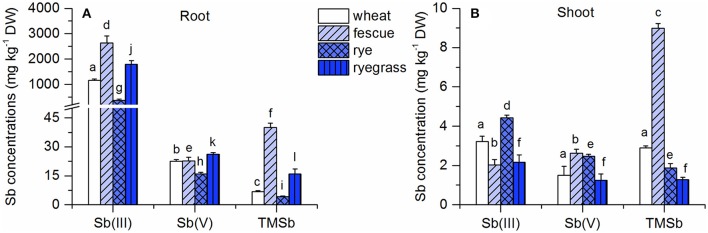
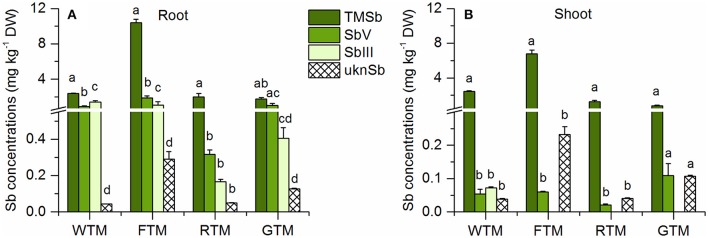
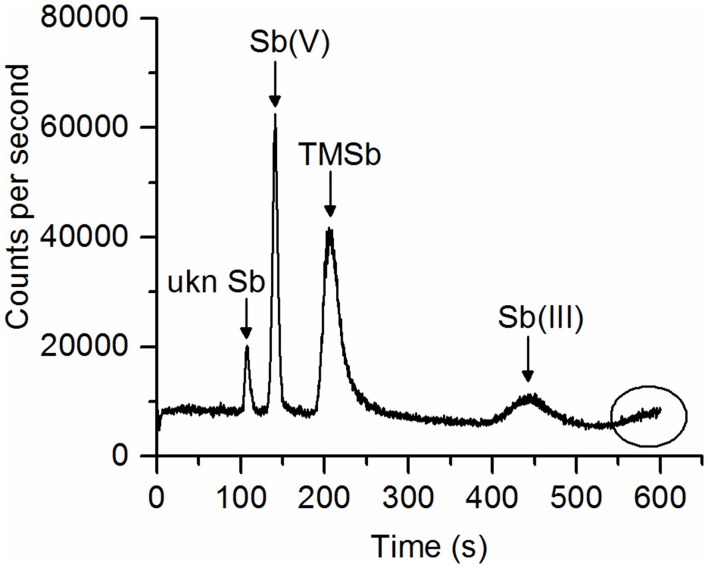
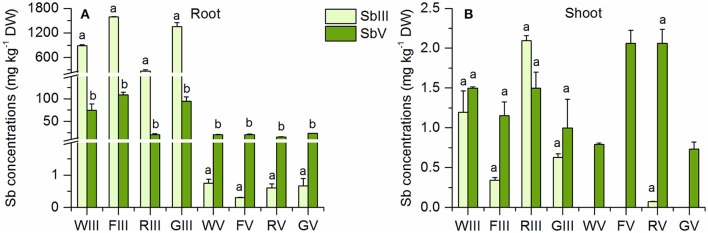
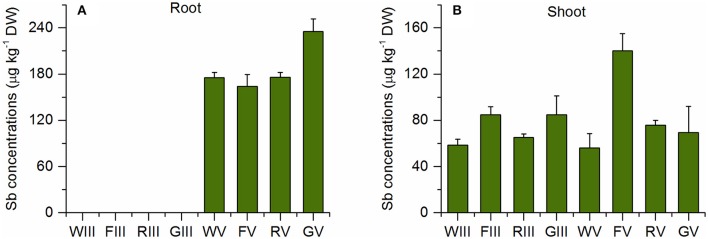
Used as a hardening agent in lead bullets, antimony (Sb) has become a major contaminant in shooting range soils of some countries including Switzerland. Soil contamination by Sb is also an environmental problem in countries with Sb-mining activities such as China and Bolivia. Because of its toxicity and relatively high mobility, there is concern over the risk of Sb transfer from contaminated soils into plants, and thus into the food chain. In particular there is very little information on the environmental behavior of methylated antimony, which can be produced by microbial biomethylation of inorganic Sb in contaminated soils. Using a new extraction and high-performance liquid chromatography inductively coupled plasma mass spectrometry (HPLC-ICP-MS) method, we investigated antimony speciation in roots and shoots of wheat, fescue, rye, and ryegrass plants exposed to trimethyl antimony(V) (TMSb), antimonite (Sb(III)), and antimonate (Sb(V)) in hydroponics. The total root Sb concentrations followed the order Sb(III) treatment > Sb(V) treatment > TMSb treatment, except for fescue. Shoot Sb concentrations, however, did not differ among the three treatments. In the Sb(V) treatment small quantities of TMSb were found in the roots, whereas no TMSb was detected in the roots of Sb(III)-treated plants. In contrast, similar concentrations of TMSb were found in the shoots in both inorganic Sb treatments. The results indicate that biomethylation of Sb may occur in plants. In the TMSb treatment TMSb was the major Sb species, but the two inorganic Sb species were also found both in shoots and roots along with some unknown Sb species, suggesting that also TMSb demethylation may occur within plant tissues. The results furthermore indicate that methylated Sb is more mobile in plants than inorganic Sb species. Knowledge about this is important in risk assessments of Sb-contaminated sites, as methylation may render Sb more toxic than inorganic Sb, as it is known for arsenic (As).
锑(Sb)在铅弹中用作硬化剂,已成为包括瑞士在内的一些国家靶场土壤中的主要污染物。在中国和玻利维亚等有锑矿开采活动的国家,锑对土壤的污染也是一个环境问题。由于其毒性和相对较高的迁移性,人们担心锑会从受污染土壤转移到植物中,进而进入食物链。特别是关于甲基化锑的环境行为的信息非常少,甲基化锑可由受污染土壤中无机锑的微生物生物甲基化产生。我们采用一种新的萃取和高效液相色谱-电感耦合等离子体质谱法(HPLC-ICP-MS),研究了水培条件下暴露于三甲基锑(V)(TMSb)、亚锑酸盐(Sb(III))和锑酸盐(Sb(V))的小麦、羊茅、黑麦和黑麦草植物根和地上部分的锑形态。除羊茅外,根中总锑浓度遵循Sb(III)处理>Sb(V)处理>TMSb处理的顺序。然而,三种处理的地上部分锑浓度没有差异。在Sb(V)处理中,根中发现少量TMSb,而在Sb(III)处理的植物根中未检测到TMSb。相反,在两种无机锑处理的地上部分中发现了相似浓度的TMSb。结果表明植物中可能发生锑的生物甲基化。在TMSb处理中,TMSb是主要的锑形态,但在地上部分和根中也发现了两种无机锑形态以及一些未知的锑形态,这表明植物组织内也可能发生TMSb去甲基化。结果还表明,甲基化锑在植物中的迁移性比无机锑形态更强。了解这一点在锑污染场地的风险评估中很重要,因为甲基化可能使锑比无机锑毒性更大,就像砷(As)一样。