Espinosa-Vellarino Francisco Luis, Garrido Inmaculada, Ortega Alfonso, Casimiro Ilda, Espinosa Francisco
Research Group of Physiology, Cellular and Molecular Biology of Plants, University of Extremadura, 06006 Badajoz, Spain.
Antioxidants (Basel). 2021 Oct 27;10(11):1698. doi: 10.3390/antiox10111698.
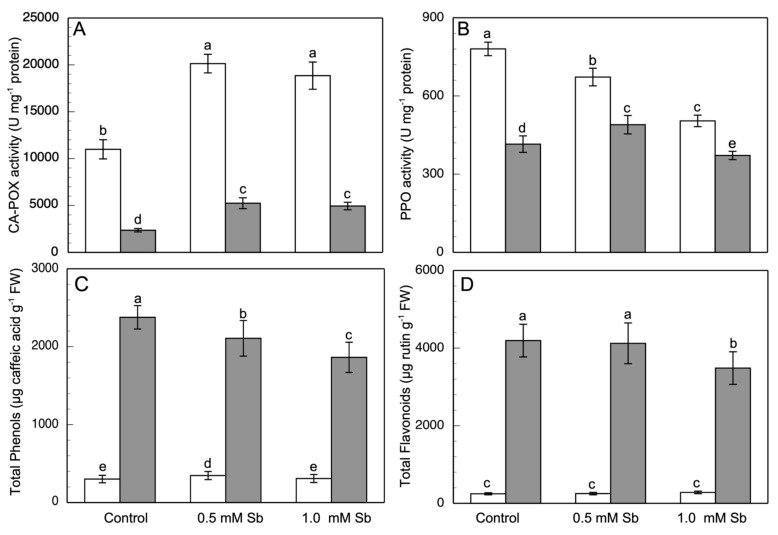
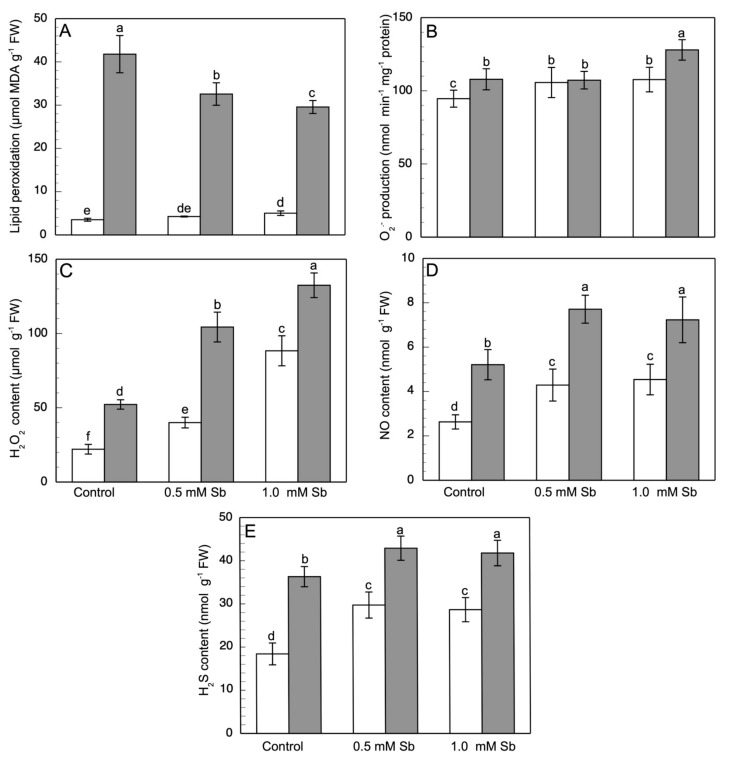
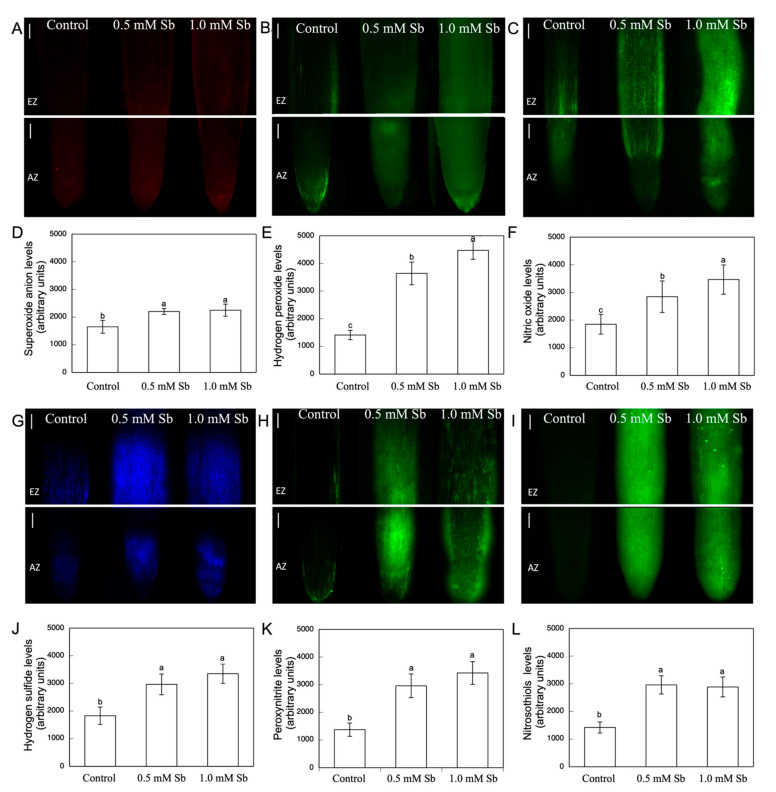
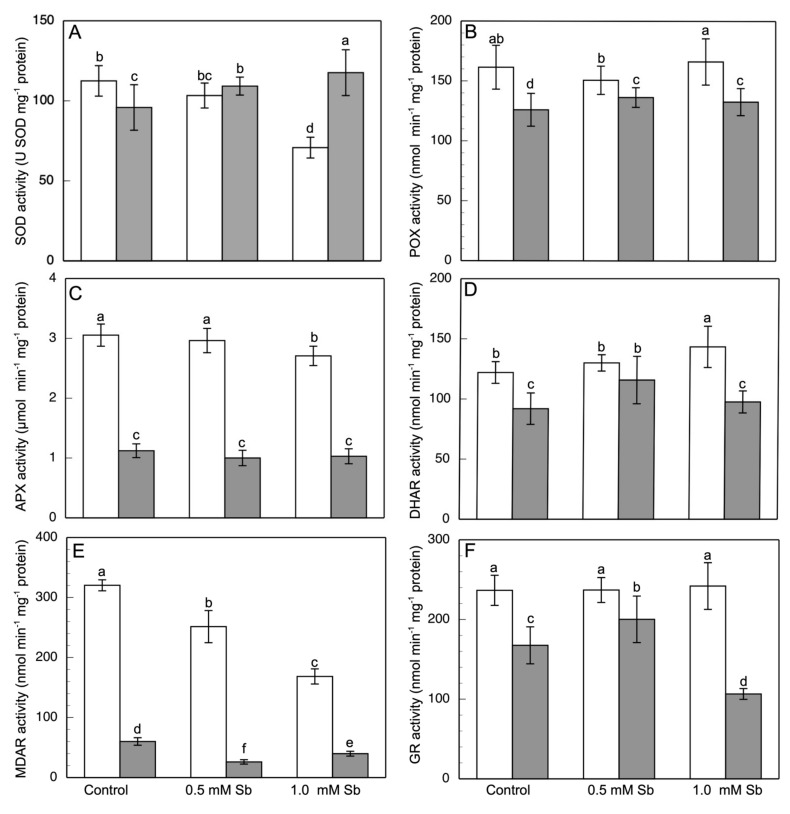
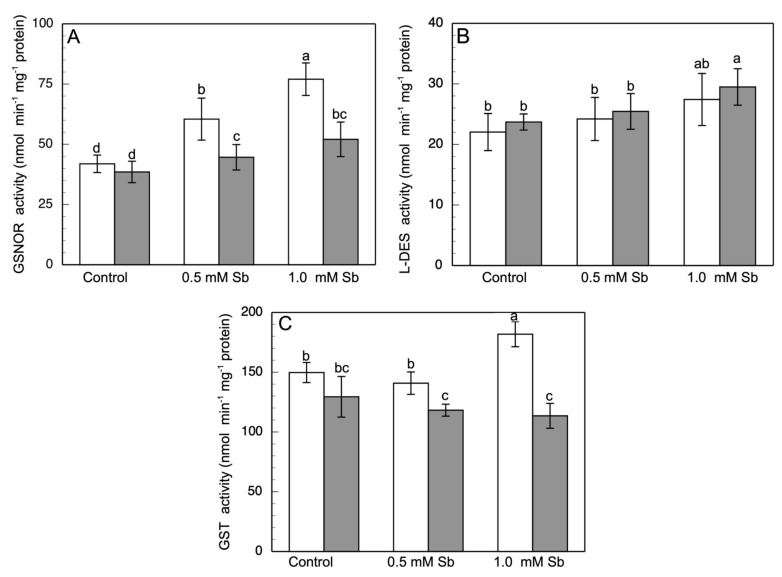
plants were grown hydroponically with different concentrations of Sb. There was preferential accumulation of Sb in roots. Fe and Cu decreased, while Mn decreased in roots but not in leaves. Chlorophyll content declined, but the carotenoid content increased, and photosynthetic efficiency was unaltered. O generation increased slightly, while lipid peroxidation increased only in roots. HO, NO, ONOO, S-nitrosothiols, and HS showed significant increases, and the enzymatic antioxidant system was altered. In roots, superoxide dismutase (SOD) and monodehydroascorbate reductase (MDAR) activities declined, dehydroscorbate reductase (DHAR) rose, and ascorbate peroxidase (APX), peroxidase (POX), and glutathione reductase (GR) were unaffected. In leaves, SOD and POX increased, MDAR decreased, and APX was unaltered, while GR increased. S-nitrosoglutathione reductase (GSNOR) and l-cysteine desulfhydrilase (l-DES) increased in activity, while glutathione S-transferase (GST) decreased in leaves but was enhanced in roots. Components of the AsA/GSH cycle decreased. The great capacity of roots to accumulate Sb is the reason for the differing behaviour observed in the enzymatic antioxidant systems of the two organs. Sb appears to act by binding to thiol groups, which can alter free GSH content and SOD and GST activities. The coniferyl alcohol peroxidase activity increased, possibly to lignify the roots' cell walls. Sb altered the ROS balance, especially with respect to HO. This led to an increase in NO and HS acting on the antioxidant system to limit that Sb-induced redox imbalance. The interaction NO, HS and HO appears key to the response to stress induced by Sb. The interaction between ROS, NO, and HS appears to be involved in the response to Sb.
植物在不同浓度的锑溶液中进行水培生长。锑在根部有优先积累现象。根部的铁和铜含量降低,而锰在根部含量降低但在叶片中未降低。叶绿素含量下降,但类胡萝卜素含量增加,光合效率未改变。O₂产生量略有增加,而脂质过氧化仅在根部增加。H₂O₂、NO、ONOO⁻、S-亚硝基硫醇和H₂S显著增加,酶促抗氧化系统发生改变。在根部,超氧化物歧化酶(SOD)和单脱氢抗坏血酸还原酶(MDAR)活性下降,脱氢抗坏血酸还原酶(DHAR)活性升高,抗坏血酸过氧化物酶(APX)、过氧化物酶(POX)和谷胱甘肽还原酶(GR)不受影响。在叶片中,SOD和POX活性增加,MDAR活性下降,APX未改变,而GR活性增加。S-亚硝基谷胱甘肽还原酶(GSNOR)和L-半胱氨酸脱硫酶(L-DES)活性增加,而谷胱甘肽S-转移酶(GST)在叶片中活性下降但在根部增强。抗坏血酸/谷胱甘肽循环的组分减少。根部积累锑的能力很强,这是两个器官酶促抗氧化系统表现出不同行为的原因。锑似乎通过与硫醇基团结合起作用,这会改变游离谷胱甘肽含量以及SOD和GST活性。松柏醇过氧化物酶活性增加,可能是为了使根部细胞壁木质化。锑改变了活性氧平衡,尤其是H₂O₂方面。这导致NO和H₂S增加,作用于抗氧化系统以限制锑诱导的氧化还原失衡。NO、H₂S和H₂O₂之间的相互作用似乎是对锑诱导应激反应的关键。活性氧、NO和H₂S之间的相互作用似乎参与了对锑的反应。