Ferguson Sherise D, Zhou Shouhao, Xiu Joanne, Hashimoto Yuuri, Sanai Nader, Kim Lyndon, Kesari Santosh, de Groot John, Spetzler David, Heimberger Amy B
Department of Neurosurgery, The University of Texas MD Anderson Cancer Center, Houston, TX, USA.
Department of Biostatistics, The University of Texas MD Anderson Cancer Center, Houston, TX, USA.
Oncotarget. 2017 Dec 15;9(8):7822-7831. doi: 10.18632/oncotarget.23288. eCollection 2018 Jan 30.
After surgery and radiation, treatment options for ependymoma are few making recurrence a challenging issue. Specifically, the efficacy of chemotherapy at recurrence is limited. We performed molecular profiling on a cohort of ependymoma cases in order to uncover therapeutic targets and to elucidate the molecular mechanisms contributing to treatment resistance.
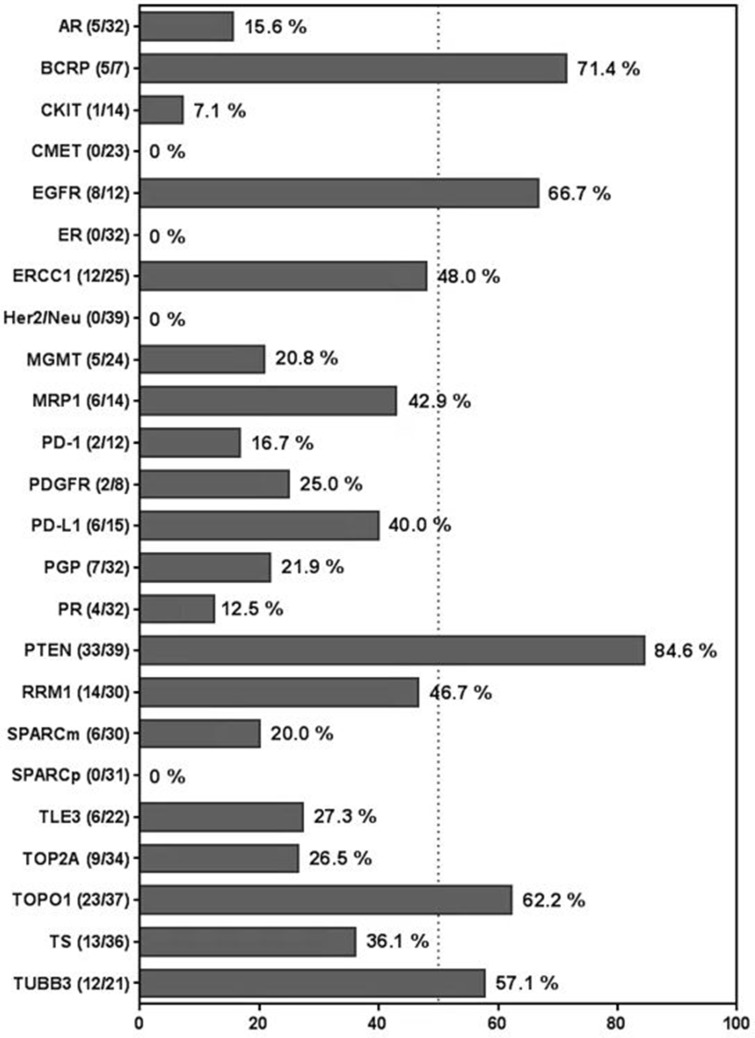
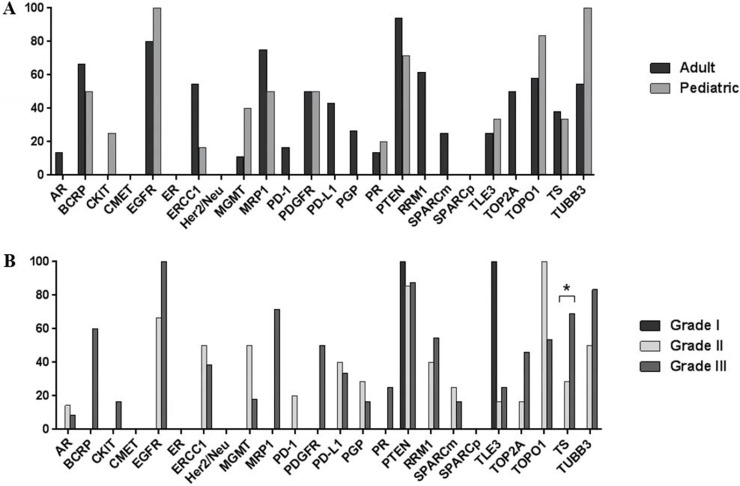
This ependymoma cohort showed minimal alterations in gene amplifications and mutations but had high expression rates of DNA synthesis and repair enzymes such as RRM1 (47%), ERCC1 (48%), TOPO1 (62%) and class III β-tublin (TUBB3) (57%), which are also all associated with chemoresistance. This cohort also had high expression rates of transporter proteins that mediate multi-drug resistance including BCRP (71%) and MRP1 (43%). Subgroup analyses showed that cranial ependymomas expressed the DNA synthesis enzyme TS significantly more frequently than spinal lesions did (57% versus 15%; = 0.0328) and that increased TS expression was correlated with increased tumor grade ( = 0.0009). High-grade lesions were also significantly associated with elevated expression of TOP2A ( = 0.0092) and TUBB3 ( = 0.0157).
We reviewed the characteristics of 41 ependymomas (21 cranial, 20 spinal; 8 grade I, 11 grade II, 22 grade III) that underwent multiplatform profiling with immunohistochemistry, next-generation sequencing, and hybridization.
Ependymomas are enriched with proteins involved in chemoresistance and in DNA synthesis and repair, which is consistent with the meager clinical effectiveness of conventional systemic therapy in ependymoma. Adjuvant therapies that combine conventional chemotherapy with the inhibition of chemoresistance-related proteins may represent a novel treatment paradigm for this difficult disease.
手术和放疗后,室管膜瘤的治疗选择有限,复发成为一个具有挑战性的问题。具体而言,复发时化疗的疗效有限。我们对一组室管膜瘤病例进行了分子分析,以发现治疗靶点并阐明导致治疗耐药的分子机制。
该室管膜瘤队列显示基因扩增和突变的改变最小,但DNA合成和修复酶如RRM1(47%)、ERCC1(48%)、TOPO1(62%)和III类β微管蛋白(TUBB3)(57%)的表达率较高,这些也都与化疗耐药相关。该队列中介导多药耐药的转运蛋白表达率也较高,包括BCRP(71%)和MRP1(43%)。亚组分析显示,颅室管膜瘤中DNA合成酶TS的表达频率显著高于脊髓病变(57%对15%;P = 0.0328),且TS表达增加与肿瘤分级增加相关(P = 0.0009)。高级别病变也与TOP2A(P = 0.0092)和TUBB3(P = 0.0157)表达升高显著相关。
我们回顾了41例室管膜瘤(21例颅部,20例脊髓;8例I级,11例II级,22例III级)的特征,这些病例通过免疫组织化学、二代测序和杂交进行了多平台分析。
室管膜瘤富含参与化疗耐药以及DNA合成和修复的蛋白质,这与传统全身治疗在室管膜瘤中临床疗效不佳一致。将传统化疗与抑制化疗耐药相关蛋白相结合的辅助治疗可能代表了这种难治性疾病的一种新治疗模式。