Institute for Risk Assessment Sciences , Utrecht University ; Yalelaan 104 , 3584 CM Utrecht , The Netherlands.
Graduate School of Oceanography , University of Rhode Island , South Ferry Road, URI Bay Campus , Narragansett , Rhode Island 02882 , United States.
Environ Sci Technol. 2018 Mar 20;52(6):3574-3582. doi: 10.1021/acs.est.7b05752. Epub 2018 Feb 28.
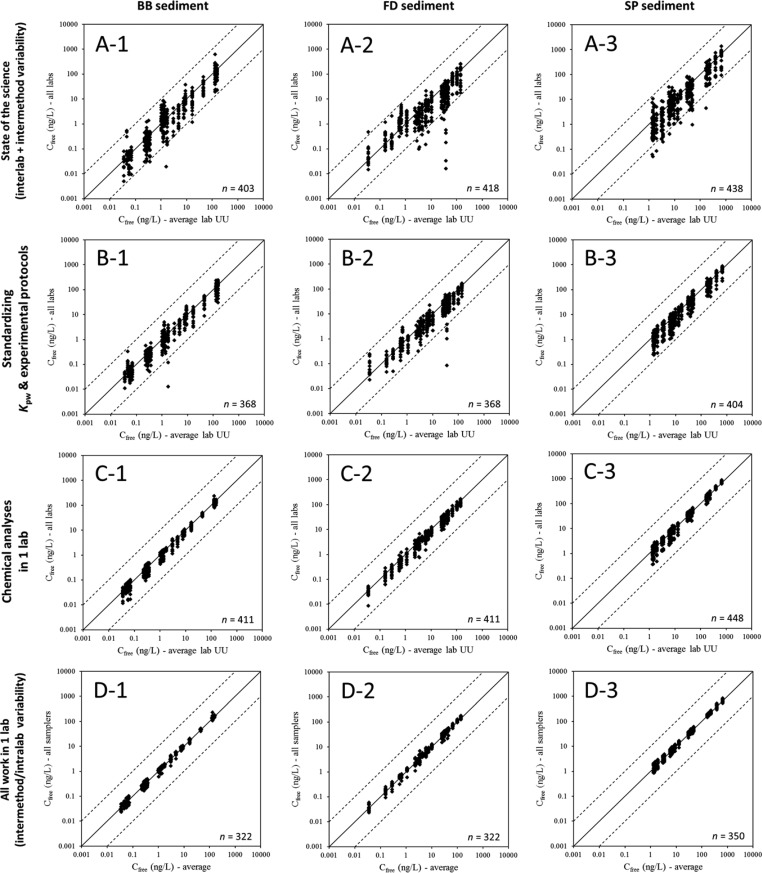
This work presents the results of an international interlaboratory comparison on ex situ passive sampling in sediments. The main objectives were to map the state of the science in passively sampling sediments, identify sources of variability, provide recommendations and practical guidance for standardized passive sampling, and advance the use of passive sampling in regulatory decision making by increasing confidence in the use of the technique. The study was performed by a consortium of 11 laboratories and included experiments with 14 passive sampling formats on 3 sediments for 25 target chemicals (PAHs and PCBs). The resulting overall interlaboratory variability was large (a factor of ∼10), but standardization of methods halved this variability. The remaining variability was primarily due to factors not related to passive sampling itself, i.e., sediment heterogeneity and analytical chemistry. Excluding the latter source of variability, by performing all analyses in one laboratory, showed that passive sampling results can have a high precision and a very low intermethod variability (<factor of 1.7). It is concluded that passive sampling, irrespective of the specific method used, is fit for implementation in risk assessment and management of contaminated sediments, provided that method setup and performance, as well as chemical analyses are quality-controlled.
本工作展示了一项国际沉积物原位被动采样实验室间比对的结果。主要目标是绘制被动采样沉积物方面的科学现状图,确定变异性的来源,为标准化被动采样提供建议和实际指导,并通过增加对该技术的使用信心,推动被动采样在监管决策中的应用。该研究由 11 个实验室组成的联盟进行,涉及 3 种沉积物上的 14 种被动采样格式和 25 种目标化学物质(多环芳烃和多氯联苯)的实验。结果表明,总体实验室间变异性很大(约 10 倍),但方法的标准化使这种变异性减半。剩余的变异性主要归因于与被动采样本身无关的因素,即沉积物的非均质性和分析化学。通过在一个实验室中进行所有分析,排除后者的变异性来源,表明被动采样结果具有很高的精密度和非常低的方法间变异性(<1.7 倍)。结论是,无论使用何种特定方法,只要方法设置和性能以及化学分析都经过质量控制,被动采样就适用于污染沉积物的风险评估和管理。