Yang Lu, Ma Guodong, Yu Tianyu, Gao Huikuan, Wang Yongliang, Wu Yongquan
Department of Cardiology, Beijing Friendship Hospital Beijing Key Laboratory of Metabolic Disorder Related Cardiovascular Disease, Beijing, China.
Medicine (Baltimore). 2018 Mar;97(9):e9900. doi: 10.1097/MD.0000000000009900.
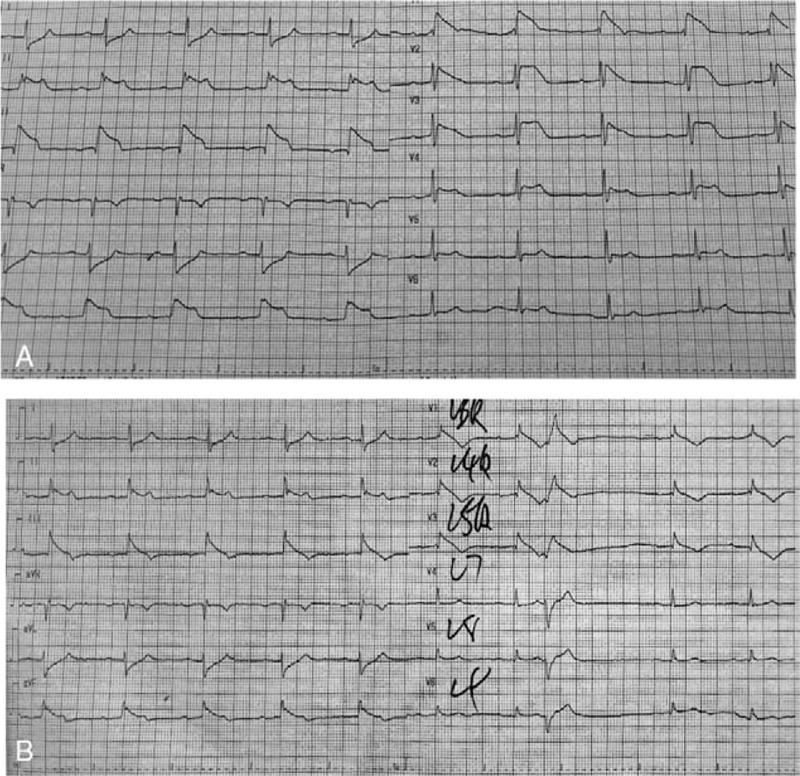
Vasospastic angina is caused by sudden occlusive vasoconstriction of a segment of an epicardial artery, with transient ST-segment elevation on electrocardiography. Brugada Syndrome is an inherited arrhythmogenic cardiac disorder with a diagnostic electrocardiography characterized by coved-type ST-segment elevation in right precordial leads (V1-V3). Those two diseases usually have no correlation. In this report, we discuss an interesting case of a patient who was diagnosed as vasospastic angina according to his coronary angiography, but his electrocardiography showed a Brugada-like ST-segment elevation.
Our patient had a 9-month history of temporary but progressive substernal burning sensation with acid bilges of shoulders and arms, as well as profuse sweating at night.
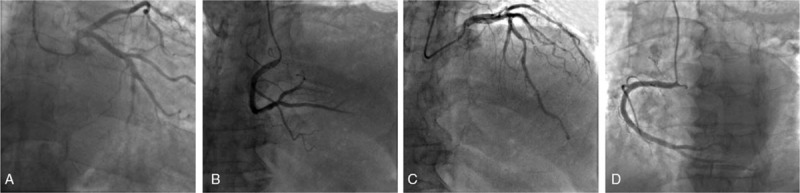
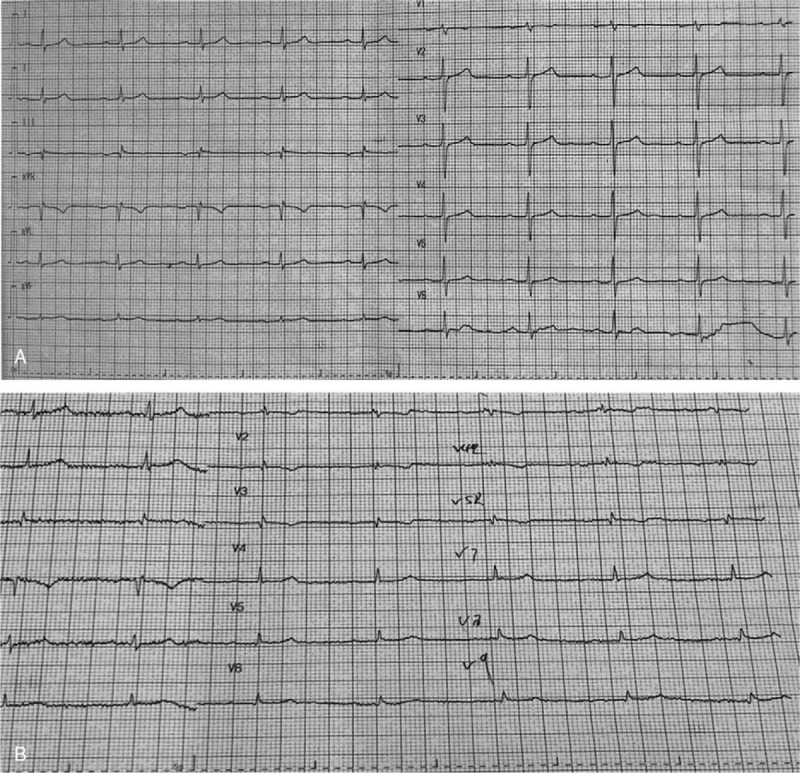
Although he had no abnormal laboratory test result, no dysfunctional recorded echocardiogram or documented arrhythmia after being admitted to the hospital, his electrocardiography showed a Brugada-like ST-segment elevation. The coronary angiography result confirmed a diagnosis of vasospastic angina.
The patient was prescribed diltiazem, aspirin, isosorbide mononitrate and rosuvastatin and was strongly advised to quit cigarettes and alcohol.
Follow-up at half a year turned out well.
This case links Brugada syndrome to coronary vasospasm. They may share similar mechanisms. Provocation test and gene test needs to be ran to distinguish both. Long-term follow-up is essential for it may bring a warning sign for life threatening ventricular arrhythmias.
变异性心绞痛是由心外膜动脉某一段突然闭塞性血管收缩引起的,心电图上有短暂的ST段抬高。Brugada综合征是一种遗传性致心律失常性心脏病,其诊断性心电图特征为右胸前导联(V1-V3)呈穹窿型ST段抬高。这两种疾病通常没有关联。在本报告中,我们讨论了一例有趣的病例,该患者根据冠状动脉造影被诊断为变异性心绞痛,但其心电图显示出类似Brugada综合征的ST段抬高。
我们的患者有9个月的病史,表现为胸骨后短暂但进行性的烧灼感,伴有肩部和手臂酸胀痛,以及夜间大量出汗。
尽管患者入院后实验室检查结果无异常,超声心动图未记录到功能障碍或心律失常,但他的心电图显示出类似Brugada综合征的ST段抬高。冠状动脉造影结果证实诊断为变异性心绞痛。
给患者开了地尔硫䓬、阿司匹林、单硝酸异山梨酯和瑞舒伐他汀,并强烈建议其戒烟戒酒。
半年后的随访情况良好。
该病例将Brugada综合征与冠状动脉痉挛联系起来。它们可能有相似的机制。需要进行激发试验和基因检测以区分两者。长期随访至关重要,因为它可能为危及生命的室性心律失常带来警示信号。