Cascaes Andreia Morales, Camargo Maria Beatriz Junqueira de, Castilhos Eduardo Dickie de, Silva Lexandre Emídio Ribeiro, Barros Aluísio J D
Departamento de Odontologia Social e Preventiva, Faculdade de Odontologia, Universidade Federal de Pelotas, Pelotas, RS, Brasil.
Centro de Pesquisas Epidemiológicas, Faculdade de Medicina, Universidade Federal de Pelotas, Pelotas, RS, Brasil.
Rev Saude Publica. 2018;52:24. doi: 10.11606/s1518-8787.2018052000340. Epub 2018 Feb 26.
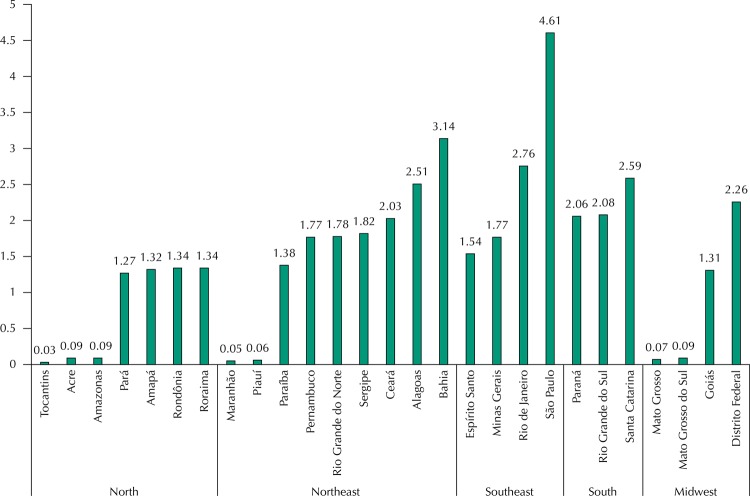
OBJECTIVE To quantify the household expenditure per capita and to estimate the percentage of Brazilian households that have spent with dental insurance. METHODS We analyzed data from 55,970 households that participated in the research Pesquisa de Orçamentos Familiares in 2008-2009. We have analyzed the annual household expenditure per capita with dental insurance (business and private) according to the Brazilian states and the socioeconomic and demographic characteristics of the households (sex, age, race, and educational level of the head of the household, family income, and presence of an older adult in the household). RESULTS Only 2.5% of Brazilian households have reported spending on dental insurance. The amount spent per capita amounted to R$5.10 on average, most of which consisted of private dental insurance (R$4.70). Among the characteristics of the household, higher educational level and income were associated with higher spending. São Paulo was the state with the highest household expenditure per capita (R$10.90) and with the highest prevalence of households with expenditures (4.6%), while Amazonas and Tocantins had the lowest values, in which both spent less than R$1.00 and had a prevalence of less than 0.1% of households, respectively. CONCLUSIONS Only a small portion of the Brazilian households has dental insurance expenditure. The market for supplementary dentistry in oral health care covers a restricted portion of the Brazilian population.
量化人均家庭支出,并估算购买了牙科保险的巴西家庭的比例。方法:我们分析了2008 - 2009年参与家庭预算调查(Pesquisa de Orçamentos Familiares)的55970个家庭的数据。我们根据巴西各州以及家庭的社会经济和人口特征(户主的性别、年龄、种族和教育水平、家庭收入以及家中是否有老年人),分析了家庭人均年度牙科保险支出(商业和私人)。结果:只有2.5%的巴西家庭报告有牙科保险支出。人均支出平均为5.10雷亚尔,其中大部分为私人牙科保险支出(4.70雷亚尔)。在家庭特征方面,较高的教育水平和收入与较高的支出相关。圣保罗是人均家庭支出最高的州(10.90雷亚尔),也是有支出家庭患病率最高的州(4.6%),而亚马孙州和托坎廷斯州的数值最低,这两个州的支出均低于1.00雷亚尔,家庭患病率分别低于0.1%。结论:只有一小部分巴西家庭有牙科保险支出。口腔卫生保健中的补充牙科市场覆盖的巴西人口比例有限。