Department of Hematology, The First Affiliated Hospital of Xiamen University and Institute of Hematology, Medical College of Xiamen University, Xiamen, 361003, People's Republic of China.
Key Laboratory of Regenerative Biology, Southern China Institute for Stem Cell Biology and Regenerative Medicine, Guangzhou Institutes of Biomedicine and Health, Chinese Academy of Sciences, Guangzhou, China.
J Transl Med. 2018 Feb 28;16(1):47. doi: 10.1186/s12967-018-1421-y.
Acute lymphoblastic leukemia (ALL) is a clonal malignant disorder characterized by an uncontrolled proliferation of immature B or T lymphocytes. Extensive studies have suggested an involvement of angiogenesis signaling in ALL progression and resistance to treatment. Thus, targeting angiogenesis with anti-angiogenic drugs may be a promising approach for ALL treatment. In this study, we investigated the effectiveness of Apatinib, a novel receptor tyrosine kinase inhibitor selectively targeting VEGFR-2 in ALL cells.
ALL cell lines were treated with different concentration of Apatinib and then CCK8 assay, flow cytometry were used to determine the IC value and cell apoptosis, respectively. The effect of Apatinib against primary ALL cells from 11 adult patients and normal counterparts were also analyzed by apoptosis with flow cytometry. Next, we used western bolting and mass cytometry (CyTOF) assay to explore the underlying mechanism of the cytotoxicity of Apatinib. Finally, the anti-leukemia activity was further evaluated in an in vivo xenograft model of ALL.
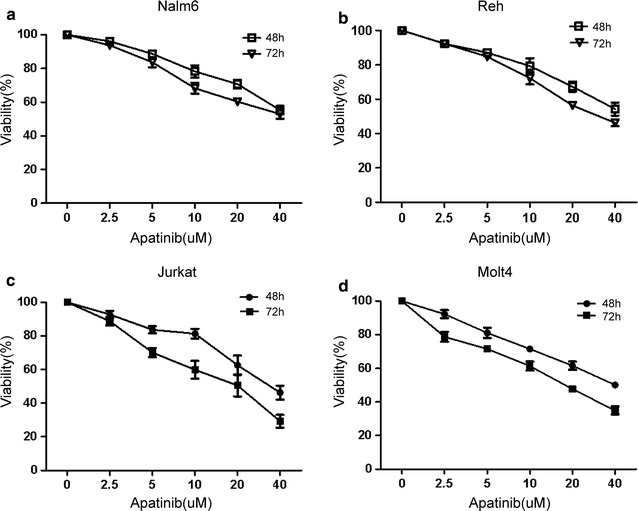
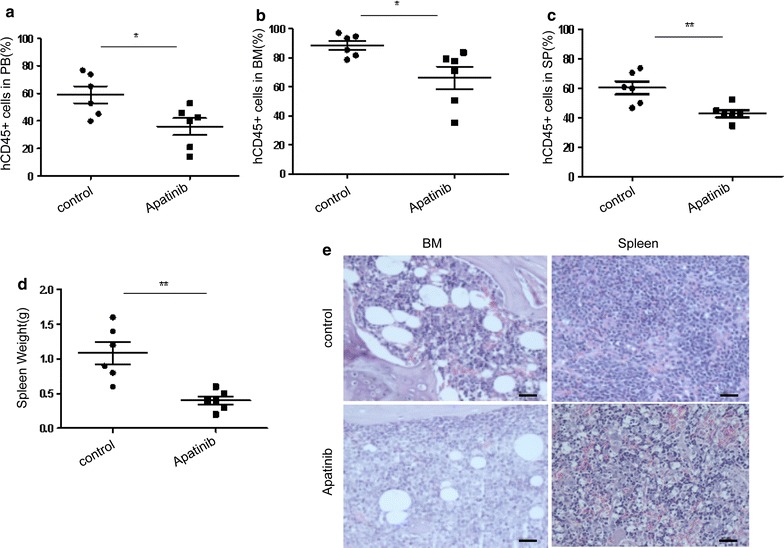
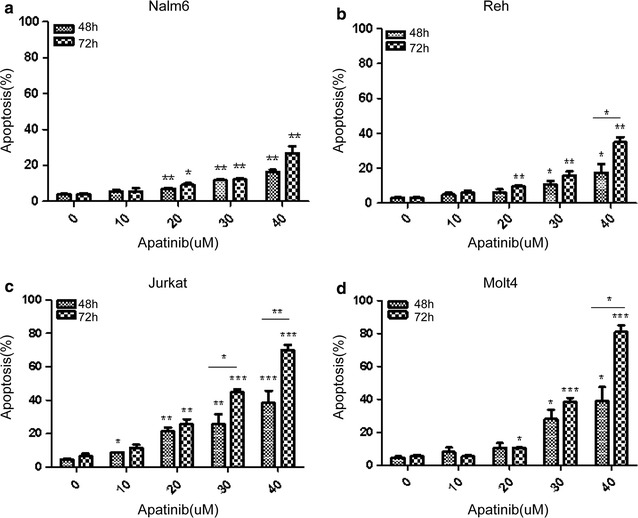
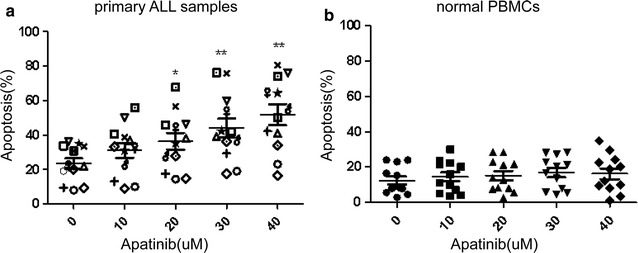
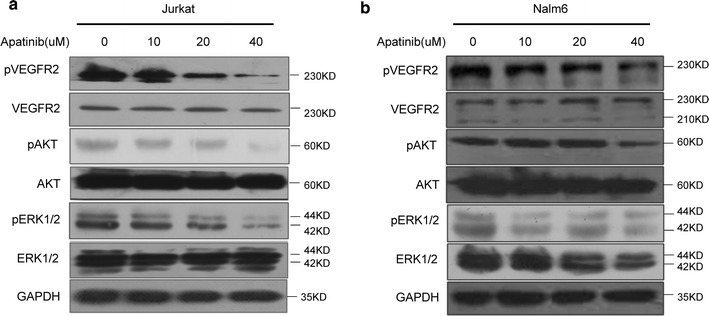
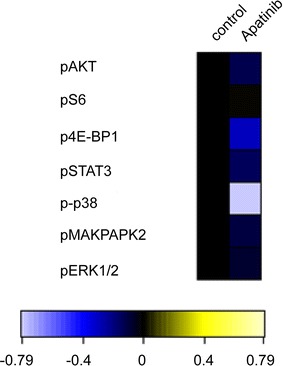
Our results showed that Apatinib significantly inhibited cell growth and promoted apoptosis in both B and T lineage ALL cell lines in a dose- and time-dependent manner. The IC values of Apatinib against Nalm6, Reh, Jurkat and Molt4 for 48 h were 55.76 ± 13.19, 51.53 ± 10.74, 32.43 ± 5.58, 39.91 ± 9.88 μmol/L, and for 72 h were 30.34 ± 2.65, 31.96 ± 3.92, 17.62 ± 5.90, and 17.65 ± 2.17 μmol/L respectively. Similarly, Apatinib shows cytotoxic activity against primary adult ALL cells while sparing their normal counterparts in vitro. Moreover, Apatinib suppressed ALL growth and progression in an in vivo xenograft model. Mechanistically, Apatinib-induced cytotoxicity was closely associated with inhibition of VEGFR2 and its downstream signaling cascades, including the PI3 K, MAPK and STAT3 pathways.
Our study indicates that Apatinib exerts its anti-leukemia effect by inducing apoptosis through suppressing the VEGFR2 signaling pathway, supporting a potential role for Apatinib in the treatment of ALL.
急性淋巴细胞白血病(ALL)是一种以不成熟 B 或 T 淋巴细胞不受控制增殖为特征的克隆性恶性疾病。大量研究表明,血管生成信号通路参与 ALL 的进展和治疗耐药。因此,用抗血管生成药物靶向血管生成可能是 ALL 治疗的一种有前途的方法。在这项研究中,我们研究了一种新型受体酪氨酸激酶抑制剂阿帕替尼(Apatinib)在 ALL 细胞中的作用,该抑制剂选择性靶向 VEGFR-2。
用不同浓度的阿帕替尼处理 ALL 细胞系,然后分别用 CCK8 测定法和流式细胞术确定 IC 值和细胞凋亡。还通过流式细胞术分析阿帕替尼对 11 例成人患者和正常对照的原代 ALL 细胞的作用。接下来,我们使用 Western blot 和质谱流式细胞术(CyTOF)检测来探讨阿帕替尼细胞毒性的潜在机制。最后,在 ALL 的体内异种移植模型中进一步评估了抗白血病活性。
我们的结果表明,阿帕替尼以剂量和时间依赖的方式显著抑制 B 和 T 谱系 ALL 细胞系的细胞生长并促进细胞凋亡。Nalm6、Reh、Jurkat 和 Molt4 对阿帕替尼的 48 h IC 值分别为 55.76±13.19、51.53±10.74、32.43±5.58 和 39.91±9.88 μmol/L,72 h IC 值分别为 30.34±2.65、31.96±3.92、17.62±5.90 和 17.65±2.17 μmol/L。同样,阿帕替尼在体外对原代成人 ALL 细胞具有细胞毒性活性,而对其正常对照无细胞毒性活性。此外,阿帕替尼在体内异种移植模型中抑制 ALL 的生长和进展。在机制上,阿帕替尼诱导的细胞毒性与 VEGFR2 及其下游信号级联,包括 PI3K、MAPK 和 STAT3 途径的抑制密切相关。
我们的研究表明,阿帕替尼通过抑制 VEGFR2 信号通路诱导细胞凋亡发挥抗白血病作用,支持阿帕替尼在 ALL 治疗中的潜在作用。