School of Rehabilitation, Université de Montréal, Montreal, QC, Canada.
Pathokinesiology Laboratory, Centre for Interdisciplinary Research in Rehabilitation of Greater Montreal, Centre intégré universitaire de santé et services sociaux du Centre-Sud-de-l'Île-de-Montréal, Installation Institut de réadaptation Gingras-Lindsay-de-Montréal, 6300 Avenue Darlington, Montreal, QC, H3S 2J4, Canada.
J Neuroeng Rehabil. 2018 Mar 1;15(1):12. doi: 10.1186/s12984-018-0354-2.
For individuals who sustain a complete motor spinal cord injury (SCI) and rely on a wheelchair as their primary mode of locomotion, overground robotic exoskeletons represent a promising solution to stand and walk again. Although overground robotic exoskeletons have gained tremendous attention over the past decade and are now being transferred from laboratories to clinical settings, their effects remain unclear given the paucity of scientific evidence and the absence of large-scale clinical trials. This study aims to examine the feasibility of a locomotor training program with an overground robotic exoskeleton in terms of recruitment, attendance, and drop-out rates as well as walking performance, learnability, and safety.
Individuals with a SCI were invited to participate in a 6 to 8-week locomotor training program with a robotic exoskeleton encompassing 18 sessions. Selected participants underwent a comprehensive screening process and completed two familiarization sessions with the robotic exoskeleton. The outcome measures were the rate of recruitment of potential participants, the rate of attendance at training sessions, the rate of drop-outs, the ability to walk with the exoskeleton, and its progression over the program as well as the adverse events.
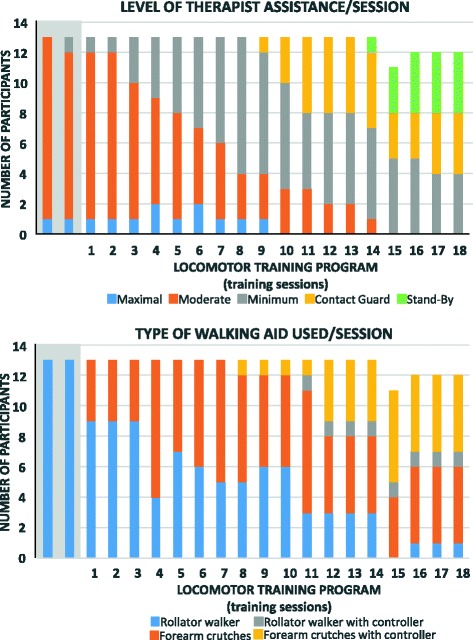
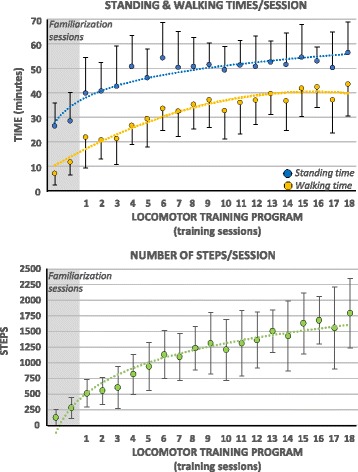
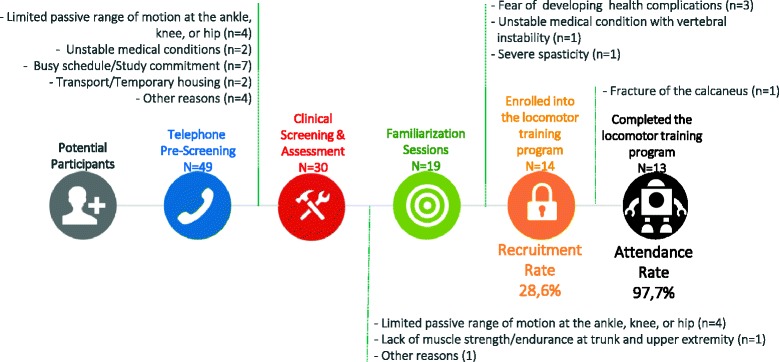
Out of 49 individuals who expressed their interest in participating in the study, only 14 initiated the program (recruitment rate = 28.6%). Of these, 13 individuals completed the program (drop-out rate = 7.1%) and attended 17.6 ± 1.1 sessions (attendance rate = 97.9%). Their greatest standing time, walking time, and number of steps taken during a session were 64.5 ± 10.2 min, 47.2 ± 11.3 min, and 1843 ± 577 steps, respectively. During the training program, these last three parameters increased by 45.3%, 102.1%, and 248.7%, respectively. At the end of the program, when walking with the exoskeleton, most participants required one therapist (85.7%), needed stand-by or contact-guard assistance (57.1%), used forearm crutches (71.4%), and reached a walking speed of 0.25 ± 0.05 m/s. Five participants reported training-related pain or stiffness in the upper extremities during the program. One participant sustained bilateral calcaneal fractures and stopped the program.
This study confirms that larger clinical trials investigating the effects of a locomotor training program with an overground robotic exoskeleton are feasible and relatively safe in individuals with complete motor SCI. Moreover, to optimize the recruitment rate and safety in future trials, this study now highlights the need of developing pre-training rehabilitation programs to increase passive lower extremity range of motion and standing tolerance. This study also calls for the development of clinical practice guidelines targeting fragility fracture risk assessment linked to the use of overground robotic exoskeletons.
对于完全性脊髓损伤(SCI)并依赖轮椅作为主要移动方式的个体,地面机器人外骨骼代表了重新站立和行走的有前途的解决方案。尽管地面机器人外骨骼在过去十年中引起了极大的关注,并且现在正在从实验室转移到临床环境中,但由于科学证据不足且缺乏大规模临床试验,其效果仍不清楚。本研究旨在考察在招募、出勤率和脱落率以及行走表现、可学习性和安全性方面,使用地面机器人外骨骼进行运动训练计划的可行性。
邀请 SCI 患者参加为期 6 至 8 周的机器人外骨骼运动训练计划,共 18 次。入选患者需经过全面的筛选过程,并完成两次机器人外骨骼的熟悉过程。主要观察指标是潜在参与者的招募率、参加训练课程的出勤率、脱落率、穿着外骨骼行走的能力以及在训练计划中的进展情况以及不良事件。
49 名表达参加研究兴趣的患者中,只有 14 名患者启动了计划(招募率为 28.6%)。其中,13 名患者完成了计划(脱落率为 7.1%),参加了 17.6±1.1 次课程(出勤率为 97.9%)。他们最大的站立时间、行走时间和每次训练的步数分别为 64.5±10.2 分钟、47.2±11.3 分钟和 1843±577 步。在训练期间,这三个参数分别增加了 45.3%、102.1%和 248.7%。在训练计划结束时,当穿着外骨骼行走时,大多数患者需要一位治疗师(85.7%)、需要Standby 或 Contact-Guard 辅助(57.1%)、使用前臂拐杖(71.4%),并达到 0.25±0.05m/s 的步行速度。有 5 名患者报告在训练期间上肢有训练相关的疼痛或僵硬。1 名患者双侧跟骨骨折并停止了计划。
本研究证实,在完全性运动 SCI 患者中,进行地面机器人外骨骼运动训练计划的更大规模临床试验是可行且相对安全的。此外,为了提高未来试验的招募率和安全性,本研究现在强调需要开发预训练康复计划,以增加被动下肢活动范围和站立耐受性。本研究还呼吁制定针对与地面机器人外骨骼使用相关的脆性骨折风险评估的临床实践指南。