• 文献检索
  • 文档翻译
  • 深度研究
  • 学术资讯
  • Suppr Zotero 插件Zotero 插件
  • 邀请有礼
  • 套餐&价格
  • 历史记录
应用&插件
Suppr Zotero 插件Zotero 插件浏览器插件Mac 客户端Windows 客户端微信小程序
定价
高级版会员购买积分包购买API积分包
服务
文献检索文档翻译深度研究API 文档MCP 服务
关于我们
关于 Suppr公司介绍联系我们用户协议隐私条款
关注我们

Suppr 超能文献

核心技术专利:CN118964589B侵权必究
粤ICP备2023148730 号-1Suppr @ 2026

文献检索

告别复杂PubMed语法,用中文像聊天一样搜索,搜遍4000万医学文献。AI智能推荐,让科研检索更轻松。

立即免费搜索

文件翻译

保留排版,准确专业,支持PDF/Word/PPT等文件格式,支持 12+语言互译。

免费翻译文档

深度研究

AI帮你快速写综述,25分钟生成高质量综述,智能提取关键信息,辅助科研写作。

立即免费体验

消费者对脊髓损伤康复中功能性电刺激和机器人外骨骼的看法:一项小型综述。

Consumer views of functional electrical stimulation and robotic exoskeleton in SCI rehabilitation: A mini review.

作者信息

Pei Yalian, Tobita Mari, Dirlikov Benjamin, Arnold Dannae, Tefertiller Candace, Gorgey Ashraf

机构信息

Department of Communication Disorders and Sciences, Syracuse University, Syracuse, New York, USA.

Departmentof Physical Medicine and Rehabilitation, Rancho Los Amigos National Rehabilitation Center, Downey, California, USA.

出版信息

Artif Organs. 2025 May;49(5):729-748. doi: 10.1111/aor.14925. Epub 2024 Dec 23.

DOI:10.1111/aor.14925
PMID:39711332
原文链接:https://pmc.ncbi.nlm.nih.gov/articles/PMC12019081/
Abstract

BACKGROUND

Functional electrical stimulation (FES) and robotic exoskeletons represent emerging technologies with significant potential for restoring critical physical functions such as standing and walking-functions that are most susceptible after spinal cord injury (SCI). However, the further development and successful integration of these technologies into clinical practice and daily life require a deep understanding of consumer perspectives.

OBJECTIVE

This review synthesizes consumer perspectives from a diverse range of technology stakeholders, including medical service providers, researchers, and persons affected by SCI-those living with SCI and their caregivers. By capturing this diverse range of perspectives, the review aims to describe the real-world implications, challenges, and expectations associated with FES and robotic exoskeleton technologies.

METHODS

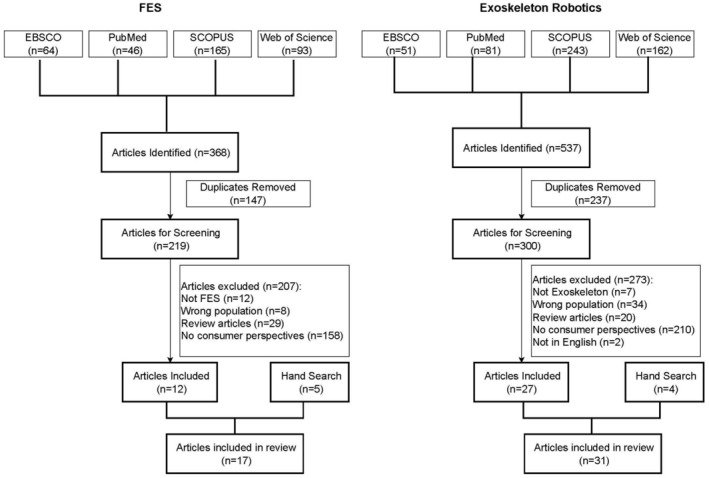
Relevant literature was primarily identified through a search in EBSCO, SCOPUS, and Web of Science. The authors supplemented the search by reviewing reference lists including appropriate articles identified by the authors. The PICO question guiding this process was defined as P (persons with SCI and caregivers, researchers, clinicians, and developers), I (use of FES or robotic exoskeletons), C (technology users compared to non-users), and O (stakeholder perspectives and experiences). Each identified article underwent a thorough appraisal, after which findings were summarized to present consumers' viewpoints on FES and robotic exoskeleton technologies.

RESULTS

The review focuses on key areas such as perceived benefits, limitations, implementation barriers, and consumer expectations. The benefits identified are multifaceted, extending from physical improvements, such as enhanced mobility and muscle strength, to psychological gains including increased confidence and sense of independence. However, these technologies also face perceived limitations, often related to accessibility, cost, and usability challenges. Beyond technical issues, implementation barriers are related to factors like insurance coverage and the need for specialized training for both users and providers. Consumer expectations include hope for technological advancements, increased accessibility and affordability, and a desire for more personalized and adaptable solutions tailored to the unique needs of individuals with SCI.

CONCLUSION

This comprehensive overview of consumer perspectives offers insights into the needs and preferences of the end-users, which are essential for creating user-centric technology and effectively translating research findings into clinical practice.

摘要

背景

功能性电刺激(FES)和机器人外骨骼代表了新兴技术,在恢复诸如站立和行走等关键身体功能方面具有巨大潜力,而这些功能在脊髓损伤(SCI)后最易受损。然而,这些技术的进一步发展以及成功融入临床实践和日常生活需要深入了解消费者的观点。

目的

本综述综合了来自不同技术利益相关者的消费者观点,包括医疗服务提供者、研究人员以及受SCI影响的人群——脊髓损伤患者及其护理人员。通过收集这些不同的观点,本综述旨在描述与FES和机器人外骨骼技术相关的实际影响、挑战和期望。

方法

相关文献主要通过在EBSCO、SCOPUS和科学网中进行检索来确定。作者通过查阅参考文献列表(包括作者确定的相关文章)对检索进行补充。指导这一过程的PICO问题定义为P(脊髓损伤患者及其护理人员、研究人员、临床医生和开发者)、I(使用FES或机器人外骨骼)、C(技术使用者与非使用者对比)和O(利益相关者的观点和经历)。对每一篇确定的文章进行全面评估,之后总结研究结果以呈现消费者对FES和机器人外骨骼技术的观点。

结果

本综述聚焦于感知到的益处、局限性、实施障碍和消费者期望等关键领域。所确定的益处是多方面的,从身体改善(如增强的移动性和肌肉力量)到心理收获(包括增强的自信心和独立感)。然而,这些技术也面临着感知到的局限性,通常与可及性、成本和可用性挑战有关。除了技术问题,实施障碍还与保险覆盖范围以及用户和提供者都需要专门培训等因素有关。消费者期望包括对技术进步的希望、更高的可及性和可承受性,以及渴望获得更符合脊髓损伤个体独特需求的个性化和适应性更强的解决方案。

结论

对消费者观点的这一全面概述提供了对终端用户需求和偏好的洞察,这对于创建以用户为中心的技术以及有效地将研究结果转化为临床实践至关重要。
https://cdn.ncbi.nlm.nih.gov/pmc/blobs/3498/12019081/6e7d71f4b5f2/AOR-49-729-g001.jpg

相似文献

1
Consumer views of functional electrical stimulation and robotic exoskeleton in SCI rehabilitation: A mini review.消费者对脊髓损伤康复中功能性电刺激和机器人外骨骼的看法:一项小型综述。
Artif Organs. 2025 May;49(5):729-748. doi: 10.1111/aor.14925. Epub 2024 Dec 23.
2
Hybrid FES-robot cooperative control of ambulatory gait rehabilitation exoskeleton.混合动力 FES-机器人协作控制助行康复外骨骼。
J Neuroeng Rehabil. 2014 Mar 4;11:27. doi: 10.1186/1743-0003-11-27.
3
Users with spinal cord injury experience of robotic Locomotor exoskeletons: a qualitative study of the benefits, limitations, and recommendations.脊髓损伤患者使用机器人助行外骨骼的体验:一项关于获益、局限和建议的定性研究。
J Neuroeng Rehabil. 2020 Sep 11;17(1):124. doi: 10.1186/s12984-020-00752-9.
4
A review of methods for achieving upper limb movement following spinal cord injury through hybrid muscle stimulation and robotic assistance.脊髓损伤后通过混合肌电刺激和机器人辅助实现上肢运动的方法综述。
Exp Neurol. 2020 Jun;328:113274. doi: 10.1016/j.expneurol.2020.113274. Epub 2020 Mar 5.
5
Perspectives of wheelchair users with chronic spinal cord injury following a walking program using a wearable robotic exoskeleton.使用可穿戴机器人外骨骼进行步行训练后慢性脊髓损伤轮椅使用者的观点
Disabil Rehabil. 2024 Dec;46(25):6204-6212. doi: 10.1080/09638288.2024.2317994. Epub 2024 Feb 15.
6
Exoskeletons for Personal Use After Spinal Cord Injury.脊髓损伤后的个人用外骨骼。
Arch Phys Med Rehabil. 2021 Feb;102(2):331-337. doi: 10.1016/j.apmr.2019.05.028. Epub 2019 Jun 20.
7
End-user and clinician perspectives on the viability of wearable functional electrical stimulation garments after stroke and spinal cord injury.脑卒中与脊髓损伤后可穿戴功能性电刺激服的用户和临床医生观点。
Disabil Rehabil Assist Technol. 2021 Apr;16(3):241-250. doi: 10.1080/17483107.2019.1668974. Epub 2019 Oct 8.
8
Locomotor training using an overground robotic exoskeleton in long-term manual wheelchair users with a chronic spinal cord injury living in the community: Lessons learned from a feasibility study in terms of recruitment, attendance, learnability, performance and safety.在社区中居住的长期使用手动轮椅的慢性脊髓损伤患者中使用地面机器人外骨骼进行运动训练:从一项可行性研究中吸取的关于招募、出勤率、可学习性、性能和安全性的经验教训。
J Neuroeng Rehabil. 2018 Mar 1;15(1):12. doi: 10.1186/s12984-018-0354-2.
9
Barriers and facilitators to exoskeleton use in persons with spinal cord injury: a systematic review.脊髓损伤患者使用外骨骼的障碍和促进因素:系统评价。
Disabil Rehabil Assist Technol. 2024 Aug;19(6):2355-2363. doi: 10.1080/17483107.2023.2287153. Epub 2023 Nov 27.
10
Satisfaction and perceptions of long-term manual wheelchair users with a spinal cord injury upon completion of a locomotor training program with an overground robotic exoskeleton.脊髓损伤的长期手动轮椅使用者在完成地面机器人外骨骼运动训练计划后的满意度和看法。
Disabil Rehabil Assist Technol. 2019 Feb;14(2):138-145. doi: 10.1080/17483107.2017.1413145. Epub 2017 Dec 19.

本文引用的文献

1
Exoskeletal-Assisted Walking in Veterans With Paralysis: A Randomized Clinical Trial.外骨骼辅助行走对瘫痪退伍军人的影响:一项随机临床试验。
JAMA Netw Open. 2024 Sep 3;7(9):e2431501. doi: 10.1001/jamanetworkopen.2024.31501.
2
Perspectives of wheelchair users with chronic spinal cord injury following a walking program using a wearable robotic exoskeleton.使用可穿戴机器人外骨骼进行步行训练后慢性脊髓损伤轮椅使用者的观点
Disabil Rehabil. 2024 Dec;46(25):6204-6212. doi: 10.1080/09638288.2024.2317994. Epub 2024 Feb 15.
3
Interleaved configurations of percutaneous epidural stimulation enhanced overground stepping in a person with chronic paraplegia.
经皮硬膜外刺激的交错配置增强了一名慢性截瘫患者的地面行走能力。
Front Neurosci. 2023 Dec 7;17:1284581. doi: 10.3389/fnins.2023.1284581. eCollection 2023.
4
Clinical Uptake of Pediatric Exoskeletons: Pilot Study Using the Consolidated Framework for Implementation Research.儿童外骨骼的临床应用:使用实施研究综合框架的试点研究
Am J Phys Med Rehabil. 2024 Apr 1;103(4):302-309. doi: 10.1097/PHM.0000000000002371. Epub 2023 Sep 26.
5
A qualitative study to elicit user requirements for lower limb wearable exoskeletons for gait rehabilitation in spinal cord injury.一项关于脊髓损伤患者步态康复用下肢可穿戴外骨骼用户需求的定性研究。
J Neuroeng Rehabil. 2023 Oct 17;20(1):138. doi: 10.1186/s12984-023-01264-y.
6
Factors that influence the adoption of rehabilitation technologies: a multi-disciplinary qualitative exploration.影响康复技术采用的因素:多学科定性探索。
J Neuroeng Rehabil. 2023 Jun 20;20(1):80. doi: 10.1186/s12984-023-01194-9.
7
Relevance of hazards in exoskeleton applications: a survey-based enquiry.外骨骼应用中的危险相关性:基于调查的探究。
J Neuroeng Rehabil. 2023 May 31;20(1):68. doi: 10.1186/s12984-023-01191-y.
8
Walking naturally after spinal cord injury using a brain-spine interface.使用脑-脊髓接口实现脊髓损伤后的自然行走。
Nature. 2023 Jun;618(7963):126-133. doi: 10.1038/s41586-023-06094-5. Epub 2023 May 24.
9
Effects of Functional Electrical Stimulation Cycling Combined With Arm Cranking Exercise on Cardiorespiratory Fitness in People With Central Nervous System Disorders: A Systematic Review and Meta-analysis.功能性电刺激骑行联合手臂曲柄运动对中枢神经系统疾病患者心肺适能的影响:一项系统评价与荟萃分析
Arch Phys Med Rehabil. 2023 Nov;104(11):1928-1940. doi: 10.1016/j.apmr.2023.03.026. Epub 2023 Apr 23.
10
Satisfaction analysis of overground gait exoskeletons in people with neurological pathology. a systematic review.地面行走外骨骼在神经病理患者中的满意度分析。系统评价。
J Neuroeng Rehabil. 2023 Apr 18;20(1):47. doi: 10.1186/s12984-023-01161-4.