Department of Molecular Biology and Biochemistry, University of California, Irvine, USA.
Institute for Memory Impairments and Neurological Disorders (UCIMIND), University of California, Irvine, USA.
Mol Neurodegener. 2018 Mar 1;13(1):11. doi: 10.1186/s13024-018-0244-x.
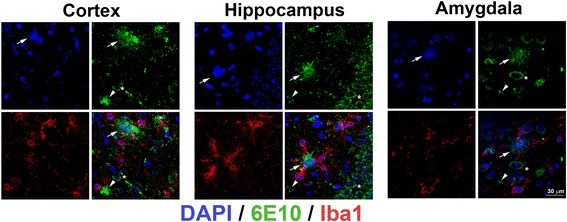
Besides the two main classical features of amyloid beta aggregation and tau-containing neurofibrillary tangle deposition, neuroinflammation plays an important yet unclear role in the pathophysiology of Alzheimer's disease (AD). Microglia are believed to be key mediators of neuroinflammation during AD and responsible for the regulation of brain homeostasis by balancing neurotoxicity and neuroprotective events. We have previously reported evidence that neuritic plaques are derived from dead neurons that have accumulated intraneuronal amyloid and further recruit Iba1-positive cells, which play a role in either neuronal demise or neuritic plaque maturation or both.
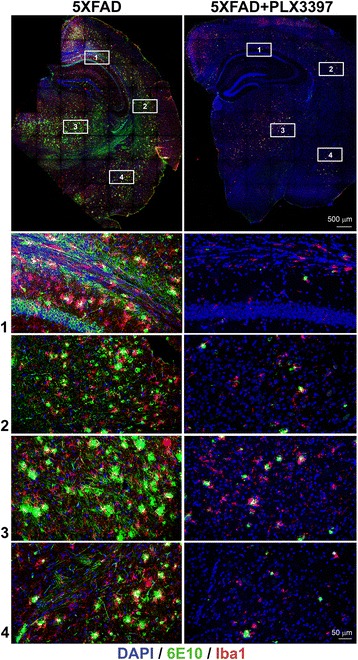
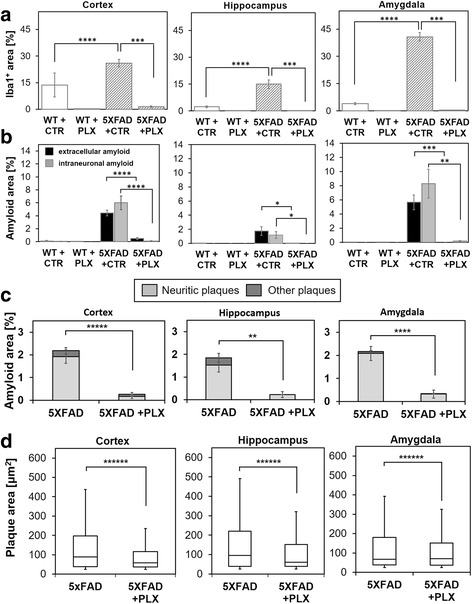
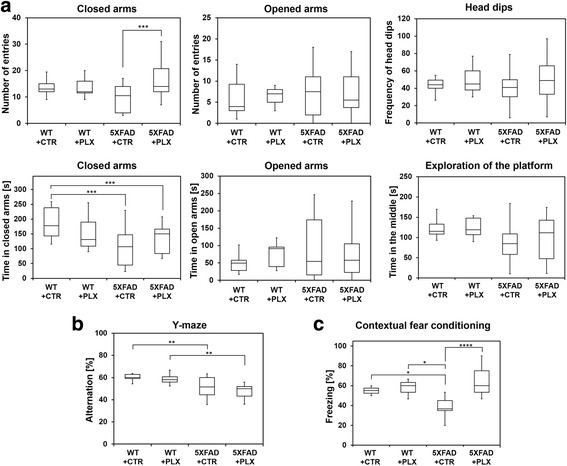
To study the impact of microglia on neuritic plaque development, we treated two-month-old 5XFAD mice with a selective colony stimulation factor 1 receptor (CSF1R) inhibitor, PLX3397, for a period of 3 months, resulting in a significant ablation of microglia. Directly after this treatment, we analyzed the amount of intraneuronal amyloid and neuritic plaques and performed behavioral studies including Y-maze, fear conditioning and elevated plus maze.
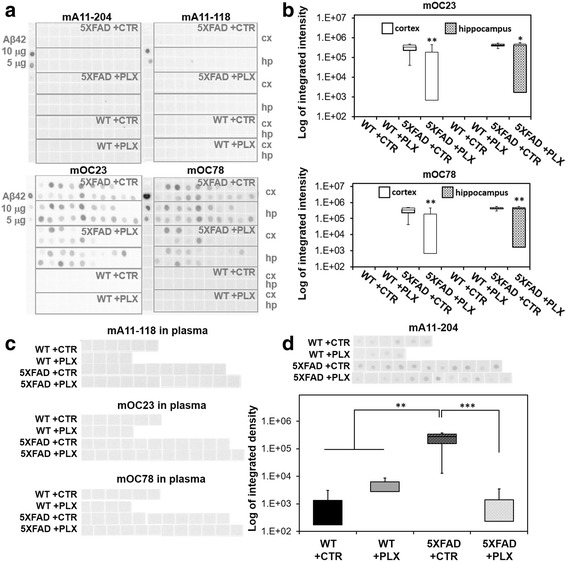
We found that early long-term PLX3397 administration results in a dramatic reduction of both intraneuronal amyloid as well as neuritic plaque deposition. PLX3397 treated young 5XFAD mice also displayed a significant decrease of soluble fibrillar amyloid oligomers in brain lysates, a depletion of soluble pre-fibrillar oligomers in plasma and an improvement in cognitive function measured by fear conditioning tests.
Our findings demonstrate that CSF1R signaling, either directly on neurons or mediated by microglia, is crucial for the accumulation of intraneuronal amyloid and formation of neuritic plaques, suggesting that these two events are serially linked in a causal pathway leading to neurodegeneration and neuritic plaque formation. CSF1R inhibitors represent potential preventative or therapeutic approach that target the very earliest stages of the formation of intraneuronal amyloid and neuritic plaques.
除了淀粉样β聚集和含有 tau 的神经原纤维缠结沉积这两个主要的经典特征外,神经炎症在阿尔茨海默病(AD)的病理生理学中起着重要但尚不清楚的作用。小胶质细胞被认为是 AD 期间神经炎症的关键介质,通过平衡神经毒性和神经保护事件来调节大脑内稳态。我们之前的研究报告表明,神经突斑块源自积累了细胞内淀粉样蛋白的死亡神经元,并进一步招募 Iba1 阳性细胞,这些细胞在神经元死亡或神经突斑块成熟或两者兼而有之的过程中发挥作用。
为了研究小胶质细胞对神经突斑块发展的影响,我们用选择性集落刺激因子 1 受体(CSF1R)抑制剂 PLX3397 处理两个月大的 5XFAD 小鼠 3 个月,导致小胶质细胞明显消融。在这种治疗后,我们分析了细胞内淀粉样蛋白和神经突斑块的含量,并进行了行为学研究,包括 Y 迷宫、恐惧条件反射和高架十字迷宫。
我们发现,早期长期给予 PLX3397 可显著减少细胞内淀粉样蛋白和神经突斑块的沉积。PLX3397 处理的年轻 5XFAD 小鼠的脑裂解液中可溶性纤维状淀粉样寡聚物的含量也显著降低,血浆中可溶性原纤维状寡聚物的含量减少,并且恐惧条件反射测试表明认知功能得到改善。
我们的研究结果表明,CSF1R 信号转导,无论是直接作用于神经元还是通过小胶质细胞介导,对于细胞内淀粉样蛋白的积累和神经突斑块的形成都是至关重要的,这表明这两个事件在导致神经退行性变和神经突斑块形成的因果途径中是连续发生的。CSF1R 抑制剂代表了针对细胞内淀粉样蛋白和神经突斑块形成的最早阶段的潜在预防或治疗方法。