Domingues Catarina, da Cruz E Silva Odete A B, Henriques Ana Gabriela
Neurosciences and Signalling Laboratory, Department of Medical Sciences and Institute of Biomedicine - iBiMED, University of Aveiro, 3810-193 Aveiro, Portugal.
Neurosciences and Signalling Laboratory, Department of Medical Sciences and Institute of Biomedicine - iBiMED, University of Aveiro, P.O. Box: 3810-193, Aveiro, Portugal.
Curr Alzheimer Res. 2017;14(8):870-882. doi: 10.2174/1567205014666170317113606.
Alzheimer's disease (AD) is the most common neurodegenerative disorder, neuropathologically characterized by aggregates of β-amyloid peptides, which deposit as senile plaques, and of TAU protein, which forms neurofibrillary tangles. It is now widely accepted that neuroinflammation is implicated in AD pathogenesis.
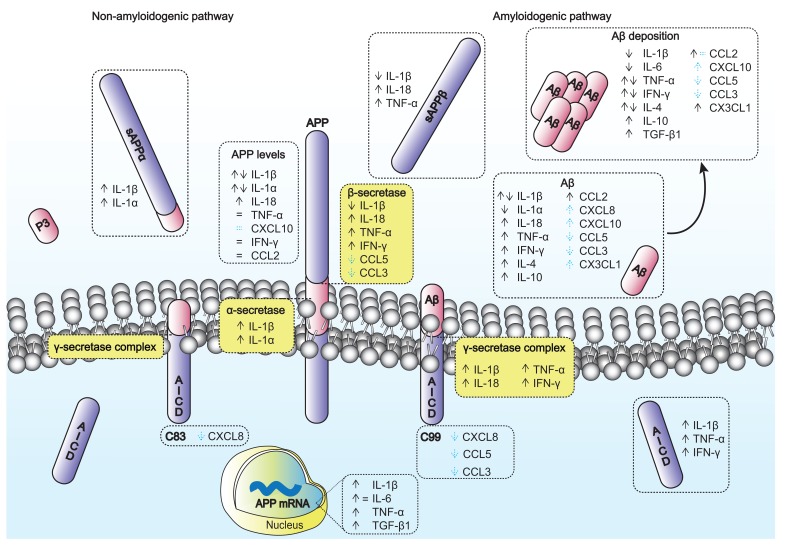
Indeed, inflammatory mediators, such as cytokines and chemokines (chemotactic cytokines) can impact on the Alzheimer´s amyloid precursor protein by affecting its expression levels and amyloidogenic processing and/or β -amyloid aggregation. Additionally, cytokines and chemokines can influence kinases' activities, leading to abnormal TAU phosphorylation. To date there is no cure for AD, but several therapeutic strategies have been directed to prevent neuroinflammation. Anti-inflammatory, but also anti-amyloidogenic compounds, such as flavonoids were shown to favourably modulate some pathological events associated with neurodegeneration.
This review focuses on the role of cytokines and chemokines in AD-associated pathologies, and summarizes the potential anti-inflammatory therapeutic approaches aimed at preventing or slowing down disease progression.
阿尔茨海默病(AD)是最常见的神经退行性疾病,其神经病理学特征是β-淀粉样肽聚集形成老年斑,以及TAU蛋白形成神经原纤维缠结。目前人们普遍认为神经炎症与AD发病机制有关。
事实上,炎症介质,如细胞因子和趋化因子(趋化性细胞因子)可通过影响阿尔茨海默病淀粉样前体蛋白的表达水平、淀粉样生成过程和/或β-淀粉样蛋白聚集来对其产生影响。此外,细胞因子和趋化因子可影响激酶的活性,导致TAU蛋白异常磷酸化。迄今为止,AD尚无治愈方法,但已有多种治疗策略致力于预防神经炎症。抗炎以及抗淀粉样生成的化合物,如类黄酮,已被证明可有利地调节一些与神经退行性变相关的病理事件。
本综述聚焦于细胞因子和趋化因子在AD相关病理中的作用,并总结了旨在预防或减缓疾病进展的潜在抗炎治疗方法。