Tianjin Key Laboratory of Metabolic Diseases, Tianjin Metabolic Diseases Hospital and Tianjin Institute of Endocrinology, Tianjin Medical University, Tianjin, China (mainland).
Med Sci Monit. 2018 Mar 1;24:1241-1250. doi: 10.12659/msm.909011.
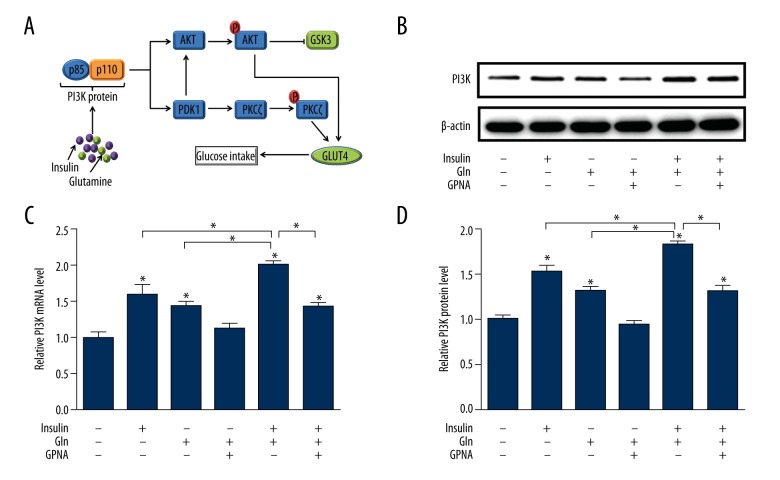
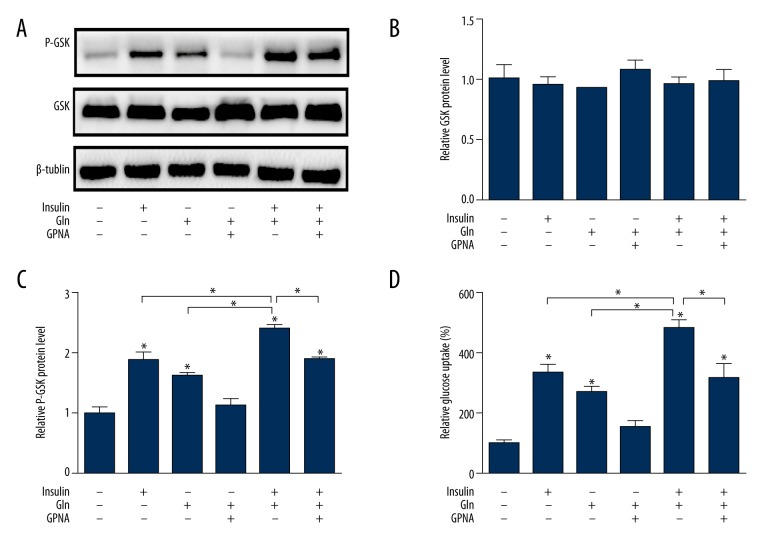
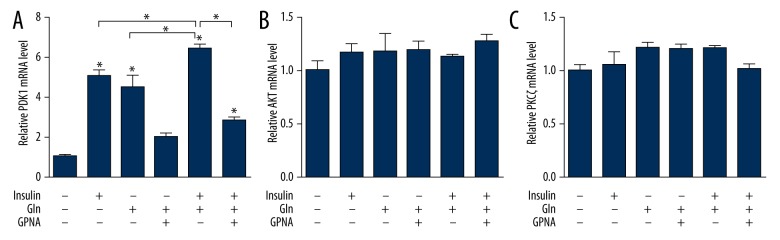
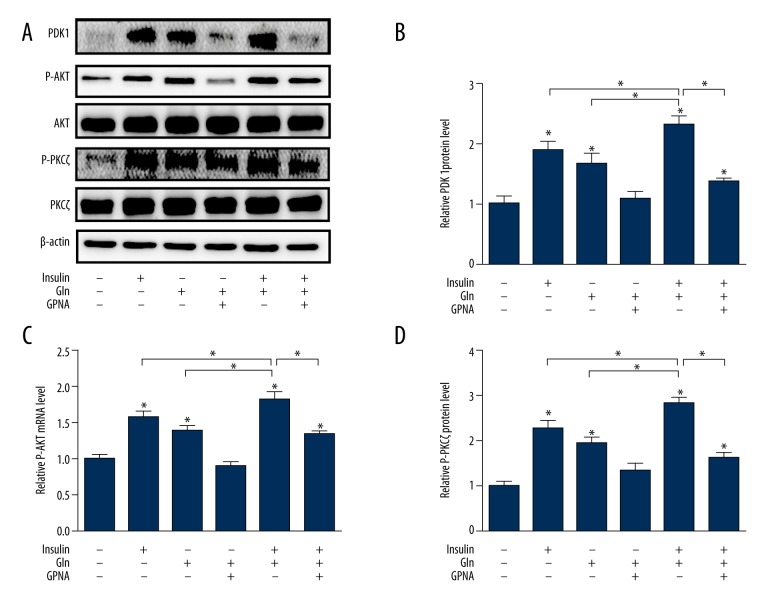
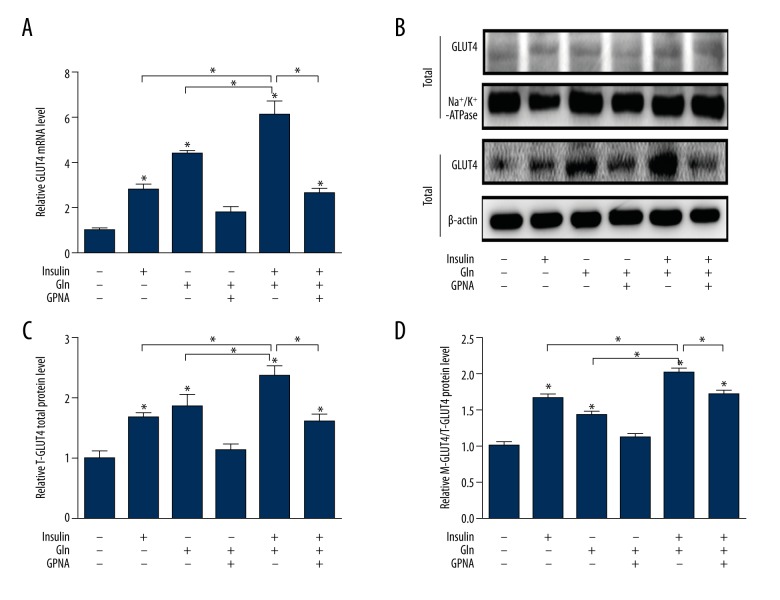
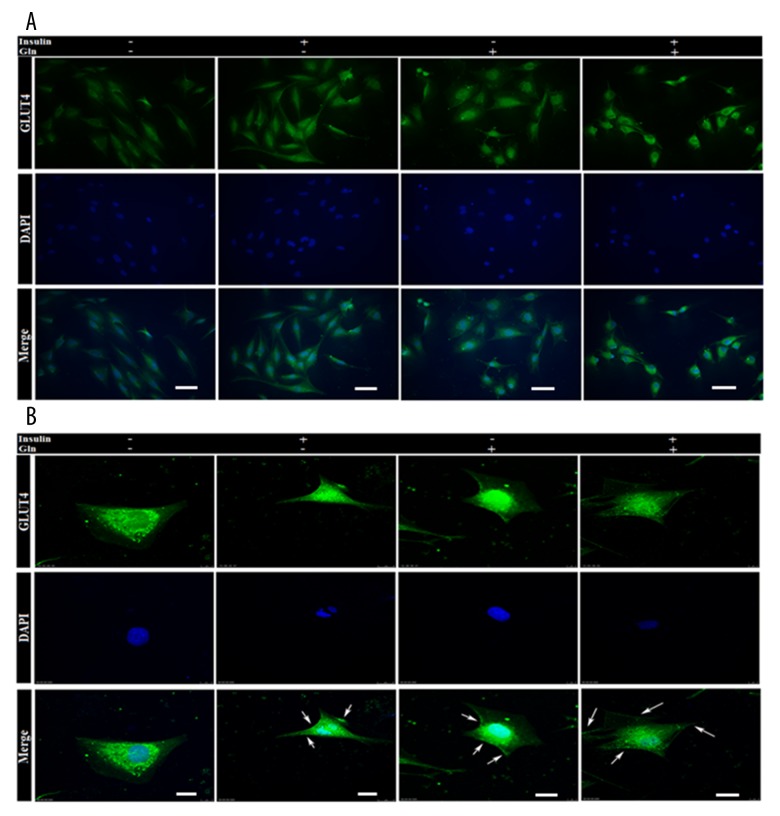
BACKGROUND Diabetes mellitus (DM) is characterized by a decreased blood level of glutamine (Gln), which may contribute to the disturbance in the effect of insulin on skeletal muscle. Therefore, it is crucial to study how to improve the effect of insulin on skeletal muscle by increasing Gln. In the present study, we investigated the effect of Gln on the hypoglycemic action of insulin in skeletal muscle L6 cells at high glucose levels through the insulin signaling pathway and glycogen synthesis pathway. MATERIAL AND METHODS The L6 cells were cultured in and stimulated by Gln and insulin. The glutamine analogue, L-Gamma-Glutamyl-p-nitroanilide (GPNA), was used for verifying the effect of Gln. The expression of insulin signaling molecules, including phosphatidylinositol-3-kinase (PI3K), 3-phosphoinositide-dependent protein kinase-1 (PDK1), protein kinase B (AKT), protein kinase C zeta (PKCz), and glucose transporter 4 (GLUT4), were detected by real-time PCR and Western blot analysis, GLUT4 translocation was observed by immunofluorescence staining, glycogen synthase kinase (GSK) was analyzed by Western blotting, and glucose uptake was measured by glucose oxidase method (GOD). RESULTS The results demonstrated that Gln combined with insulin remarkably up-regulated PI3K and PDK1 and also increased AKT and PKCz phosphorylation. The present study shows that Gln enhanced the impact of insulin on GLUT4 and its translocation. The results of glucose uptake and GSK phosphorylation further confirmed the hypoglycemic effect of Gln accompanied with insulin. The hypoglycemic effect of Gln was reversed by GPNA. CONCLUSIONS These findings suggest that Gln enhances the hypoglycemic role of insulin through the PI3K/AKT/GLUT4 signaling pathway and glycogen synthesis pathway.
糖尿病(DM)的特征是血 glutamine(Gln)水平降低,这可能导致胰岛素对骨骼肌的作用紊乱。因此,研究如何通过增加 Gln 来提高胰岛素对骨骼肌的作用至关重要。在本研究中,我们通过胰岛素信号通路和糖原合成通路研究了 Gln 对高糖水平下骨骼肌 L6 细胞中胰岛素的降血糖作用。
将 L6 细胞在 Gln 和胰岛素的刺激下进行培养。使用 Gln 的类似物 L-Gamma-Glutamyl-p-nitroanilide(GPNA)来验证 Gln 的作用。通过实时 PCR 和 Western blot 分析检测胰岛素信号分子的表达,包括磷脂酰肌醇-3-激酶(PI3K)、3-磷酸肌醇依赖性蛋白激酶-1(PDK1)、蛋白激酶 B(AKT)、蛋白激酶 C ζ(PKCz)和葡萄糖转运蛋白 4(GLUT4),通过免疫荧光染色观察 GLUT4 易位,通过 Western blot 分析检测糖原合酶激酶(GSK),通过葡萄糖氧化酶法(GOD)测量葡萄糖摄取量。
结果表明,Gln 与胰岛素联合使用可显著上调 PI3K 和 PDK1,同时增加 AKT 和 PKCz 磷酸化。本研究表明,Gln 增强了胰岛素对 GLUT4 及其易位的影响。葡萄糖摄取和 GSK 磷酸化的结果进一步证实了 Gln 与胰岛素协同的降血糖作用。GPNA 逆转了 Gln 的降血糖作用。
这些发现表明,Gln 通过 PI3K/AKT/GLUT4 信号通路和糖原合成通路增强了胰岛素的降血糖作用。