Goodrich Jaclyn M, Dolinoy Dana C, Sánchez Brisa N, Zhang Zhenzhen, Meeker John D, Mercado-Garcia Adriana, Solano-González Maritsa, Hu Howard, Téllez-Rojo Martha M, Peterson Karen E
Department of Environmental Health Sciences, University of Michigan School of Public Health, Ann Arbor, MI, USA.
Department of Nutritional Sciences, University of Michigan School of Public Health, Ann Arbor, MI, USA.
Environ Epigenet. 2016 Aug 14;2(3):dvw018. doi: 10.1093/eep/dvw018. eCollection 2016 Aug.
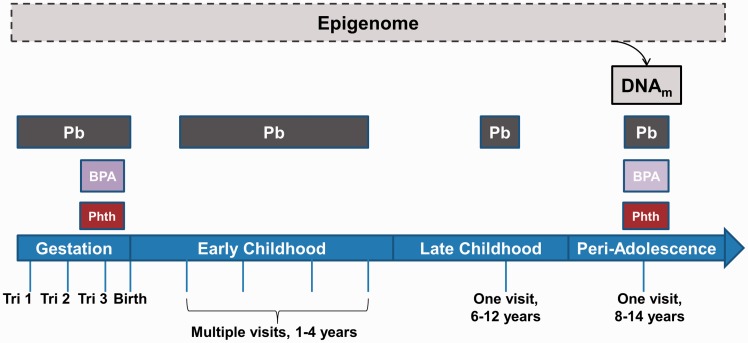
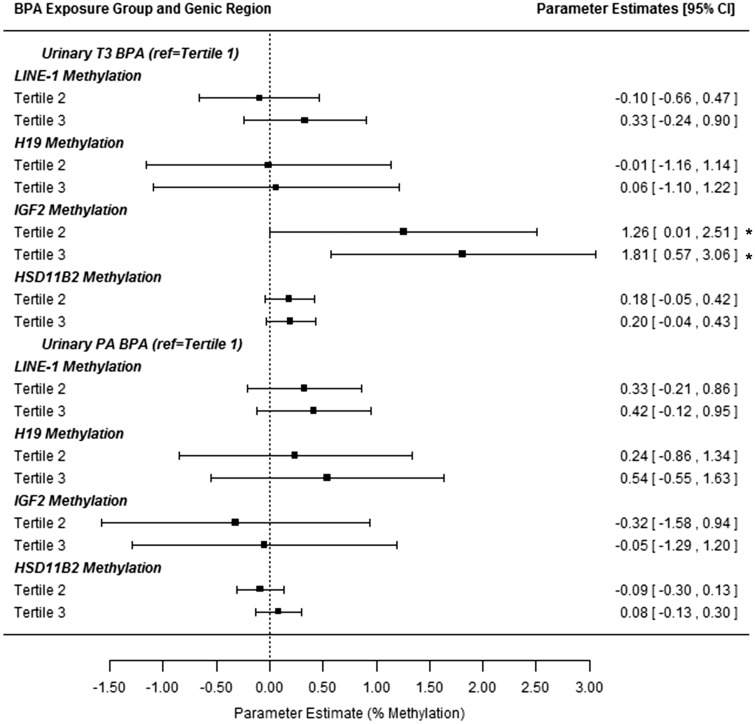
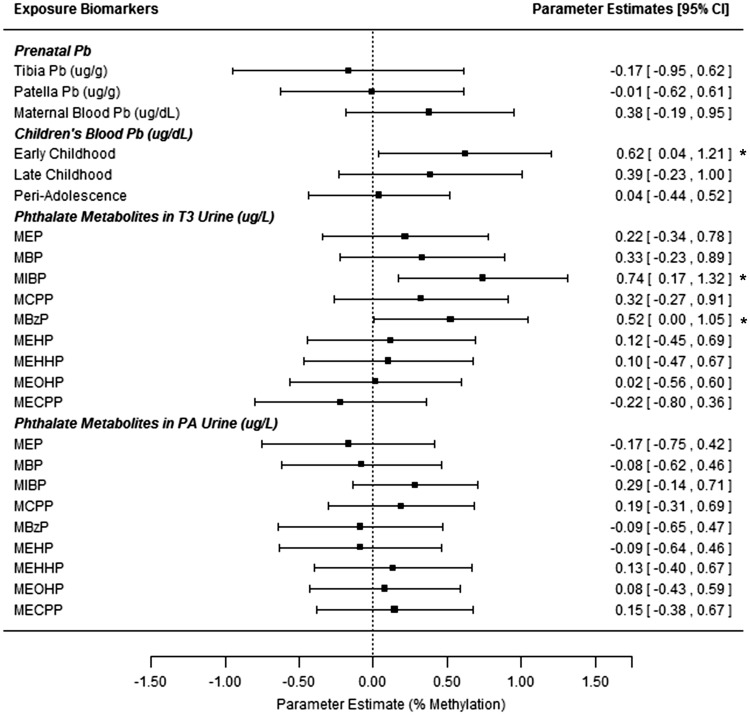
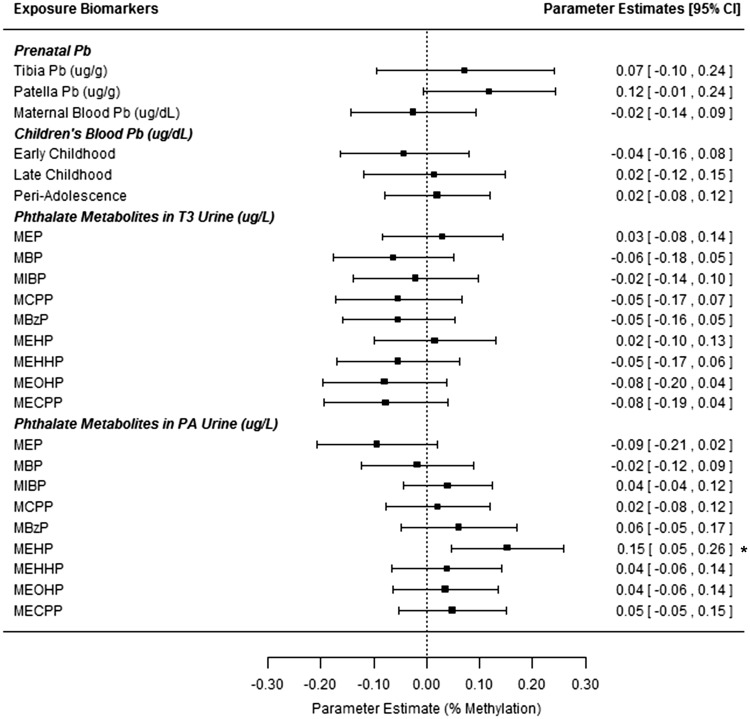
Epigenetic perturbations induced by environmental exposures at susceptible lifestages contribute to disease development. Even so, the influence of early life and ongoing exposures on the adolescent epigenome is rarely examined. We examined the association of exposure biomarkers for lead (Pb), bisphenol A (BPA), and nine phthalates metabolites with blood leukocyte DNA methylation at LINE-1 repetitive elements and environmentally responsive genes ( , , and ) in peri-adolescents. Participants ( = 247) from the Early Life Exposures in Mexico to Environmental Toxicants (ELEMENT) birth cohorts were followed-up once between the ages of 8 and 14 years, and concurrent exposures were measured in biospecimen collected at that time (blood Pb, urinary BPA, and phthalate metabolites). Prenatal and childhood exposures to Pb were previously approximated using maternal and child samples. BPA and phthalate metabolites were measured in third trimester maternal urine samples. Significant associations ( < 0.05) were observed between DNA methylation and exposure biomarkers that were gene and biomarker specific. For example, Pb was only associated with LINE-1 hypomethylation during pregnancy ( = 0.04), while early childhood Pb was instead associated with hypermethylation ( = 0.04). Concurrent urinary mono (2-ethylhexyl) phthalate (MEHP) was associated with hypermethylation ( = 0.005). Sex-specific associations, particularly among males, were also observed. In addition to single exposure models, principal component analysis was employed to examine exposure mixtures. This method largely corroborated the findings of the single exposure models. This study along with others in the field suggests that environment-epigenetic relationships vary by chemical, exposure timing, and sex.
在易感生命阶段,环境暴露引起的表观遗传扰动会促进疾病发展。即便如此,早年及持续暴露对青少年表观基因组的影响却鲜有研究。我们研究了铅(Pb)、双酚A(BPA)和九种邻苯二甲酸酯代谢物的暴露生物标志物与青春期前后青少年血液白细胞DNA在LINE-1重复元件及环境响应基因( 、 及 )上甲基化之间的关联。来自墨西哥早期生命暴露于环境毒物(ELEMENT)出生队列的参与者( = 247)在8至14岁之间接受了一次随访,并对当时采集的生物样本(血铅、尿BPA和邻苯二甲酸酯代谢物)中的同时期暴露情况进行了测量。此前已利用母婴样本估算了产前和儿童期的铅暴露情况。在孕晚期母体尿液样本中测量了BPA和邻苯二甲酸酯代谢物。观察到DNA甲基化与暴露生物标志物之间存在特定基因和生物标志物的显著关联( < 0.05)。例如,铅仅在孕期与LINE-1低甲基化相关( = 0.04),而儿童期早期的铅暴露则与 高甲基化相关( = 0.04)。同时期尿样中的单(2-乙基己基)邻苯二甲酸酯(MEHP)与 高甲基化相关( = 0.005)。还观察到了性别特异性关联,尤其是在男性中。除了单暴露模型外,还采用主成分分析来研究暴露混合物。该方法在很大程度上证实了单暴露模型的结果。这项研究以及该领域的其他研究表明,环境与表观遗传的关系因化学物质、暴露时间和性别而异。