Department of Diagnostic Pathology, Nara Medical University, Kashihara, Nara, Japan.
Third Department of Internal Medicine, Nara Medical University, Kashihara, Nara, Japan.
PLoS One. 2018 Mar 1;13(3):e0193692. doi: 10.1371/journal.pone.0193692. eCollection 2018.
Endoscopic ultrasound-guided fine needle aspiration (EUS-FNA) technology is widely used for the diagnosis of pancreatic masses. However, in some cases, inadequate tissue volume or difficulty of morphological diagnosis are constraining factors for adequate cytopathological evaluation. K-ras mutation is the most frequently acquired genetic abnormality, occurring in approximately 90% of all patients with pancreatic ductal adenocarcinoma (PDAC). In the present study, the clinical utility of residual liquid-based cytology (LBC) specimens obtained using EUS-FNA for K-ras mutation analysis was evaluated.
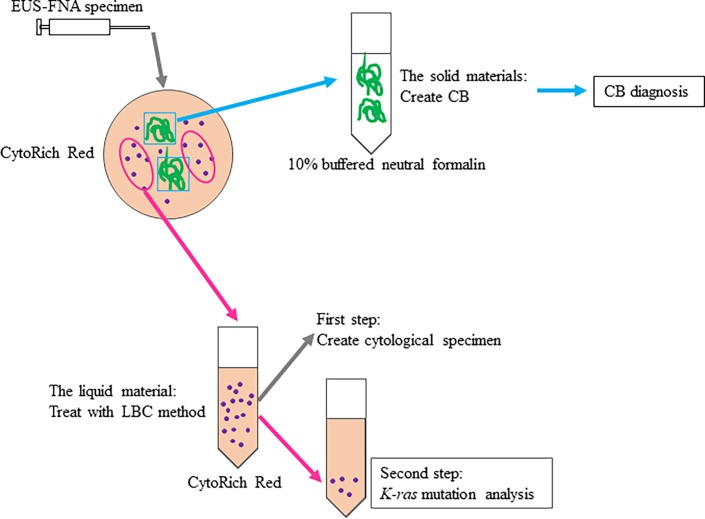
In this study, 81 patients with pancreatic lesions were examined. The cell block (CB) specimens separated from EUS-FNA samples were morphologically evaluated by hematoxylin-eosin (HE) staining. Final diagnoses were confirmed by CB specimens, surgical resection specimens, diagnostic imaging, and clinical follow-up. Genomic DNA of residual LBC specimens stored at 4°C for several months were extracted and assessed for K-ras mutations using a fluorescence resonance energy transfer-based preferential homoduplex formation assay.
K-ras mutation analysis using residual LBC samples was successful in all cases. The sensitivity, specificity, and accuracy of CB examination alone were 77.4%, 100%, and 81.3%, respectively, and those of the combination of CB examination and K-ras mutation analysis were 90.3%, 92.3%, and 90.7%, respectively. Furthermore, K-ras mutations were detected in 8 (57.1%) of 14 PDAC samples for which the CB results were inconclusive.
These findings suggest that K-ras mutation analysis using residual LBC specimens improves the diagnostic accuracy of EUS-FNA.
内镜超声引导下细针抽吸术(EUS-FNA)技术广泛用于胰腺肿块的诊断。然而,在某些情况下,组织量不足或形态学诊断困难是充分进行细胞病理学评估的限制因素。K-ras 突变是最常发生的遗传异常,发生在大约 90%的所有胰腺导管腺癌(PDAC)患者中。在本研究中,评估了使用 EUS-FNA 获得的剩余液基细胞学(LBC)标本进行 K-ras 突变分析的临床实用性。
本研究检查了 81 例胰腺病变患者。从 EUS-FNA 样本中分离出的细胞块(CB)标本通过苏木精-伊红(HE)染色进行形态学评估。最终诊断通过 CB 标本、手术切除标本、诊断性影像学和临床随访得到确认。从储存于 4°C 数周的剩余 LBC 标本中提取基因组 DNA,并使用荧光共振能量转移(FRET)优先同源双链形成测定法进行 K-ras 突变分析。
所有病例均成功进行了剩余 LBC 样本的 K-ras 突变分析。单独使用 CB 检查的灵敏度、特异性和准确性分别为 77.4%、100%和 81.3%,而 CB 检查与 K-ras 突变分析相结合的灵敏度、特异性和准确性分别为 90.3%、92.3%和 90.7%。此外,在 14 例 CB 结果不确定的 PDAC 样本中,有 8 例(57.1%)检测到 K-ras 突变。
这些发现表明,使用剩余 LBC 标本进行 K-ras 突变分析可提高 EUS-FNA 的诊断准确性。