PharmacoEpidemiology and Drug Safety Research Group, School of Pharmacy, and PharmaTox Strategic Initiative, Faculty of Mathematics and Natural Sciences, University of Oslo, Norway.
PharmacoEpidemiology and Drug Safety Research Group, School of Pharmacy, and PharmaTox Strategic Initiative, Faculty of Mathematics and Natural Sciences, University of Oslo, Norway.
J Am Acad Child Adolesc Psychiatry. 2018 Mar;57(3):200-208. doi: 10.1016/j.jaac.2017.12.010. Epub 2017 Dec 28.
To evaluate the effect of prenatal exposure to selective serotonin reuptake inhibitors (SSRIs) on children's behavioral, emotional, and social development by age 5 years, and over time since age 1.5 years.
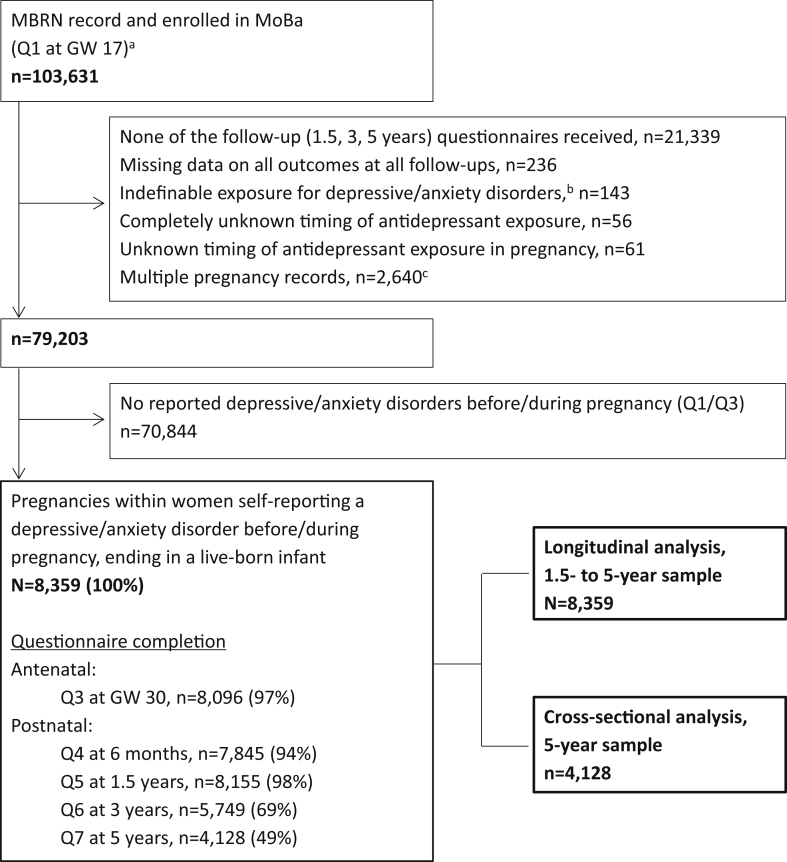
The prospective Norwegian Mother and Child Cohort Study was linked to the Medical Birth Registry of Norway. We included women who reported depressive/anxiety disorders before and/or during pregnancy. Children born to women who used SSRIs in early (weeks 0-16), mid- (weeks 17-28), or late (> week 29) pregnancy were compared to those who were unexposed. Children's internalizing and externalizing behaviors (Child Behavior Checklist) and temperament traits (Emotionality, Activity and Shyness Temperament Questionnaire) were measured at 1.5, 3, and 5 years. Mean scores were calculated and standardized. General linear marginal structural models were fitted to account for time-varying exposure and confounders, and censoring; 3-level growth-curve models were used.
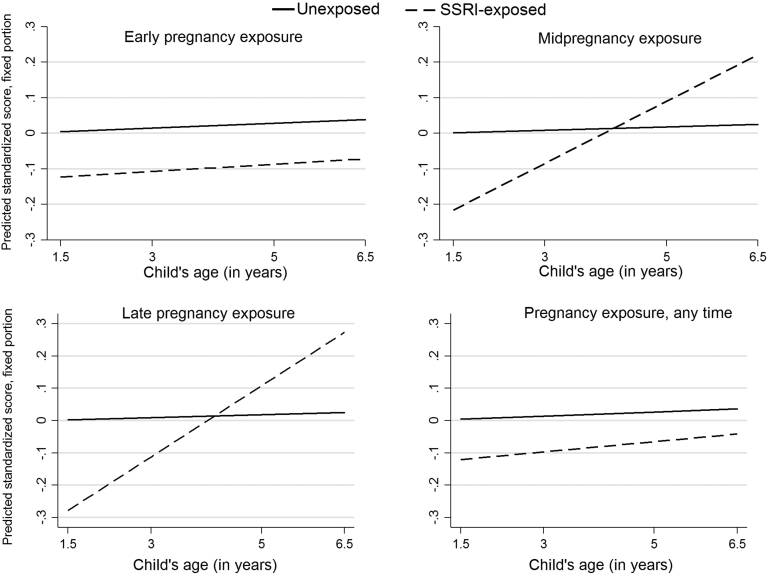
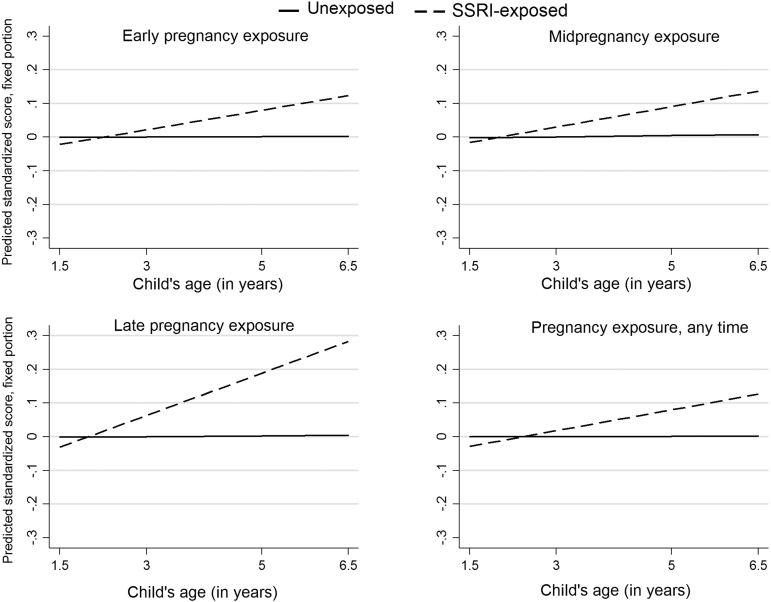
A total of 8,359 mother-child dyads were included, and 4,128 children had complete outcome data at age 5 years. Children exposed to SSRIs in late pregnancy had an increased risk of anxious/depressed behaviors by age 5 years compared with unexposed children (adjusted β = 0.50, 95% CI = 0.04, 0.96). Such risk was not evident for earlier timings of exposure. There was no evidence for a substantial prenatal SSRI effect on externalizing, social, and emotional problems.
These findings suggest no substantial increased risk for externalizing, emotional, or social problems in preschool-aged children following prenatal SSRI exposure. Although the role of chance and potential unmeasured confounding cannot be ruled out, late-pregnancy SSRI exposure was associated with greater anxious/depressed behaviors in the offspring.
评估产前暴露于选择性 5-羟色胺再摄取抑制剂(SSRIs)对 5 岁以下儿童行为、情绪和社会发展的影响,并随着年龄的增长进行评估。
前瞻性挪威母婴队列研究与挪威医学出生登记处相关联。我们纳入了在妊娠前和/或妊娠期间报告患有抑郁/焦虑症的女性。与未暴露于 SSRIs 的女性相比,在妊娠早期(0-16 周)、中期(17-28 周)或晚期(>29 周)使用 SSRIs 的女性所生的儿童被纳入研究。在 1.5 岁、3 岁和 5 岁时,使用儿童行为检查表测量儿童的内化和外化行为,以及使用情绪、活动和害羞气质问卷测量其气质特征。计算并标准化平均得分。使用广义线性边缘结构模型来解释随时间变化的暴露和混杂因素,并进行删失处理;使用 3 级增长曲线模型。
共纳入 8359 对母婴对,其中 4128 名儿童在 5 岁时具有完整的结局数据。与未暴露于 SSRIs 的儿童相比,在妊娠晚期暴露于 SSRIs 的儿童在 5 岁时出现焦虑/抑郁行为的风险增加(调整后的β=0.50,95%CI=0.04,0.96)。这种风险在早期暴露时并不明显。没有证据表明产前 SSRIs 暴露会导致明显的外化、社会和情绪问题。
这些发现表明,在学龄前儿童中,产前 SSRIs 暴露后,外化、情绪或社会问题的风险没有显著增加。尽管不能排除机会和潜在未测量混杂的作用,但妊娠晚期 SSRIs 暴露与后代出现更多的焦虑/抑郁行为相关。