Department of Public & Occupational Health, and the Amsterdam Public Health research institute, VU University Medical Center, Amsterdam, The Netherlands.
Department of Health Sciences and the Amsterdam Public Health research institute, Faculty of Earth and Life Sciences, Vrije Universiteit Amsterdam, Amsterdam, The Netherlands.
J Cancer Surviv. 2018 Jun;12(3):417-429. doi: 10.1007/s11764-018-0681-0. Epub 2018 Mar 1.
This study aimed to evaluate the long-term effectiveness and cost-effectiveness of high intensity (HI) versus low-to-moderate intensity (LMI) exercise on physical fitness, fatigue, and health-related quality of life (HRQoL) in cancer survivors.
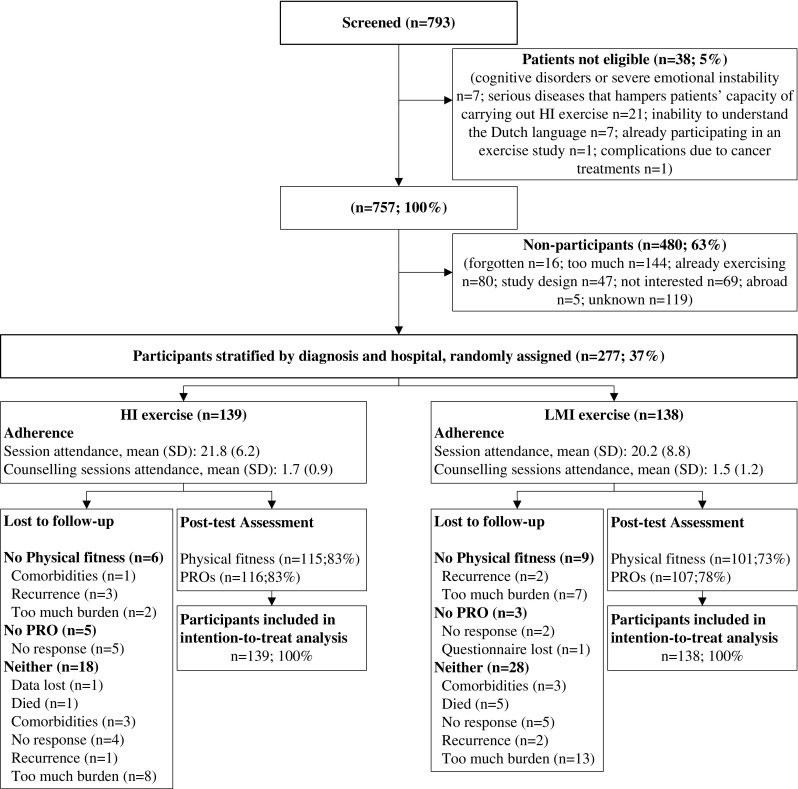
Two hundred seventy-seven cancer survivors participated in the Resistance and Endurance exercise After ChemoTherapy (REACT) study and were randomized to 12 weeks of HI (n = 139) or LMI exercise (n = 138) that had similar exercise types, durations, and frequencies, but different intensities. Measurements were performed at baseline (4-6 weeks after primary treatment), and 12 (i.e., short term) and 64 (i.e., longer term) weeks later. Outcomes included cardiorespiratory fitness, muscle strength, self-reported fatigue, HRQoL, quality-adjusted life years (QALYs) and societal costs. Linear mixed models were conducted to study (a) differences in effects between HI and LMI exercise at longer term, (b) within-group changes from short term to longer term, and (c) the cost-effectiveness from a societal perspective.
At longer term, intervention effects on role (β = 5.9, 95% CI = 0.5; 11.3) and social functioning (β = 5.7, 95%CI = 1.7; 9.6) were larger for HI compared to those for LMI exercise. No significant between-group differences were found for physical fitness and fatigue. Intervention-induced improvements in cardiorespiratory fitness and HRQoL were maintained between weeks 12 and 64, but not for fatigue. From a societal perspective, the probability that HI was cost-effective compared to LMI exercise was 0.91 at 20,000€/QALY and 0.95 at 52,000€/QALY gained, mostly due to significant lower healthcare costs in HI exrcise.
At longer term, we found larger intervention effects on role and social functioning for HI than for LMI exercise. Furthermore, HI exercise was cost-effective with regard to QALYs compared to LMI exercise.
This study is registered at the Netherlands Trial Register [NTR2153 [ http://www.trialregister.nl/trialreg/admin/rctview.asp?TC=2153 ]] on the 5th of January 2010.
Exercise is recommended to be part of standard cancer care, and HI may be preferred over LMI exercise.
本研究旨在评估高强度(HI)与低至中等强度(LMI)运动对癌症幸存者身体适应性、疲劳和健康相关生活质量(HRQoL)的长期效果和成本效益。
277 名癌症幸存者参加了化疗后耐力和抵抗训练(REACT)研究,并被随机分为 12 周的高强度(HI)组(n=139)或低至中等强度(LMI)运动组(n=138)。两组的运动类型、持续时间和频率相似,但强度不同。测量在基线(初次治疗后 4-6 周)以及 12 周(即短期)和 64 周(即长期)后进行。结果包括心肺适能、肌肉力量、自我报告的疲劳、HRQoL、质量调整生命年(QALYs)和社会成本。线性混合模型用于研究:(a)HI 与 LMI 运动在长期的效果差异;(b)短期到长期的组内变化;(c)从社会角度的成本效益。
在长期,与 LMI 运动相比,HI 对角色(β=5.9,95%置信区间=0.5;11.3)和社会功能(β=5.7,95%置信区间=1.7;9.6)的干预效果更大。两组在身体适应性和疲劳方面均未发现显著的组间差异。心肺适能和 HRQoL 的干预改善在 12 周到 64 周之间保持不变,但疲劳则没有。从社会角度来看,HI 比 LMI 运动在 20,000 欧元/QALY 和 52,000 欧元/QALY 时更具成本效益,这主要是由于 HI 运动的医疗保健成本显著降低。
在长期,我们发现 HI 比 LMI 运动对角色和社会功能的干预效果更大。此外,与 LMI 运动相比,HI 运动在 QALYs 方面具有成本效益。
本研究于 2010 年 1 月 5 日在荷兰试验注册中心(NTR2153 [http://www.trialregister.nl/trialreg/admin/rctview.asp?TC=2153])注册。
建议将运动作为癌症护理标准的一部分,HI 可能优于 LMI 运动。