Vos Rimke Cathelijne, Kasteleyn Marise Jeannine, Heijmans Monique Johanna, de Leeuw Elke, Schellevis François Georges, Rijken Mieke, Rutten Guy Emile
Julius Center for Health Sciences and Primary Care, University Medical Center Utrecht, Utrecht University, Utrecht, the Netherlands.
NIVEL (Netherlands institute for health services research), Utrecht, the Netherlands.
BMC Fam Pract. 2018 Mar 2;19(1):35. doi: 10.1186/s12875-018-0720-y.
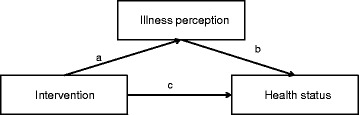
Chronically ill patients such as people with type 2 diabetes develop perceptions of their illness, which will influence their coping behaviour. Perceptions are formed once a health threat has been recognised. Many people with type 2 diabetes suffer from multimorbidity, for example the combination with cardiovascular disease. Perceptions of one illness may influence perceptions of the other condition. The aim of the current study was to evaluate the effect of an intervention in type 2 diabetes patients with a first acute coronary event on change in illness perceptions and whether this mediates the intervention effect on health status. The current study is a secondary data analysis of a RCT.
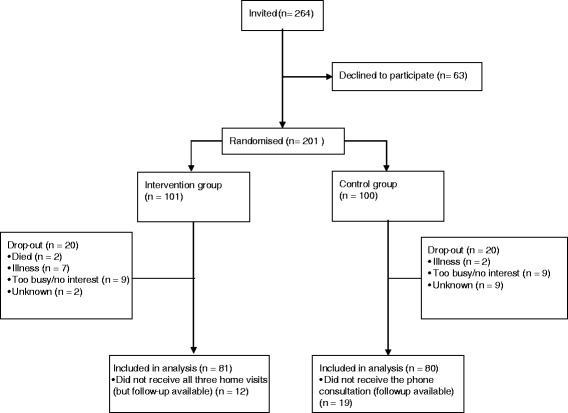
Two hundred one participants were randomised (1:1 ratio) to the intervention (n = 101, three home visits) or control group (n = 100). Outcome variables were diabetes and acute coronary event perceptions, assessed with the two separate Brief Illness Perceptions Questionnaires (BIPQs); and health status (Euroqol Visual Analog Scale (EQ-VAS)). The intervention effect was analysed using ANCOVA. Linear regression analyses were used to assess whether illness perceptions mediated the intervention effect on health status.
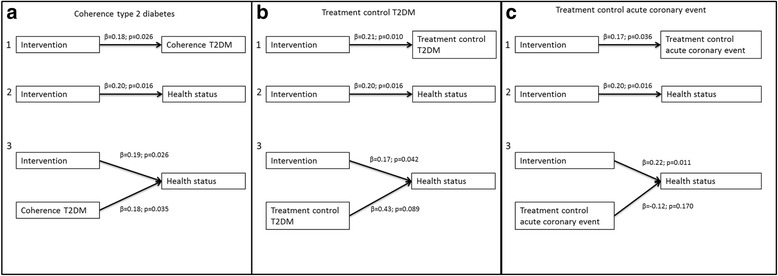
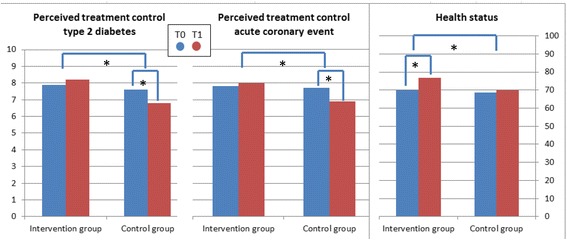
A positive intervention effect was found on the BIPQ diabetes items coherence and treatment control (F = 8.19, p = 0.005; F = 14.01, p < 0.001). No intervention effect was found on the other BIPQ diabetes items consequence, personal control, identity, illness concern and emotional representation. Regarding the acute coronary event, a positive intervention effect on treatment control was found (F = 7.81, p = 0.006). No intervention effect was found on the other items of the acute coronary event BIPQ. Better diabetes coherence was associated with improved health status, whereas perceiving more treatment control was not. The mediating effect of the diabetes perception 'coherence' on health status was not significant.
Targeting illness perceptions of people with diabetes after an acute coronary event has no effect on most domains, but can improve the perceived understanding of their diabetes. Discussing perceptions prevents people with type 2 diabetes who recently experienced an acute coronary event from the perception that they will lose control of both their diabetes and the acute coronary event. Illness perceptions of diabetes patients should therefore be discussed in the dynamic period after an acute coronary event.
Nederlands trial register; NTR3076 , Registered September 20 2011.
慢性病患者,如2型糖尿病患者,会形成对自身疾病的认知,这将影响他们的应对行为。一旦认识到健康威胁,认知就会形成。许多2型糖尿病患者患有多种疾病,例如合并心血管疾病。对一种疾病的认知可能会影响对另一种疾病的认知。本研究的目的是评估对首次发生急性冠状动脉事件的2型糖尿病患者进行干预对疾病认知变化的影响,以及这是否介导了干预对健康状况的影响。本研究是一项随机对照试验的二次数据分析。
201名参与者按1:1比例随机分为干预组(n = 101,三次家访)或对照组(n = 100)。结局变量为糖尿病和急性冠状动脉事件认知,分别用两份简短疾病认知问卷(BIPQ)进行评估;以及健康状况(欧洲五维度健康量表视觉模拟量表(EQ-VAS))。使用协方差分析(ANCOVA)分析干预效果。采用线性回归分析评估疾病认知是否介导了干预对健康状况的影响。
发现干预对BIPQ糖尿病项目的连贯性和治疗控制有积极影响(F = 8.19,p = 0.005;F = 14.01,p < 0.001)。未发现干预对其他BIPQ糖尿病项目的后果、个人控制、身份认同、疾病担忧和情感表征有影响。关于急性冠状动脉事件,发现干预对治疗控制有积极影响(F = 7.81,p = 0.006)。未发现干预对急性冠状动脉事件BIPQ的其他项目有影响。更好的糖尿病连贯性与改善的健康状况相关,而更多的治疗控制感知则不然。糖尿病认知“连贯性”对健康状况的中介作用不显著。
针对急性冠状动脉事件后糖尿病患者的疾病认知,对大多数领域没有影响,但可以提高他们对糖尿病的认知理解。讨论认知可以防止近期经历急性冠状动脉事件的2型糖尿病患者认为他们将失去对糖尿病和急性冠状动脉事件的控制。因此,应在急性冠状动脉事件后的动态时期讨论糖尿病患者的疾病认知。
荷兰试验注册;NTR3076,2011年9月20日注册。